
Views: 2
A guide to the first modern Ford GT: its 550 hp supercharged V8, six-speed manual transmission, retro design and place between the GT40 and EcoBoost GT.
.jpeg)
The first modern Ford GT translated a racing silhouette into a road-going supercar with an especially direct appeal: a supercharged V8 behind the seats and a six-speed manual gear lever beside the driver. It is the chapter to explore if the GT40’s shape attracts you but your interest is a modern road car.
Launch and production context
The revival appeared as a concept in 2002, followed by the production car for the 2005 and 2006 model years. Customer-car manufacturing began in 2004, which explains why calendar-year and model-year descriptions do not always match. It was followed, after a long gap, by the second modern Ford GT for the 2017 model year. The earlier GT40 is its historical inspiration, rather than an identical chassis underneath the body.
Factory specification snapshot
| Field | 2005–2006 Ford GT |
|---|---|
| Body | Two-seat coupe |
| Layout | Mid-engine, rear-wheel drive |
| Engine | 5.4-litre supercharged V8, aluminium block, four valves per cylinder |
| Power | 550 hp at 6,500 rpm |
| Torque | 500 lb-ft at 3,750 rpm (approximately 678 Nm) |
| Transmission | Six-speed manual |
| Suspension | Double wishbones front and rear |
| Wheels | 18-inch front; 19-inch rear |
| Height | 44.3 inches, approximately 1,125 mm |
| Status | Original production completed; collector-market vehicle |
These are production specifications from Ford’s period brochure. Early development reports sometimes quote different output figures. The factory table is the better reference for a standard production car; tuned examples require their own documentation.
Why the engine and gearbox matter
Ford’s engine-history document describes a purpose-built combination of an aluminium block, four-valve cylinder heads, an external oil pump and a Lysholm supercharger. The machinery explains why the GT is more than a styling exercise. The manual transmission also makes it meaningfully different from the later dual-clutch GT: shifting is part of the driver’s job, not simply a command sent through a paddle.
Design, variants and performance context
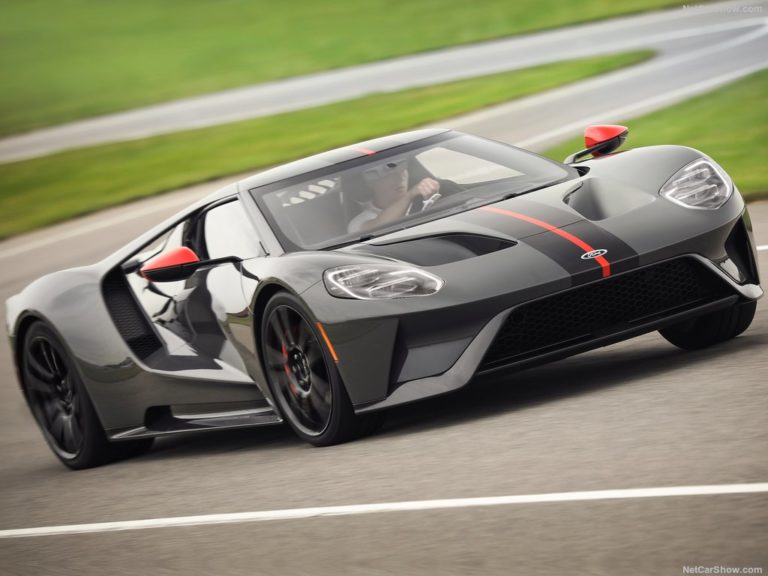
The shape recalls the GT40, but the brochure’s 44.3-inch height immediately shows that this is not a literal recreation of the original’s proportions. Standard cars could be specified with different colours, stripe treatments and wheel options. Heritage liveries and aftermarket conversions should be described separately from mechanical specification; a paint scheme alone does not imply a different engine.
Acceleration figures depend on test conditions, tyres and launch technique. This guide does not substitute a simulated result for a measured test. Its central performance facts are the verified 550 hp output, substantial torque and mid-engine layout.
For a UAE collector
Before treating a low-mileage example as the best car, inspect the service record, tyre age, cooling-system condition, accident repairs and any changes to the supercharger or engine calibration. Ask a qualified specialist to assess the specific vehicle. A brochure describes the car when new; it cannot establish the condition of a twenty-year-old example.
Editorial verdict: the 2005–2006 GT is the most obvious bridge between the visual drama of Ford’s endurance-racing past and the involvement of a manual road-going supercar. Its appeal rests on the whole experience, not a single acceleration number.
Sources
- Ford period brochure and 2005 specification table (archived copy)
- Ford Racing: engine history
- Ford: 2005 GT owner guide
- Autoweek: period production-ending report


.jpeg)