
Views: 0
The Science of Downforce in Racing and Road Cars
Automotive Engineering | Aerodynamics | Performance Technology
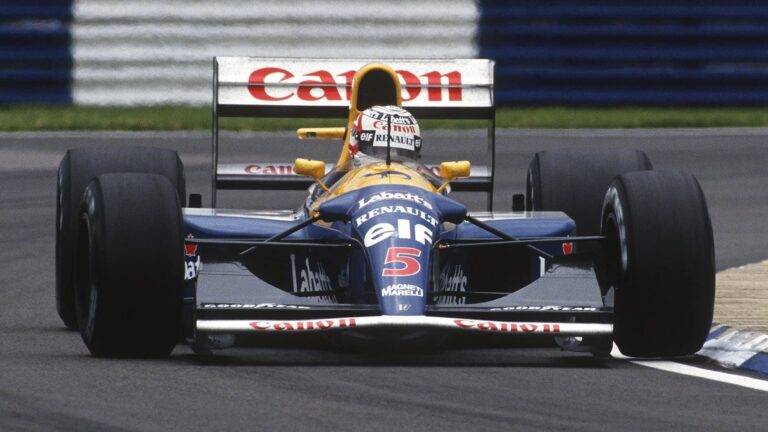
Rising Ferrari F1 star handed surprise Formula E debut | RacingNews365
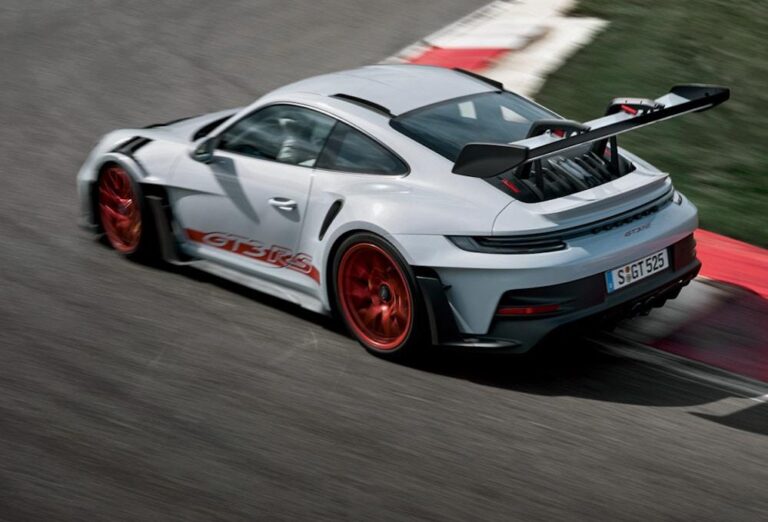
2023 Porsche 911 GT3 RS (992) | PH Review – PistonHeads UK
The aero revamp that Red Bull has unleashed in Portugal
9
Downforce is one of the most important forces in high-performance automotive engineering. It allows racing cars to corner at extraordinary speeds and helps road-going sports cars maintain stability when travelling fast.
Unlike engine power, which drives a car forward, downforce pushes the vehicle toward the road using aerodynamic forces. The result is greater tyre grip, improved handling and better high-speed performance.
But how does air create this downward force, and why don’t all cars generate as much downforce as possible?
1. What Is Downforce?
Downforce is an aerodynamic force acting vertically downward on a moving vehicle. It is essentially the opposite of the lift that helps an aircraft fly.
As air flows around a car’s body, wings and underfloor, differences in pressure and changes in airflow momentum produce aerodynamic forces.
The downward component increases the load on the tyres without requiring the equivalent increase in vehicle mass.
This can improve:
- High-speed cornering grip
- Braking performance at speed
- Stability during rapid direction changes
- Traction in fast corners
Formula 1 engineers adjust downforce levels to suit the characteristics of individual circuits, balancing cornering performance against straight-line speed. Formula 1®+1
2. The Physics Behind Downforce
A simplified aerodynamic equation is:
\[ F_D=\frac12\rho v^2 A C_D \]
Here, \(F_D\) represents downforce, \(\rho\) is air density, \(v\) is speed relative to the air, \(A\) is a reference area and \(C_D\) is the positive coefficient of downforce—not the conventional drag coefficient.
The most important factor is speed, because aerodynamic force increases approximately with the square of velocity when the other variables remain constant. NASA
How downforce increases with speed
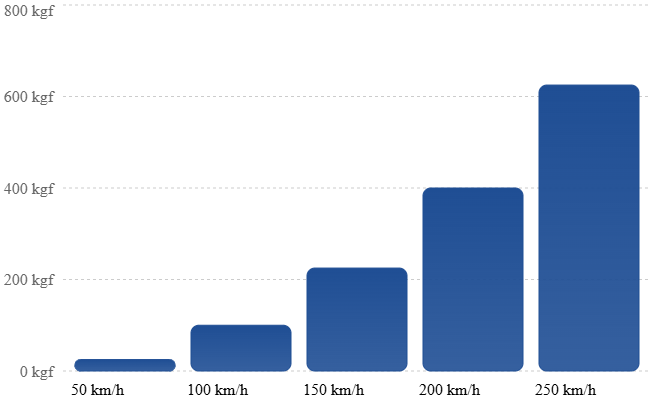
Illustrative model: assumes 100 kgf equivalent at 100 km/h and constant aerodynamic characteristics.
Doubling speed from 100 km/h to 200 km/h theoretically produces four times as much downforce, assuming the aerodynamic setup and airflow conditions remain unchanged.
3. How Different Aerodynamic Parts Generate Downforce
【ギャラリー】王朝復権へ……再び漆黒の鎧をまとう。メルセデスF1の2023年ニューマシン『W14』がベールを脱ぐ
Front wings and splitters
Manage airflow at the front of the car, reduce front-axle lift and help establish aerodynamic balance.
2024 Porsche 911 GT3 RS review | CarExpert
Rear wings and spoilers
Generate rear downforce through aerodynamic pressure differences and airflow deflection. Their design influences stability and drag.
F1マシン解説:フロアデザインがF1の主戦場になった理由 【 F1-Gate .com 】
Underfloors and diffusers
Carefully shaped underbody passages produce low-pressure regions beneath the car, while the diffuser helps manage airflow expansion and recovery.
These components must operate as an integrated aerodynamic package. A powerful rear wing, for example, may create substantial rear grip but also introduce understeer if the front axle lacks sufficient downforce.
4. Ground Effect: Using the Road Surface
File:Lotus Modell 79 under-body.svg – Wikimedia Commons
Ground effect uses the interaction between the car’s underbody and the road surface to help generate downforce.
Engineers design underfloor airflow passages to establish low-pressure regions beneath the vehicle. The resulting pressure difference contributes to a downward aerodynamic force.
However, ground-effect performance is sensitive to ride height, pitch and airflow separation. If the underbody gets too close to the track or airflow becomes unstable, aerodynamic performance can deteriorate suddenly.
Modern Formula 1 regulations introduced for 2026 reduce reliance on large Venturi floor tunnels, instead using a flatter floor, a larger rear diffuser and adjustable wings. Formula 1® – The Official F1® Website
5. Racing Cars vs Road Cars
Both racing cars and road-going performance cars use aerodynamics, but they are designed for different purposes.
| Feature | Racing cars | Road cars |
|---|---|---|
| Downforce | Very high priority | Balanced with efficiency |
| Ride height | Low and controlled | Greater ground clearance |
| Wings | Large, track-focused | Smaller or retractable |
| Drag | Accepted for faster lap times | Minimized for efficiency |
| Suspension | Designed for aerodynamic consistency | Designed for comfort and varying roads |
| Main objective | Lap-time performance | Stability, comfort and usability |
A Formula 1 car prioritizes circuit performance, while a road vehicle must also account for speed limits, noise, fuel consumption, ground clearance and everyday driving conditions.
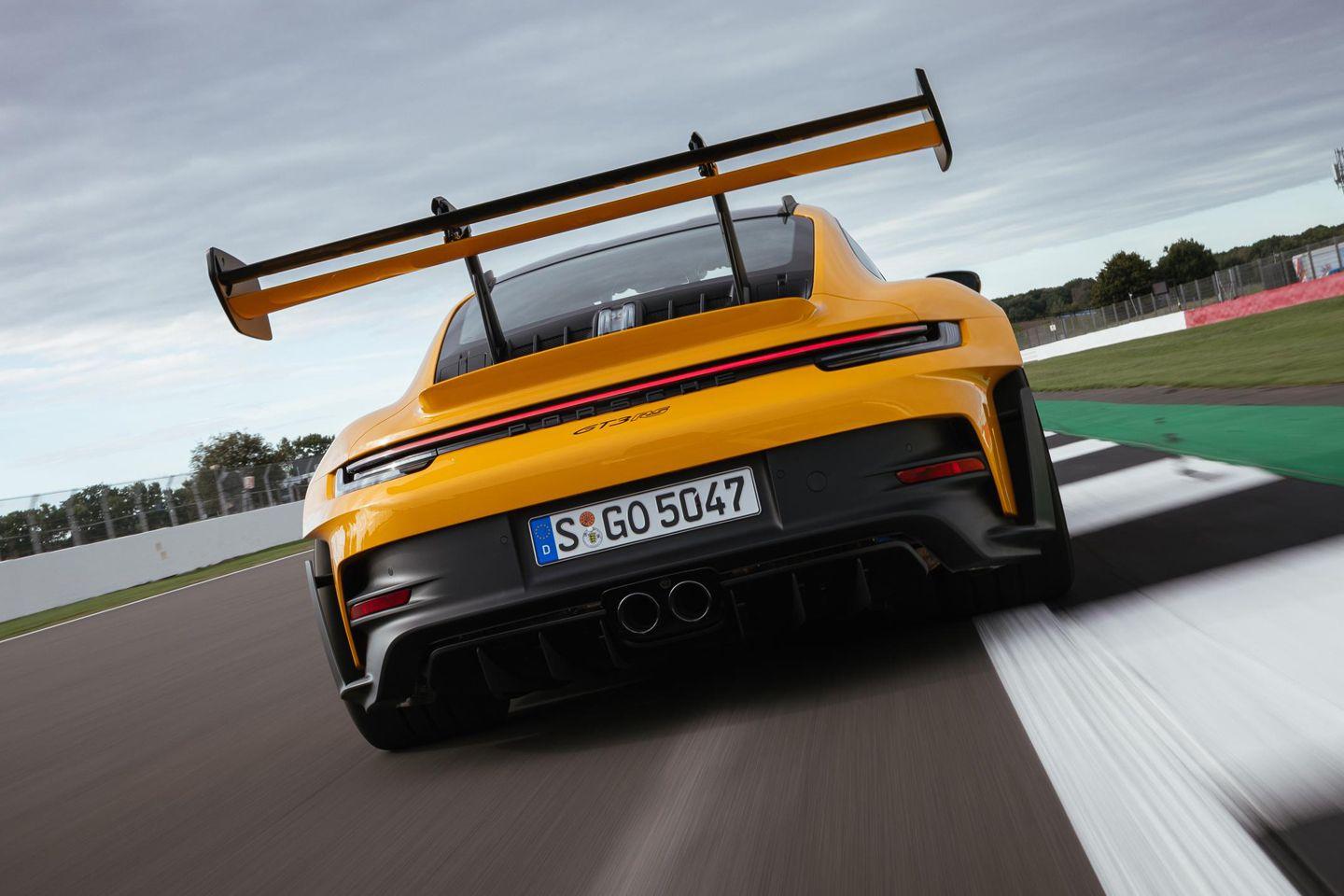
6. Real-World Example: Porsche 911 GT3 RS
2023 Porsche 911 GT3 RS: A High-Downforce Track Monster
Every Ridiculous High-Tech Feature On The 2023 Porsche 911 GT3 RS
2023 Porsche 911 GT3 RS review | CarExpert
8
The Porsche 911 GT3 RS (992) demonstrates how racing aerodynamics can influence a production sports car.
Claimed downforce at 285 km/h
860 kg
Approximately 8.43 kN of force
Aerodynamic technology
Active aero
Including a drag-reduction system
Porsche states that the 992-generation GT3 RS produces approximately 860 kgf of downforce at 285 km/h. Its aerodynamic system adjusts elements according to speed, driving conditions and selected settings. Porsche Newsroom
This is evidence that serious aerodynamic engineering is no longer limited to professional race cars.
7. The Downforce vs Drag Trade-Off
Generating downforce frequently increases aerodynamic drag, which opposes forward motion.
A larger or more aggressively angled wing may improve cornering performance but reduce top speed and increase energy consumption.
Engineers must therefore balance two competing objectives:
- High-downforce setup: Better suited to circuits with numerous fast corners.
- Low-drag setup: Better suited to circuits with long straights where top speed is especially important.
Active aerodynamics offers a solution by changing wing configurations depending on the driving situation. The 2026 Formula 1 rules employ adjustable front and rear aerodynamic elements for cornering and straight-line configurations. Formula One World Championship Limited
8. Does More Downforce Always Mean Faster Lap Times?
Not necessarily.
Although downforce generally increases available tyre grip, its benefits depend on tyre characteristics, suspension settings, aerodynamic balance and track layout.
Excessive drag can reduce acceleration and top speed. Poor aerodynamic balance may also make a vehicle difficult to control, while unstable airflow can create unpredictable handling.
Furthermore, aerodynamic grip is particularly effective at high speeds. At lower speeds, mechanical grip from tyres, suspension geometry and weight distribution plays a much greater role.
9. The Future of Automotive Aerodynamics
Future development is likely to emphasize adaptive aerodynamic systems, improved airflow management and the integration of aerodynamic controls with vehicle electronics.
For racing cars, engineers will continue refining the balance between downforce, drag and aerodynamic stability within competition regulations.
For road cars, the challenge is broader: achieving sufficient high-speed stability without compromising everyday comfort, efficiency or safety.
Conclusion
Downforce transforms airflow into usable vehicle performance. Through carefully designed wings, splitters, floors and diffusers, engineers can increase tyre loading and enable faster, more stable cornering.
The science behind downforce also explains why the fastest car in a straight line is not necessarily the fastest around a racetrack.
The ultimate goal is not maximum downforce alone, but the right aerodynamic balance for the vehicle, its tyres and the conditions in which it operates.
WordPress SEO package
SEO title
The Science of Downforce in Racing and Road Cars
Copy
URL slug
science-of-downforce-racing-road-cars
Copy
Meta description
Discover how downforce works in racing and road cars, from aerodynamic wings and diffusers to ground effect, tyre grip and high-speed stability.
Copy
Suggested category
Automotive Technology / Aerodynamics
Focus keyphrase
Science of downforce
Tags
Downforce, Car Aerodynamics, Racing Technology, Ground Effect, Formula 1, Rear Wing, Front Splitter, Diffuser, Active Aerodynamics, Automotive Engineering, Porsche 911 GT3 RS, Vehicle Dynamics
Copy tags
Recommended featured image: A Formula 1 car or Porsche 911 GT3 RS showing its front aerodynamic surfaces, rear wing and visible airflow paths, with the headline “THE SCIENCE OF DOWNFORCE.”
Recommended image alt text: Racing car aerodynamic downforce explained through front wings, rear wings and underbody airflow.
Reference sources: NASA – Lift Equation · Formula 1 – Downforce Explained · Mercedes-AMG F1 – Downforce Engineering
Publication status: Article prepared for cars.bin3aiah.net; not published.