


Views: 0
The Evolution of Automotive Active Suspension Systems
Automotive Engineering | Suspension Technology | Vehicle Dynamics


6
Automotive suspension technology has undergone a remarkable transformation, evolving from basic mechanical springs and shock absorbers into sophisticated, computer-controlled systems capable of adjusting vehicle behavior in real time.
Among the most important developments is active suspension, a technology designed to improve ride comfort, vehicle stability, handling, and tire contact with the road.
Originally explored through experimental engineering and motorsport, active suspension is now used in advanced luxury vehicles, performance cars, and high-end SUVs.
1. Understanding Automotive Suspension
A vehicle’s suspension system connects the wheels to the chassis while allowing controlled movement over uneven road surfaces.
Traditional suspension consists of springs, dampers, control arms, and other mechanical components. These absorb road impacts, support the vehicle, and help the tires maintain traction.
However, conventional suspension involves a compromise: softer settings generally improve comfort, while stiffer settings can improve body control and handling.
Active suspension seeks to reduce this compromise by using electronically controlled actuators to generate forces that influence vehicle movement.
Passive, semi-active, and fully active suspension
| Type | Operating principle | Main characteristic |
|---|---|---|
| Passive | Fixed mechanical springs and dampers | Simple and reliable |
| Adaptive | Adjustable damping or spring characteristics | Multiple comfort and handling settings |
| Semi-active | Electronic control continuously varies damping | Reacts to driving conditions without independently driving suspension movement |
| Fully active | Powered actuators generate controlled forces | Can actively counteract roll, pitch, and road disturbances |
Not every electronically adjustable suspension is fully active. This distinction is important when comparing modern vehicle technologies.
2. Early Development: From Mechanical Springs to Hydropneumatics


For decades, automotive suspension depended primarily on leaf springs, coil springs, torsion bars, and hydraulic dampers.
A significant milestone arrived in the 1950s with Citroën’s hydropneumatic suspension technology.
The 1955 Citroën DS introduced an advanced system combining hydraulic fluid and compressed gas to provide self-leveling suspension and exceptional ride comfort.
Although hydropneumatic suspension was not equivalent to today’s fully active systems, it demonstrated that vehicle height and spring behavior could be controlled through hydraulic engineering.
This concept laid important groundwork for more advanced suspension architectures.
3. The 1980s: Lotus Pioneers Electronic Active Suspension


The development of modern active suspension accelerated during the 1980s, particularly through research conducted by Lotus.
Lotus engineers explored ways to control vehicle body movement using sensors, hydraulic actuators, and electronic control systems.
The 1983 Lotus Type 92 became the first Formula One car to race with an active suspension system.
Unlike a conventional suspension, its experimental arrangement used computer-controlled hydraulics to actively manage vehicle behavior.
The technology returned in improved form on the 1987 Lotus 99T, driven by Ayrton Senna and Satoru Nakajima.
The objective was to stabilize the car’s aerodynamic platform while improving consistency during acceleration, braking, and cornering.
Motor Sport Magazine
+1
4. The 1990s: Formula One Demonstrates Its Potential
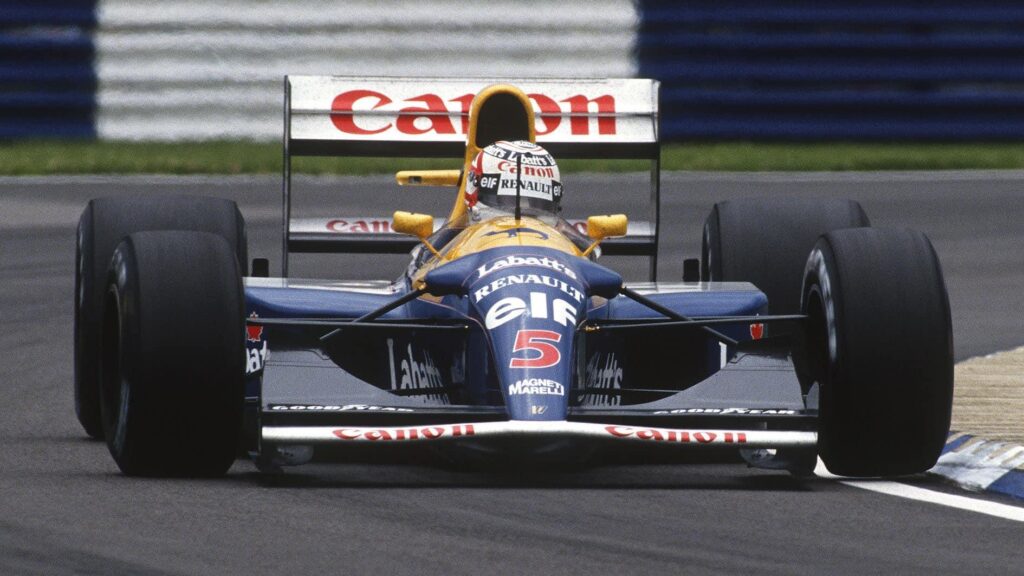
One of the most famous applications of active suspension appeared on the Williams FW14B in 1992.
The Williams system maintained precise control over the vehicle’s ride height and aerodynamic attitude.
This helped the car generate consistent downforce through corners, under braking, and during acceleration.
Nigel Mansell won the 1992 Formula One World Drivers’ Championship, while Williams secured the Constructors’ Championship.
The car won 10 of the season’s 16 races, demonstrating the competitive potential of its advanced suspension and electronic systems.
The technology progressed further with the Williams FW15C in 1993. Active suspension was subsequently prohibited in Formula One for the 1994 season.
Formula 1®
+2
5. The Transition to Production Cars
Active suspension research gradually moved from experimental vehicles and racing into production automobiles.
A major breakthrough arrived in 1999 when Mercedes-Benz introduced Active Body Control (ABC) on the CL-Class.
The system used electronically controlled hydraulics to counteract vehicle body movement.
It could reduce body roll while cornering, limit forward pitching during braking, and improve vehicle stability without requiring excessively stiff conventional suspension settings.
Later Mercedes-Benz developments introduced predictive road scanning and more sophisticated control of individual wheels.
The ROAD SURFACE SCAN function appeared in 2013, enabling certain suspension systems to anticipate road irregularities ahead.

Mercedes-Benz USA Media
6. How Modern Active Suspension Works
Basic active suspension control process
Sensors and road informationWheel position, body acceleration, steering, braking, and optional forward-looking cameras
Electronic control unitCalculates desired suspension forces based on vehicle conditions
Hydraulic or electromechanical actuatorsGenerate forces to control wheel and body motion
Vehicle responseReduced unwanted body movement and improved ride control
Modern systems operate through a continuous feedback process. Sensors measure vehicle movement and driving inputs, while a computer calculates the appropriate response.
Depending on the architecture, actuators can add energy to the suspension to counter disturbances or alter the forces acting between the wheels and body.
Advanced predictive systems may also use forward-looking cameras to identify road irregularities before the wheels encounter them.
These technologies can improve comfort and stability, although their effectiveness depends on actuator speed, power, vehicle geometry, control software, and available tire grip.
7. Modern Active Suspension: Porsche, Ferrari, and Mercedes-Benz
Contemporary active suspension systems are considerably more sophisticated than their early predecessors. High-voltage electrical architectures, compact electric motors, precision hydraulic components, and advanced control software have expanded what engineers can achieve.


Porsche Panamera — Porsche Active Ride
Introduced with the latest Panamera generation, Porsche Active Ride uses electrically driven hydraulic pumps connected to individual dampers. The system operates through the vehicle’s 400-volt electrical architecture and can actively manage compression and rebound.
It can counteract body movements, optimize wheel loads, and even make the vehicle lean inward during cornering when the relevant mode is selected.
Porsche Newsroom
+1


Ferrari Purosangue — Ferrari Active Suspension
Ferrari introduced an advanced active suspension system developed with Multimatic.
The system combines 48-volt electric motor actuation with sophisticated hydraulic dampers. It can generate forces to control body roll and pitch while maintaining tire contact with the road.
Ferrari subsequently developed the technology further for the F80, with a third generation described for the Ferrari Elettrica project.
ferrari.com
+1


Mercedes-Benz GLS — E-ACTIVE BODY CONTROL
Mercedes-Benz combines electronically controlled suspension with hydraulic force adjustment at individual wheels.
Its E-ACTIVE BODY CONTROL technology is designed to manage roll, pitch, body height, and uneven road surfaces, helping large luxury vehicles deliver both comfort and dynamic control.
Mercedes-Benz USA Media
8. Advantages and Limitations of Active Suspension
Advantages
- Improved ride comfort
- Reduced body roll and pitch
- Better control of tire contact
- Adjustable driving characteristics
- Improved ride-height management
- Greater chassis tuning flexibility
Limitations
- Higher manufacturing cost
- Additional mechanical complexity
- Greater power demand
- Potential weight increase
- Expensive repairs and maintenance
- Dependence on electronics and sensors
Active suspension does not eliminate the laws of physics. Tire grip, vehicle mass, road conditions, and suspension travel continue to impose fundamental limitations.
However, it offers engineers much more precise control over how a vehicle responds within those limitations.
9. The Evolution Timeline
- 1955 — Citroën DSHydropneumatic suspension establishes a new benchmark for self-leveling and ride comfort.
- 1983 — Lotus Type 92Electronically controlled active suspension makes an early Formula One racing appearance.
- 1987 — Lotus 99TActive suspension wins Formula One races with Ayrton Senna.
- 1992–1993 — Williams FW14B and FW15CActive ride-height control contributes to championship-winning Formula One cars.
- 1999 — Mercedes-Benz Active Body ControlAdvanced hydraulic active body control enters series production.
- 2013 — Predictive Road ScanningMercedes-Benz introduces ROAD SURFACE SCAN to anticipate surface irregularities.
- 2022–2024 — Ferrari and PorscheFerrari introduces the Purosangue’s 48-volt active suspension, while Porsche brings Active Ride to the Panamera.
- 2025 and beyond — More Integrated Chassis ControlFerrari details further generations of active suspension technology, illustrating continued development of electrically actuated chassis systems.
10. The Future of Active Suspension
The future of automotive active suspension is closely connected to developments in electric vehicles, software-defined vehicle architectures, sensor technology, and integrated chassis management.
Several areas could shape the next generation.
AI-assisted suspension control: More sophisticated algorithms may learn from driving conditions and improve suspension response across different road surfaces.
Predictive road analysis: Cameras and other sensors may enable increasingly accurate advance identification of potholes, bumps, and surface changes.
Electromechanical actuation: Advances in electric motors, power electronics, and compact actuators could reduce reliance on centralized hydraulic systems.
Integrated vehicle dynamics: Suspension systems may work more closely with braking, steering, stability control, and electric torque distribution.
Energy efficiency: Engineers will continue seeking ways to reduce the electrical power required for active chassis control, making sophisticated systems more practical across a wider range of vehicles.
The long-term objective is not simply to produce an exceptionally smooth ride. It is to create a chassis capable of adapting precisely to the demands of the driver, the vehicle, and the road.
Conclusion
The evolution of automotive active suspension represents one of the most important advances in chassis engineering.
From early hydropneumatic systems and Lotus’s experimental Formula One technology to modern solutions from Porsche, Ferrari, and Mercedes-Benz, active suspension has fundamentally changed how engineers approach comfort, stability, and performance.
As electronics, sensors, and control software continue improving, active suspension is likely to become more capable and potentially more accessible.
The next generation of vehicles may increasingly rely on intelligent chassis systems that respond to road conditions faster and more precisely than conventional mechanical suspension ever could.
WordPress SEO Details
SEO Title Copy
The Evolution of Automotive Active Suspension Systems
Meta Description Copy
Explore the evolution of active suspension, from Lotus F1 and Mercedes-Benz ABC to advanced Ferrari and Porsche chassis technology.
URL Slug Copy
evolution-automotive-active-suspension-systems
Focus Keyword Copy
automotive active suspension systems
WordPress Tags Copy
Active Suspension, Automotive Engineering, Suspension Technology, Vehicle Dynamics, Adaptive Suspension, Lotus F1, Williams FW14B, Mercedes-Benz ABC, Porsche Active Ride, Ferrari Active Suspension, Hydraulic Suspension, Chassis Engineering, Automotive Innovation, Car Technology, Predictive Suspension
Suggested category: Automotive Technology / Engineering
Suggested website: cars.bin3aiah.net
Technical References
- Formula 1 — Active Suspension and the Williams FW14B
- Motor Sport Magazine — The History of Active Suspension
- Porsche — Active Ride Technical Information
- Ferrari — Purosangue Active Suspension Technology
Editorial note: The illustrations above are visual references; confirm image rights before using them on your website.
Next publishing assets
Create complete copy-ready WordPress HTMLCreate featured post thumbnailFind 10 images and 3 videos