


Views: 0
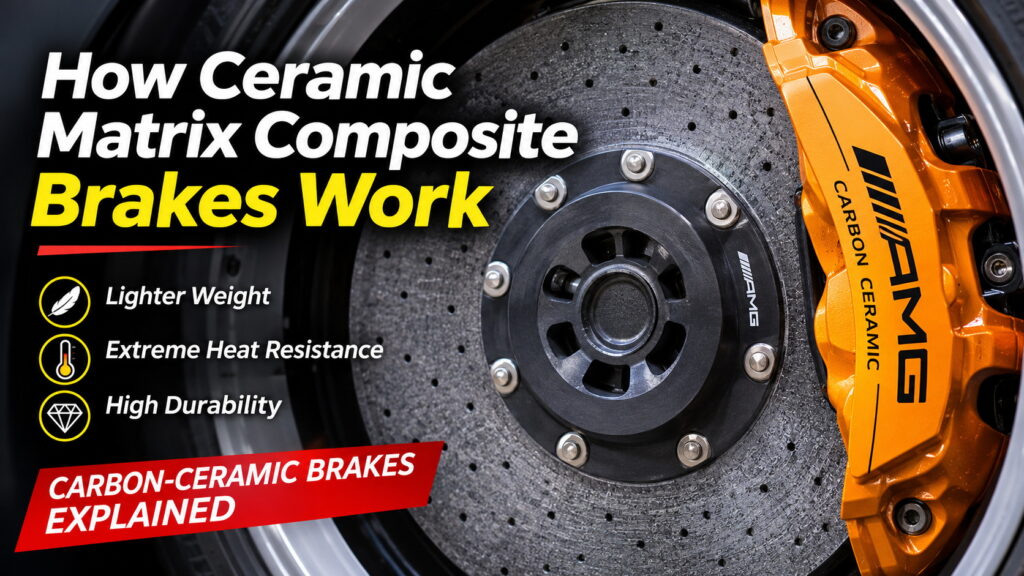
How Ceramic Matrix Composite Brakes Work
Ceramic Matrix Composite (CMC) brakes, commonly called carbon-ceramic brakes, are among the most advanced braking systems used in modern high-performance cars. Found in supercars, luxury sports cars, and selected performance vehicles, they combine lightweight construction, high-temperature resistance, and excellent wear characteristics.


What Are Ceramic Matrix Composite Brakes?
Traditional brake discs are generally made from cast iron. Carbon-ceramic discs instead use a composite material reinforced with carbon fibers and incorporating silicon carbide, an extremely hard ceramic compound.
The material typically combines:
- Carbon fibers: Reinforce the disc, improve mechanical strength, and help resist crack propagation.
- Silicon carbide (SiC): Provides hardness, wear resistance, and high-temperature capability.
- Residual silicon and carbon: Form part of the engineered composite structure, depending on the production method.
By combining these materials, engineers produce a rotor capable of handling demanding braking conditions at substantially lower weight than many comparable cast-iron designs.
How Carbon-Ceramic Brakes Work
The basic operating principle is similar to that of conventional disc brakes. When a driver presses the brake pedal, hydraulic pressure causes pistons inside the brake caliper to clamp the brake pads against the rotating disc.
Friction between the pads and disc generates braking torque, slowing the wheel. The vehicle’s kinetic energy is converted primarily into heat, which must be managed by the rotor, pads, ventilation channels, and surrounding airflow.
The Five Stages of Braking
- Brake pedal activation: The driver requests deceleration.
- Hydraulic pressure: Brake fluid transmits force to the calipers.
- Friction: The brake pads press against the carbon-ceramic disc.
- Energy conversion: Friction converts vehicle motion into heat.
- Cooling: Airflow and ventilated disc construction help remove thermal energy.
Carbon-ceramic technology does not change the fundamental physics of braking. Its major benefit is maintaining desirable material properties and reliable performance during repeated high-energy braking.


Why Heat Resistance Is So Important
Braking from high speed generates enormous amounts of thermal energy. The faster a vehicle travels, the more energy its brakes must absorb during deceleration.
For example, a 1,500 kg vehicle traveling at 200 km/h possesses approximately 2.31 megajoules of translational kinetic energy. During a complete stop, much of this energy is converted into heat by the friction brakes, although aerodynamic drag and other factors also contribute.
Repeated hard braking can cause brake fade when high temperatures reduce friction effectiveness or affect other braking components.
Carbon-ceramic rotors withstand high operating temperatures and are engineered to retain their structural characteristics under severe thermal loads. However, the brake pads, fluid, cooling, and overall system design remain essential.
How Carbon-Ceramic Brake Discs Are Manufactured
Producing a carbon-ceramic brake disc is substantially more complicated than casting an iron rotor. Manufacturers use carefully controlled forming and high-temperature processing.
- Fiber preparation: Carbon fibers are cut and prepared for use in the composite.
- Preform creation: Fibers and resin-based binders are pressed into the required disc geometry.
- Carbonization: Heating converts the resin-rich material into a carbon-based structure.
- Silicon infiltration: Molten silicon penetrates the porous structure and reacts with carbon to create silicon carbide.
- Finishing: The disc undergoes precision machining, inspection, and assembly with its mounting bell.
Some manufacturers use dedicated friction layers and specialized internal cooling structures. According to Brembo, its carbon-ceramic manufacturing process includes carbonization at approximately 900°C and silicon infiltration at approximately 1,700°C.
Inside the Carbon-Ceramic Material
One of the most interesting characteristics of carbon-ceramic discs is the visible composite structure. Unlike ordinary cast iron, the material contains reinforced regions and a ceramic-rich matrix designed to combine toughness with wear resistance.


Carbon-Ceramic vs. Cast-Iron Brakes
| Feature | Carbon-Ceramic | Cast Iron |
|---|---|---|
| Weight | Significantly lighter | Heavier |
| Thermal capability | Excellent | Good; design-dependent |
| Corrosion resistance | Excellent | May develop surface rust |
| Road-use durability | Potentially very long | Generally shorter |
| Replacement cost | Very high | Generally lower |
| Typical application | Performance and luxury vehicles | Most passenger vehicles |
Why Supercars Use Carbon-Ceramic Brakes
1. Lower Unsprung Mass
Brakes form part of a vehicle’s unsprung mass, along with wheels and other components that move with the suspension. Reducing this weight can improve suspension response and wheel control over uneven surfaces.
2. Reduced Rotational Inertia
Lighter discs can reduce rotational inertia, helping the vehicle respond more efficiently during acceleration and deceleration.
3. Resistance to Repeated Heavy Braking
High thermal stability is especially valuable during demanding mountain driving, high-speed operation, and certain track conditions.
4. Corrosion and Wear Resistance
Unlike iron brake discs, carbon-ceramic rotors are highly resistant to ordinary corrosion. They can also provide exceptionally long service life under suitable road conditions.
Do Carbon-Ceramic Brakes Stop Cars Faster?
Not necessarily. Stopping distance depends on tire grip, road surface, ABS calibration, weight transfer, brake balance, and other factors.
Both high-quality cast-iron systems and carbon-ceramic systems can generate sufficient braking torque to reach the tire’s grip limit.
The major advantage of carbon-ceramic technology is its combination of lower mass, durability, and consistent performance under demanding thermal conditions rather than an automatic reduction in single-stop braking distance.
Disadvantages of Carbon-Ceramic Brakes
Despite their advanced engineering, carbon-ceramic brakes involve several compromises:
- High cost: Complex production makes replacement discs expensive.
- Impact sensitivity: Certain forms of mechanical damage, such as edge chipping, can require replacement.
- Pad compatibility: Systems require appropriately specified friction materials.
- Variable cold characteristics: Noise and pedal response may vary by system.
- Track wear: Severe track conditions can reduce service life substantially compared with normal road driving.
The Future of Ceramic Composite Braking
Brake manufacturers continue to develop improved composite structures, surface treatments, and manufacturing processes. These developments aim to reduce costs, improve longevity, and expand the applications of lightweight braking technology.
In March 2026, Brembo introduced its Hyction carbon-ceramic motorcycle brake disc for the Ducati Superleggera V4 Centenario, demonstrating the technology’s continued development beyond passenger-car applications.
Conclusion
Ceramic Matrix Composite brakes represent a major achievement in automotive materials engineering. By reinforcing a silicon-carbide-based structure with carbon fibers, manufacturers create lightweight brake discs capable of resisting heat, corrosion, and wear.
Although they remain considerably more expensive than conventional cast-iron discs, their advantages make them valuable in high-performance applications where thermal consistency and reduced weight are important.
The technology proves that improving braking performance is not only about increasing stopping force. It is also about controlling heat, minimizing mass, and maintaining predictable behavior under extreme conditions.