


Views: 1
How Electronic Differentials Improve Sports Car Handling
Modern sports cars depend on far more than horsepower to deliver outstanding performance. Advanced suspension systems, high-performance tires, aerodynamics, and intelligent electronic controls all contribute to the driving experience. Among these technologies, the electronic differential plays an important role in improving traction, cornering stability, and acceleration.
By controlling the locking behavior of the differential, electronically controlled limited-slip differential systems help sports cars use the available tire grip more effectively.


What Is an Electronic Differential?
A traditional open differential allows the two wheels on a driven axle to rotate at different speeds. This is necessary during cornering because the outside wheel travels a longer distance than the inside wheel.
However, when one wheel loses traction, an open differential may allow excessive wheelspin, limiting the useful driving force transmitted to the road.
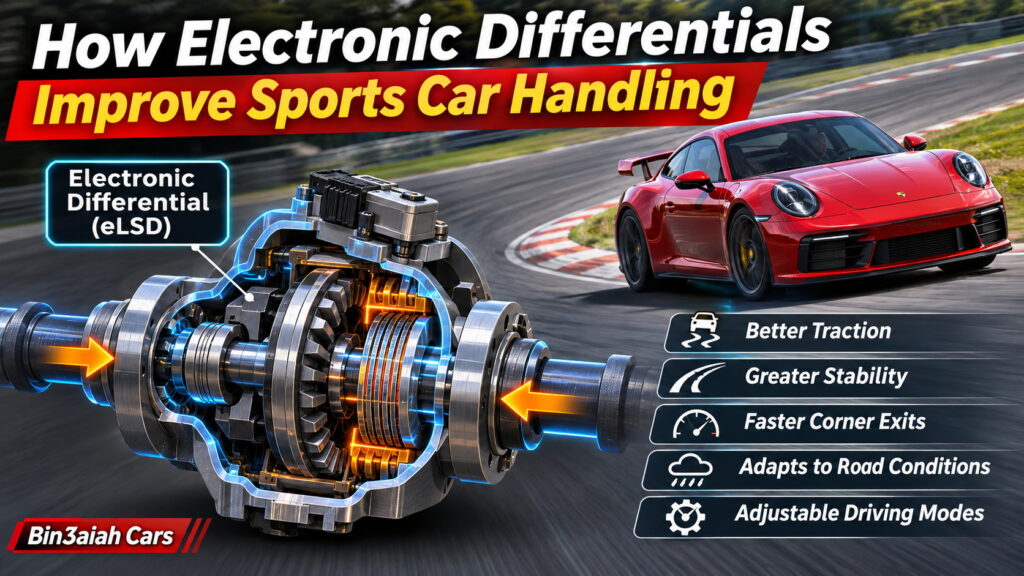
An electronically controlled limited-slip differential, often called an eLSD, addresses this limitation by using an electronic control unit and an adjustable locking mechanism.
Many eLSD systems employ an electronically actuated multi-plate clutch to control the amount of differential locking. This helps manage traction while allowing the wheels to rotate at different speeds when appropriate.
How Does an Electronic Differential Work?
An electronic differential continuously responds to information collected from sensors throughout the vehicle.
Depending on the system, inputs may include:
- Individual wheel speeds
- Steering wheel angle
- Throttle position and engine torque
- Vehicle speed
- Lateral acceleration
- Yaw rate, or the vehicle’s rotational movement
The electronic control unit processes these signals and determines how much differential locking is appropriate for the current driving conditions.
When the inside driven wheel begins to lose traction during cornering, the system can increase locking to help transfer more useful drive torque through the axle.
When less locking is required, the controller can reduce clutch engagement, allowing smoother wheel-speed differences during turning.


Five Ways Electronic Differentials Improve Sports Car Handling
1. Improved Traction During Acceleration
When accelerating out of a corner, weight transfer and cornering forces can reduce the available grip at the inside driven wheel.
An eLSD can adjust its locking behavior to reduce uncontrolled wheelspin and make better use of traction at both driven wheels.
This is especially valuable in high-powered rear-wheel-drive sports cars.
2. Greater Stability Through Corners
Differential behavior influences how a vehicle responds when entering, negotiating, and exiting a corner.
An electronically controlled differential can adjust locking according to driving conditions, helping the vehicle maintain a more predictable balance.
Carefully calibrated control can support stability without unnecessarily restricting wheel-speed differences.
3. Faster and More Controlled Corner Exits
Efficient power delivery is essential when accelerating away from a bend.
By helping the driven tires maintain traction, an eLSD can allow the driver to apply throttle more progressively and effectively.
This may improve corner-exit acceleration and lap-time consistency, depending on the car, road surface, and driving conditions.
4. Better Performance on Changing Surfaces
Wet roads, uneven surfaces, and sudden grip changes can make powerful vehicles more challenging to control.
Electronic differential control can adapt its response to changing traction levels and cooperate with the vehicle’s traction and stability systems.
However, no differential can overcome the physical grip limits of the tires.
5. Adaptable Driving Characteristics
Many performance vehicles offer different driving modes that influence drivetrain and chassis behavior.
Depending on the manufacturer, these modes may modify differential locking strategies to prioritize smoothness, traction, stability, or performance driving.
This flexibility allows one vehicle to deliver different handling characteristics in everyday driving and on a circuit.
Electronic Differentials vs. Torque Vectoring
Although the terms are sometimes used together, electronic limited-slip differentials and torque-vectoring systems are not identical.
An eLSD primarily manages differential locking and the available torque distribution between driven wheels.
Active torque-vectoring systems may go further by deliberately creating a torque difference that helps rotate or stabilize the vehicle.
Some systems achieve this through sophisticated clutch and gear arrangements, while others use selective wheel braking.
| Technology | Main Function | Handling Benefit |
|---|---|---|
| Open Differential | Allows different wheel speeds | Smooth normal cornering |
| Mechanical LSD | Mechanically limits wheel-speed differences | Better traction |
| Electronic LSD | Electronically adjusts differential locking | Adaptive traction and stability |
| Active Torque Vectoring | Actively manages left-to-right driving torque | Improved agility and yaw control |
| Brake-Based Torque Vectoring | Applies selective wheel braking | Helps influence cornering behavior |
Electronic Differentials in Real Sports Cars
Porsche 911 — Porsche Torque Vectoring Plus
Porsche Torque Vectoring Plus combines an electronically controlled rear differential lock with selective braking interventions.
The system helps improve steering response, cornering agility, and traction when accelerating out of bends.
PTV Plus availability depends on the Porsche model and specification.
BMW M4 — Active M Differential
The BMW M4 uses an Active M Differential to manage rear-wheel traction and differential locking.
Its electronically controlled operation supports acceleration and handling under demanding driving conditions.
Jaguar F-Type R — Electronic Active Differential
The Jaguar F-Type R is another example of a performance vehicle equipped with electronically controlled rear differential technology.
The system helps manage rear-wheel traction and contributes to the car’s handling characteristics.


Are Electronic Differentials Better Than Mechanical Differentials?
Electronic systems offer the advantage of adaptable control. Their locking behavior can respond to vehicle sensors and changing road conditions rather than relying entirely on fixed mechanical characteristics.
However, mechanical limited-slip differentials remain useful in motorsport and performance vehicles because of their simplicity, durability, and consistent operating characteristics.
Electronic designs can add weight, cost, software complexity, and thermal-management requirements.
The best solution depends on the vehicle’s intended purpose, drivetrain configuration, and overall chassis calibration.
The Future: Electric Motors and Intelligent Torque Distribution
Electric and hybrid sports cars are expanding the possibilities of drivetrain control.
Vehicles with independently controlled electric motors can vary torque delivery with exceptional responsiveness.
In certain multi-motor configurations, electronic control can distribute driving torque between wheels without relying on a conventional mechanical differential for every function.
Combined with advanced chassis sensors and control software, these systems can deliver increasingly precise traction management and vehicle dynamics.
Conclusion
Electronic differentials are an important technology in modern sports car engineering. By adjusting differential locking according to driving conditions, they help improve traction, cornering stability, and acceleration.
Working alongside suspension, tire, traction-control, and stability systems, they allow performance vehicles to use available grip more intelligently.
Ultimately, sports car performance is not only about producing more horsepower. It is about controlling how effectively that power reaches the road.