


Views: 0
Naturally Aspirated vs Turbocharged Supercar Engines: Which Is Better?
BIN3AIAH CARS | SUPERCAR TECHNOLOGY | ENGINEERING GUIDE


In the world of high-performance supercars, few debates are as passionate as naturally aspirated versus turbocharged engines. Both technologies have produced legendary machines, but they deliver their extraordinary performance in remarkably different ways.
Naturally aspirated engines are celebrated for their immediate throttle response, high-revving character, and thrilling sound. Turbocharged engines are known for generating enormous power and torque from relatively compact displacements.
From Lamborghini’s screaming V12 engines to Ferrari’s sophisticated twin-turbocharged V8s, understanding these two approaches reveals what makes each supercar unique.
1. How do these engines work?


Naturally aspirated (NA)
A naturally aspirated engine draws air into its cylinders using atmospheric pressure and the vacuum created during the piston’s intake stroke, without a turbocharger or supercharger.


Turbocharged
A turbocharged engine uses exhaust-gas energy to drive a turbine connected to a compressor. This forces denser air into the cylinders, allowing the engine to burn more fuel and produce greater power.
Garrett Motion
+1
2. Naturally aspirated vs turbocharged: Key differences
| Feature | Naturally aspirated | Turbocharged |
|---|---|---|
| Throttle response | Very direct | Can have some lag |
| Power per litre | Usually lower | Usually higher |
| Torque delivery | Often builds with RPM | Often stronger at low-mid RPM |
| Engine sound | Clearer intake/exhaust character | More muted, with turbo sounds |
| Mechanical complexity | Fewer induction components | Additional turbo, plumbing and cooling |
| Heat management | Generally simpler | Greater thermal demands |
| Fuel efficiency | Depends heavily on design | Downsizing can improve efficiency |
| Driving character | Linear and progressive | Strong, often forceful acceleration |
These are general tendencies rather than universal rules. Engine displacement, tuning, gearing, hybrid assistance, and vehicle weight can change the result dramatically.
3. Throttle response and turbo lag
One of the defining advantages of a naturally aspirated supercar is its connection between the accelerator pedal and engine output. As the driver opens the throttle, the engine responds without waiting for boost pressure to build.
Turbochargers take time to accelerate and produce the desired boost, potentially creating a delay known as turbo lag. Modern twin-scroll systems, sophisticated boost control, and electric assistance can greatly reduce this effect.
Garrett Motion
+1
4. Engine sound: The emotional difference


Naturally aspirated
High-pitched V10 and V12 notes, mechanical intensity, and a dramatic crescendo toward redline.


Turbocharged
Deep exhaust notes, aggressive acceleration sounds, turbo whistles, and occasional wastegate or bypass-valve noises.
Turbochargers extract energy from exhaust gases, which can dampen some exhaust pulses. However, exhaust design and engine configuration are just as important as the induction method.
5. Famous supercars: Real-world examples


Lamborghini Aventador SVJ
6.5L naturally aspirated V12 delivering approximately 770 PS. A celebrated example of high-revving V12 performance.


Porsche 911 GT3 RS (992)
4.0L naturally aspirated flat-six, approximately 525 PS, with a 9,000-rpm maximum engine speed.


Ferrari F8 Tributo
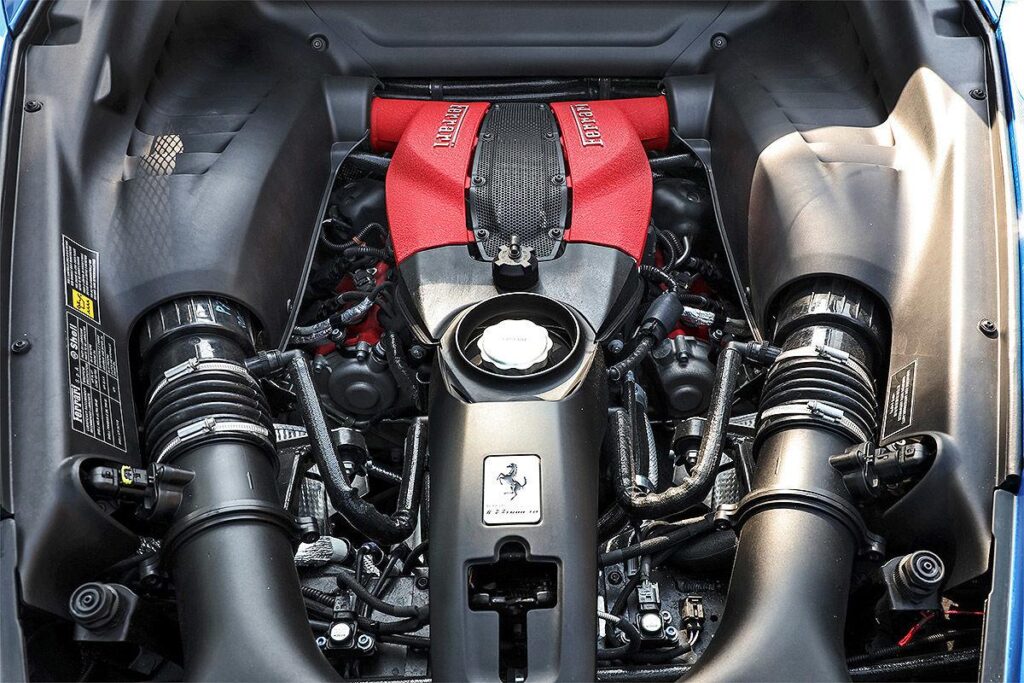
3.9L twin-turbocharged V8 producing 720 PS, combining relatively small displacement with extraordinary output.

McLaren 720S
4.0L twin-turbocharged V8 producing 720 PS and 770 Nm of torque.
6. The future: Hybrid supercar engines
Electrification is transforming the traditional naturally aspirated versus turbocharged debate. Electric motors can provide additional low-speed torque, improve acceleration, and compensate for weaknesses in combustion-engine response.


Lamborghini Revuelto
6.5L naturally aspirated V12 combined with three electric motors, delivering 1,015 CV.
Lamborghini.com
+1

Ferrari 296 GTB
3.0L twin-turbocharged V6 combined with an electric motor, delivering 830 CV.
ferrari.com
These two supercars demonstrate that electrification does not require abandoning either engine philosophy.
7. Which engine is better?
For emotional driving and high-revving sound: Naturally aspirated
For power density and strong midrange torque: Turbocharged
For lap times and outright speed: Depends on the complete vehicle
A turbocharged engine is not automatically faster, and a naturally aspirated engine is not automatically more reliable. Aerodynamics, mass, traction, gearing, thermal performance, and electronic controls all influence the final driving experience.
Conclusion
Naturally aspirated engines preserve a mechanical connection that many supercar enthusiasts treasure. Turbocharged engines demonstrate how advanced engineering can extract extraordinary performance from smaller engines.
Neither technology is universally superior. The naturally aspirated engine often wins in sound and responsiveness, while the turbocharged engine excels in power density and torque delivery.
As hybrid supercars become increasingly sophisticated, the future may combine the best qualities of both worlds.
SEO publishing details
SEO title: Naturally Aspirated vs Turbocharged Supercar Engines: Complete Comparison
Meta description: Discover the differences between naturally aspirated and turbocharged supercar engines, including power, torque, sound, throttle response and reliability.
Suggested URL slug: naturally-aspirated-vs-turbocharged-supercar-engines
Focus keyword: Naturally aspirated vs turbocharged supercar engines
Secondary keywords: NA vs turbo engines, supercar engine comparison, turbo lag, V12 engine, twin-turbo V8, supercar technology
Category: Cars / Technology / Engine Engineering
Suggested featured image: Lamborghini naturally aspirated V12 engine alongside a Ferrari twin-turbocharged engine.
Suggested internal links: Ferrari F40, Porsche 911 GT3 RS, Lamborghini Aventador, Ferrari 296 GTB, McLaren 720S.
Technical references: Garrett Motion – How a Turbocharger Works · Lamborghini – Revuelto Specifications · Ferrari Official Website
Editorial status: Article prepared for Bin3aiah Cars. Not published to WordPress. Images shown are visual references; publishing rights and video embeds should be verified before publication.