


Views: 1
Why Lightweight Wheels Improve Vehicle Performance
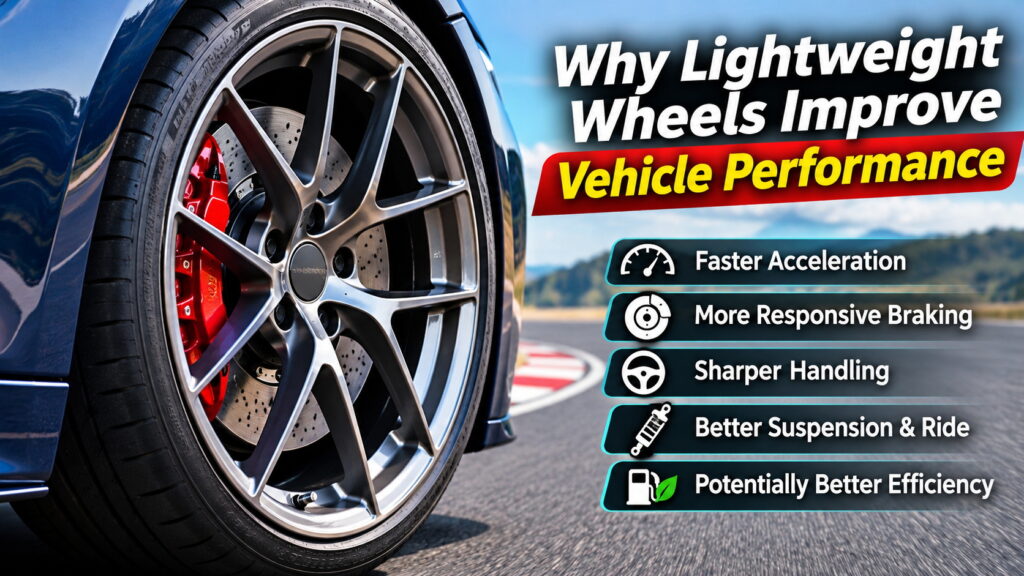
Lightweight wheels are among the most effective upgrades for improving a vehicle’s responsiveness without increasing engine power. Although many drivers choose alloy wheels for their appearance, reducing wheel weight can also improve acceleration response, suspension behavior, handling and potentially braking efficiency.
The engineering advantage comes from reducing two important types of mass: unsprung mass and rotating mass. Understanding these concepts explains why wheel weight matters so much in automotive performance.


1. What Is Unsprung Weight?
A vehicle’s mass can be divided into two main categories:
- Sprung mass: The parts supported by the suspension, including the vehicle body, engine, passengers and interior.
- Unsprung mass: Components that move with the wheels, including wheels, tires, brakes and portions of the suspension.
When a vehicle encounters bumps or uneven pavement, the suspension must control the vertical movement of its unsprung components.
Reducing their weight makes these components easier to accelerate and control, potentially allowing the tires to follow the road surface more consistently.
This is particularly important during cornering on uneven roads, where maintaining tire contact helps preserve grip and stability.
2. Lightweight Wheels Improve Acceleration
Wheels rotate whenever the vehicle moves. Accelerating a car therefore requires energy not only to move its mass forward but also to increase the rotational speed of its wheels and tires.
This resistance to changes in rotational speed is called rotational inertia.
Reducing wheel inertia decreases the energy needed to accelerate the rotating assembly, potentially improving throttle response and acceleration.
Importantly, the location of mass within the wheel matters. Removing weight near the outer rim generally reduces rotational inertia more effectively than removing the same weight near the center.


3. Better Braking Response
When a vehicle slows down, its braking system must dissipate kinetic energy, including the rotational energy stored in its wheels and tires.
Lighter rotating assemblies can reduce some of this energy, particularly during repeated acceleration and braking.
However, lighter wheels do not automatically produce shorter stopping distances. Tire grip, brake condition, road surface and vehicle dynamics remain important factors.
4. Sharper Handling and Steering
Reduced unsprung mass can help the suspension control wheel movement more effectively during rapid steering inputs and road disturbances.
Potential handling benefits include:
- More responsive steering behavior.
- Better suspension control over uneven surfaces.
- More consistent tire contact during bumpy corners.
- Improved vehicle responsiveness during direction changes.
These advantages can be particularly useful in sports cars and track-focused vehicles, where precise feedback and predictable tire behavior matter.
5. Improved Suspension Performance and Ride Comfort
Every time a car travels over a bump, its suspension must manage the motion of the wheel assembly.
A lighter assembly requires less force to change its vertical motion. With suitable suspension tuning, this can improve road holding and ride compliance.
However, wheel diameter, tire sidewall height and suspension setup also affect comfort. Installing larger wheels with very low-profile tires may make a car ride more harshly even when the wheels themselves are lighter.
6. Potential Fuel Economy and EV Efficiency Benefits
Reducing vehicle weight and rotational inertia can lower the energy required during acceleration.
For combustion-engine cars, this may contribute to slightly improved fuel economy. Electric vehicles may also benefit from reduced energy consumption during acceleration.
Nevertheless, wheel aerodynamics, tire rolling resistance, driving conditions and vehicle speed can have a significant effect on overall efficiency.
Therefore, lightweight wheels should not be expected to deliver a guaranteed fuel economy or range improvement.
7. Materials Used in Lightweight Wheels
Forged Aluminum Wheels
Forged aluminum wheels are produced through manufacturing processes that shape aluminum under substantial pressure, followed by machining and finishing.
Well-designed forged wheels can achieve an excellent combination of strength, rigidity and low weight. They are common in premium performance vehicles and motorsport.


Magnesium Alloy Wheels
Magnesium alloys have lower density than aluminum alloys and can offer additional weight savings in specialized applications.
They are used in some motorsport environments, although cost, material properties, protective treatments and maintenance requirements limit their suitability for ordinary road vehicles.
Carbon Fiber Wheels
Carbon fiber composite wheels offer substantial weight-saving potential through specialized composite construction.
They appear on selected high-performance vehicles but remain relatively expensive because of complex manufacturing and engineering requirements.
8. Lightweight Wheels vs. Conventional Wheels
| Characteristic | Conventional Wheels | Lightweight Wheels |
|---|---|---|
| Mass | Generally higher | Generally lower |
| Rotational inertia | Often higher | Potentially lower |
| Acceleration | Baseline response | Potential improvement |
| Suspension response | More mass to control | Less mass to control |
| Cost | Often more affordable | Premium options cost more |
9. Example: How Much Weight Can You Save?
Consider a vehicle fitted with four conventional wheels, each weighing 14 kilograms.
- Original wheel weight: 14 kg each.
- Lightweight replacement: 10 kg each.
- Weight reduction per wheel: 4 kg.
- Total weight saved: 16 kg.
That is a 16 kg reduction in total vehicle mass and, more importantly, a 4 kg reduction in wheel mass at each corner.
The effects on acceleration and handling will depend on the vehicle, wheel geometry, tire selection and suspension setup. There is no universal horsepower-equivalent formula for wheel weight savings.
10. Are Lightweight Wheels Worth Buying?
Lightweight wheels can be a worthwhile investment for drivers seeking more responsive vehicle behavior, particularly when combined with appropriate tires and suspension tuning.
Before purchasing, consider:
- Wheel load rating and structural certification.
- Compatibility with vehicle specifications.
- Correct offset, width and diameter.
- Brake clearance and tire compatibility.
- Durability under expected road conditions.
- Manufacturing quality and warranty.
- Price relative to the likely performance benefit.
The lightest available wheel is not necessarily the best choice. A well-engineered wheel should provide an appropriate balance of strength, weight, safety and durability.
Conclusion
Lightweight wheels can improve vehicle dynamics because they reduce both unsprung mass and rotating mass.
These reductions can contribute to faster acceleration response, improved suspension control, sharper handling and potentially greater efficiency.
For automotive enthusiasts, wheel weight is therefore an important engineering consideration, not merely a styling detail.
Ultimately, choosing the right lightweight wheels can make a vehicle feel more responsive without requiring additional engine power.
Image Credits and Licensing
- Aluminum alloy wheel: Angela2109, public domain. Source.
- Vision Boost alloy wheel: Colin Venable, CC0 1.0. Source.
- Aluminum wheel forging: Cameronm125, CC BY-SA 4.0. Source.


