


Views: 0
BIN3AIAH CARS | AUTOMOTIVE TECHNOLOGY | ENGINEERING
How Active Aerodynamics Work in Modern Hypercars
The science behind moving wings, intelligent airflow, extreme downforce, and the technology that helps the world’s fastest road cars stay under control.


9
Modern hypercars are no longer defined by horsepower alone. Although powerful engines and advanced transmissions remain essential, engineers increasingly rely on another critical technology to extract performance: active aerodynamics.
Unlike traditional aerodynamic components, which remain fixed, active systems can change their position or angle while a vehicle is moving. These adjustments help generate downforce during cornering, reduce drag during acceleration, and improve stability under heavy braking.
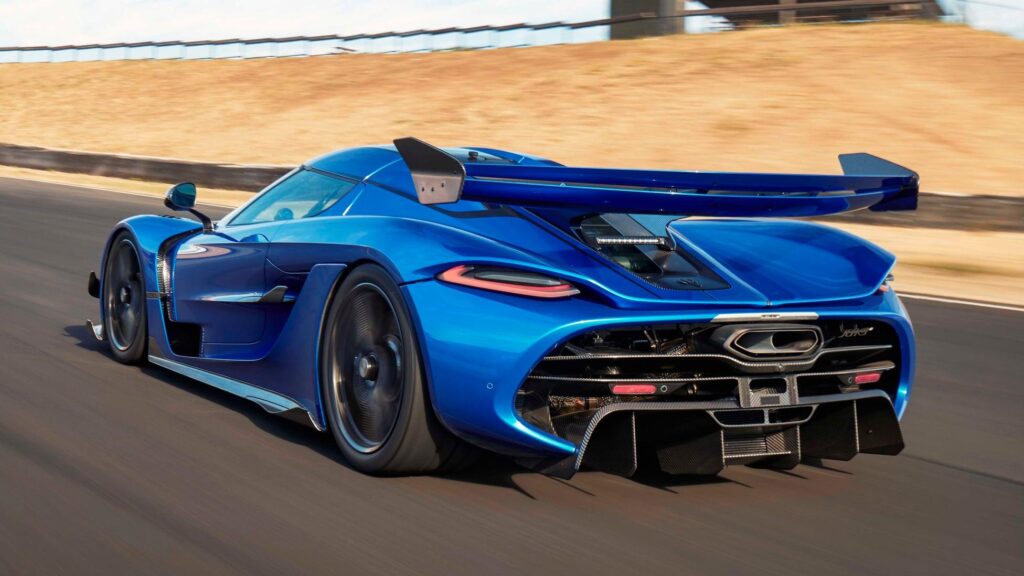
Cars such as the McLaren W1, Koenigsegg Jesko Attack, and Bugatti Tourbillon demonstrate how airflow management has become a central part of modern hypercar engineering.
1. What is active aerodynamics?
Active aerodynamics describes a system that adjusts aerodynamic elements in response to driving conditions.
Traditional sports cars use fixed wings, splitters and diffusers to manage airflow. Their effectiveness changes with speed, but their physical configuration usually remains unchanged.
Active aerodynamic systems go further, using electronically controlled mechanisms to change the vehicle’s aerodynamic characteristics.
These systems may include:
- Adjustable front splitters and underbody flaps.
- Deployable rear wings and spoilers.
- Airbrake functions for high-speed deceleration.
- Variable airflow openings for cooling and drag reduction.
- Ride-height adjustments that influence underbody airflow.
The objective is to balance two competing aerodynamic forces: downforce and drag.
2. Understanding downforce and drag
Downforce
Aerodynamic force pushing the vehicle toward the road, increasing available tire grip.

Drag
Aerodynamic resistance opposing motion, affecting top speed, acceleration, and energy consumption.
Downforce improves a hypercar’s ability to corner and brake by increasing the force pressing its tires against the road. However, producing more downforce often increases aerodynamic drag.
Drag becomes especially significant at very high speeds because the force increases approximately with the square of vehicle speed.
The two basic aerodynamic equations are:
\[ F_D=\frac12\rho v^2 C_D A \]
\[ F_L=\frac12\rho v^2 C_L A \]
Here, \(\rho\) represents air density, \(v\) is airspeed relative to the vehicle, \(A\) is reference area, and \(C_D\) and \(C_L\) are drag and lift coefficients. Negative lift is generally described as downforce.
Doubling speed produces approximately four times the aerodynamic force, assuming the coefficients and other conditions stay constant.
That explains why an aerodynamic system that produces modest force at 100 km/h can create enormous loads at 300 km/h.
3. How active aerodynamic systems operate
A modern system combines sensors, software and mechanical actuators to adjust the car’s aerodynamic behavior.
Active aerodynamics control process
Vehicle sensorsSpeed, steering, braking, acceleration and vehicle motion
Electronic control systemCalculates the appropriate aerodynamic configuration
Front aero
Rear wing
Ride height
Actuators reposition components to achieve the target aerodynamic balance.
For example, when the driver brakes heavily from high speed, the system may raise the rear wing to increase drag and rear downforce. During straight-line acceleration, it may adopt a lower-drag configuration instead.
Importantly, the control strategies differ between manufacturers. Not every hypercar uses every type of sensor or movable component.
4. The four main operating situations
Explore aerodynamic modesHigh-speed accelerationHigh-speed corneringHeavy brakingNormal road driving
Low-drag configuration
The system reduces unnecessary aerodynamic resistance to support acceleration and maximum speed. It must still preserve sufficient stability.Conceptual illustration of rear-wing positions; not a manufacturer-specific control model or scale drawing.
5. Real-world examples: The hypercars redefining aerodynamics


McLaren W1
GROUND EFFECT + ACTIVE LONG TAIL
The W1 uses a movable front aerodynamic element, ground-effect underbody, and an Active Long Tail that extends rearward by 300 mm in Race Mode. McLaren specifies up to 1,000 kg of downforce in this configuration, five times the road-mode figure.
Specs, Speed, Engine, Interior
+1


Ferrari F80
ADAPTIVE FRONT AND REAR AERODYNAMICS
The F80 features a rear wing that adjusts both height and angle, alongside an active front aerodynamic flap. Ferrari reports up to 1,050 kg of downforce at 250 km/h, illustrating how active aero and ground effect work together.
Ferrari
+1

Koenigsegg Jesko Attack
EXTREME TRACK DOWNFORCE
The Jesko Attack combines a dynamic twin-profile rear wing with independently controlled front underbody flaps. Koenigsegg specifies 700 kg of downforce at 250 km/h and a maximum figure of 1,400 kg under different conditions.
Koenigsegg
+1


Bugatti Tourbillon
HIGH-SPEED EFFICIENCY + AIRBRAKE
Bugatti’s Tourbillon uses its rear wing for increased downforce and aerodynamic braking, while the wing remains retracted during top-speed operation. Its advanced diffuser helps maintain aerodynamic balance at extreme speeds.
Bugatti Newsroom


Pagani Huayra
FOUR INDEPENDENT AERODYNAMIC FLAPS
The Huayra was an influential early example of road-hypercar active aero. Four movable flaps and its front suspension help control aerodynamic balance, varying the vehicle’s behavior during acceleration, braking and cornering.
Pagani
6. Why ground effect matters

Ground effect is a major part of modern hypercar aerodynamic design.
By carefully shaping the floor and diffuser, engineers accelerate and manage the air flowing beneath the vehicle. This helps produce a low-pressure region under the car, generating downforce without relying exclusively on large external wings.
Ground-effect performance depends on several factors, including ride height, floor geometry, diffuser design and airflow separation.
Active suspension can complement aerodynamic systems by helping maintain a useful platform height and vehicle attitude during high-speed cornering and braking.
The McLaren W1 and Ferrari F80 demonstrate how the floor, active aerodynamic surfaces and suspension can operate as interconnected systems rather than individual components.
McLaren
+1
7. Comparing active aerodynamic technologies
| Hypercar | Main aerodynamic technology | Primary advantage |
|---|---|---|
| McLaren W1 | Active Long Tail and front aero | Ground-effect performance |
| Ferrari F80 | Adaptive rear wing and front flap | Downforce/drag management |
| Koenigsegg Jesko Attack | Active rear wing and front underbody flaps | Extreme cornering downforce |
| Bugatti Tourbillon | Active rear wing and diffuser | High-speed balance |
| Pagani Huayra | Four active aerodynamic flaps | Aerodynamic balance control |
| Mercedes-AMG ONE | Extendable rear wing and active front aero | Track-focused adjustability |
8. What are the limitations of active aerodynamics?
Despite its benefits, active aerodynamics introduces engineering challenges.
Movable components require actuators, sensors, control systems and additional structures. These increase cost, mechanical complexity, and potentially weight. The system must also tolerate considerable aerodynamic loads, changing temperatures and vibration.
Reliability is especially important. Engineers must consider what happens if an aerodynamic surface becomes stuck or fails to reach its commanded position.
Another challenge is aerodynamic balance. Increasing rear downforce without coordinating the front axle can change the car’s handling characteristics. The best systems therefore manage the vehicle’s overall behavior, rather than simply maximizing the force produced by a single wing.
9. The future of active aerodynamics
As hypercars become more advanced, aerodynamic systems are likely to grow more integrated with chassis electronics and vehicle dynamics.
Potential developments include finer control of individual aerodynamic surfaces, more sophisticated predictive strategies, variable cooling airflow and increased coordination between active suspension and ground-effect systems.
These changes could make aerodynamic performance more adaptable while reducing compromises in efficiency and everyday usability.
The next engineering frontier is not necessarily the largest rear wing. It is the ability to generate precisely the required aerodynamic forces at the right moment, with minimal unnecessary drag.
Conclusion
Active aerodynamics has transformed the modern hypercar from a machine with a fixed aerodynamic shape into one that can adapt dynamically to the demands of the road or racing circuit.
From the McLaren W1’s extending rear bodywork to the Ferrari F80’s continuously adjustable wing and the Bugatti Tourbillon’s high-speed aerodynamic strategy, manufacturers are pursuing the same fundamental goal: making extraordinary power easier to exploit.
The future of hypercar performance is not just about pushing harder through the air. It is about controlling how the air pushes back.
Publication package — Bin3aiah Cars
SEO title
How Active Aerodynamics Work in Modern Hypercars
Suggested URL slug
how-active-aerodynamics-work-hypercars
Meta description
Discover how active aerodynamics work in modern hypercars, from moving wings and airbrakes to ground effect in McLaren, Ferrari, and Bugatti.
Primary keyword: Active aerodynamics in hypercars
Secondary keywords: Hypercar downforce, active rear wing, ground effect, aerodynamic drag, hypercar engineering
Suggested categories: Automotive Technology, Hypercars, Engineering
Article status: Draft prepared — not published
Suggested multimedia package
Use manufacturer-provided media or appropriately licensed photographs, with source credits and reuse permission verified before publishing.


13
Video sources: McLaren W1 Aerodynamics Film · Koenigsegg Aerodynamics and Handling · Mercedes-AMG ONE Technology
The gallery above provides ten visual references, while the three links provide relevant manufacturer video or multimedia resources. The complete set has not been checked for downloadable media rights.
Technical figures are manufacturer-reported and may reflect different speed, configuration, and measurement conditions. They are not directly comparable as standardized performance test results.