


Views: 0
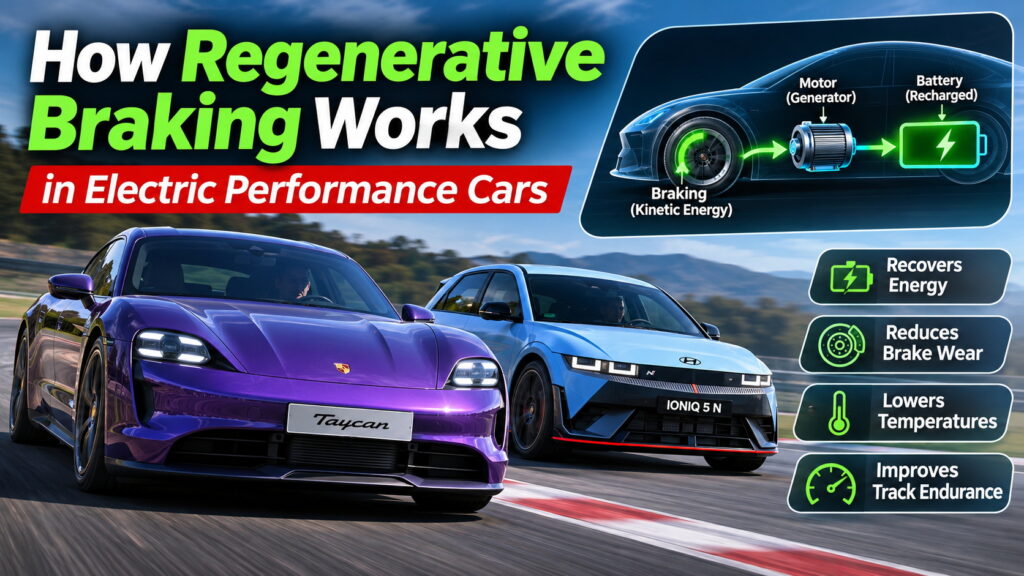
Regenerative braking is one of the most important technologies in modern electric performance cars. Instead of wasting nearly all braking energy as heat, electric vehicles can recover some of that energy and store it in their batteries.
In performance-focused EVs, this technology does more than improve driving range. It can reduce the workload on conventional brakes, help manage temperatures during demanding driving, and contribute to better overall efficiency.


What Is Regenerative Braking?
Regenerative braking allows the electric motor of a vehicle to operate as a generator when the car slows down.
During acceleration, electricity travels from the battery to the motor, creating torque that turns the wheels. During regenerative braking, the wheels drive the motor, producing electricity while generating resistance that slows the vehicle.
Part of the recovered electrical energy is then transferred back into the high-voltage battery.
Acceleration: energy is consumed
Braking: energy is recovered
Simplified illustration of electrical energy flow.
How Regenerative Braking Works Step by Step
1. The Driver Begins to Slow Down
Regenerative braking can activate when the driver releases the accelerator or presses the brake pedal, depending on the vehicle’s braking system and selected driving mode.
2. The Motor Operates as a Generator
As the wheels continue rotating, they drive the electric motor through the drivetrain. The motor then converts some of the vehicle’s kinetic energy into electrical energy.
3. The Vehicle Experiences Braking Torque
Generating electricity creates torque opposing the wheels’ rotation. This resistance helps slow the vehicle without relying entirely on friction brakes.
4. Electricity Returns to the Battery
The inverter and vehicle electronics manage the generated electricity so it can be accepted by the battery.
5. Conventional Brakes Assist
When additional braking force is required, hydraulic friction brakes supplement regenerative braking. This combined operation is commonly called blended braking.
Why Regenerative Braking Matters in Performance Cars
High-performance electric vehicles can accelerate extremely quickly, but that performance also places significant demands on their braking systems.
Regenerative braking offers several advantages:
- Energy recovery: Converts part of the car’s motion back into usable electrical energy.
- Reduced brake wear: Less frequent use of friction brakes can extend the life of pads and discs.
- Better thermal management: Sharing braking duties with electric motors reduces heat generated by conventional brakes.
- Potentially improved track endurance: Lower friction-brake temperatures may help reduce brake fade during repeated high-speed braking.
- Adjustable deceleration: Some EVs offer selectable regenerative braking levels.
Real-World Example: Porsche Taycan
The Porsche Taycan demonstrates how regenerative braking can become part of a high-performance electric powertrain.
For the extensively updated Taycan introduced in 2024, Porsche increased maximum regenerative braking power during deceleration from high speeds from 290 kW to up to 400 kW.
This allows the vehicle to recover substantial electrical power under suitable conditions. Porsche also emphasizes brake-pedal-controlled recuperation and a consistent driving feel.
- Maximum recuperation power: up to 400 kW.
- Regeneration primarily controlled through the brake pedal.
- Advanced blending between electric and friction braking.
- Recovered power depends on speed, battery state and system conditions.
Real-World Example: Hyundai IONIQ 5 N


The Hyundai IONIQ 5 N takes a motorsport-oriented approach through its dedicated N Brake Regen system.
According to Hyundai, N Brake Regen can produce up to 0.6 g of deceleration through regenerative braking alone. It can also remain active at up to 0.2 g when the anti-lock braking system is operating.
By using regeneration for a large share of the braking effort, Hyundai aims to reduce the heat load on mechanical brakes during demanding track use.
The vehicle still incorporates large conventional brake discs and hydraulic braking equipment for additional stopping force when necessary.
Regenerative Braking vs. Conventional Braking
| Feature | Regenerative Braking | Conventional Braking |
|---|---|---|
| Operating method | Electric motor generates electricity | Brake pads create friction against discs |
| Energy conversion | Kinetic energy into electrical energy | Kinetic energy into heat |
| Brake component wear | Can reduce friction-brake use | Causes pad and disc wear |
| Low-speed braking | Often limited | Effective through a complete stop |
| Hard braking | Limited by motor, battery and traction conditions | Provides essential additional braking force |
What Limits Regenerative Braking?
Although regenerative braking offers significant benefits, the amount of energy recovered is not constant.
Battery Charge Level
When the battery is nearly full, there may be insufficient capacity to accept significant recovered electrical energy.
Battery Temperature
Very cold or excessively hot batteries may have reduced charging capability, limiting regenerative braking power.
Vehicle Speed
The amount of recoverable braking power changes with speed. Regeneration generally becomes less effective at very low speeds.
Motor and Inverter Limits
The electric motor and inverter have maximum power and torque ratings that limit how much energy can be recovered at a given moment.
Road Grip
On wet or slippery surfaces, the vehicle may reduce regenerative braking to preserve traction and stability.
Does Regenerative Braking Increase Electric Vehicle Range?
Yes. By recovering part of the energy that would otherwise be lost during deceleration, regenerative braking can improve overall efficiency.
The benefits are often particularly noticeable in city driving, where vehicles repeatedly accelerate and slow down.
Regeneration can also recover energy while driving downhill. However, it cannot recover all the energy used during acceleration, because losses occur throughout the electrical and mechanical systems.
Smooth acceleration, anticipating traffic and avoiding unnecessary braking generally improve efficiency more than repeatedly accelerating hard and recovering only part of the energy afterward.
Is Regenerative Braking Better for Racetrack Driving?
Regenerative braking can be particularly valuable on a racetrack because high-speed braking generates large amounts of heat.
By recovering energy through electric motors, performance EVs can reduce the braking force demanded from friction brakes and potentially improve resistance to brake fade.
However, the maximum useful regeneration depends on battery temperature, state of charge, vehicle speed, traction and powertrain limits. Repeated aggressive driving may reduce regenerative performance if the battery or electrical components become too hot.
For this reason, high-performance EVs use sophisticated software to coordinate regenerative braking, hydraulic braking, traction control and battery thermal management.
The Future of Regenerative Braking
Regenerative braking technology is expected to continue developing as electric performance vehicles become more advanced.
Important areas of development include:
- Higher regenerative power capabilities.
- More sophisticated brake blending software.
- Improved battery charging and thermal management.
- Better integration with stability and traction control.
- More adaptable braking feel for road and track driving.
Conclusion
Regenerative braking is more than an energy-saving feature. In electric performance cars, it contributes to efficiency, braking-system durability and thermal management while allowing engineers greater flexibility in controlling deceleration.
Vehicles such as the Porsche Taycan and Hyundai IONIQ 5 N demonstrate two different approaches: one prioritizing powerful, refined energy recuperation and the other emphasizing track-oriented regenerative braking performance.
As electric vehicle engineering advances, regenerative braking will remain an important technology in the development of faster, more efficient and more capable electric performance cars.