


Views: 1
Bugatti introduced the Chiron at the 2016 Geneva Motor Show as the next step after the Veyron. The original production coupé combined an 8.0-litre-class W16 engine, four turbochargers and permanent all-wheel drive. Its specifications are distinct from the later Sport, Pur Sport, Super Sport and Super Sport 300+ derivatives.
Sources: 2016 launch release.


Specifications
| Specification | Original-model details |
|---|---|
| Introduction | 2016 Geneva world premiere; launch announcement dated 29 February 2016 |
| Production/status | Customer production documented by early 2017; first deliveries announced 3 March 2017. Chiron family completed in 2024. |
| Body and seating | Two-seat coupé |
| Engine | 7,993 cc W16; four turbochargers with two-stage operation |
| Power | 1,103 kW / 1,500 PS at 6,700 rpm |
| Torque | 1,600 Nm at 2,000–6,000 rpm |
| Transmission/drivetrain | Seven-speed DSG dual-clutch; permanent all-wheel drive |
| Acceleration, manufacturer figures | 0–100 km/h: 2.4 s; 0–200 km/h: 6.1 s; 0–300 km/h: 13.1 s, from the later standard-model technical sheet |
| Top speed, manufacturer figure | 420 km/h limited in Top Speed mode; 380 km/h in ordinary named modes |
| Weight | 1,995 kg; DIN empty weight |
| Production quantity | 500 across the Chiron family; not a standard-Chiron-only total |
Sources: Bugatti — 2016 Chiron launch; Bugatti — standard-model technical sheet; Bugatti — first customer deliveries; Bugatti — Chiron family completion; Bugatti — Tourbillon introduction.
Engineering and design
The W16’s four turbochargers worked in two stages. Two operated initially, with the other pair joining around 3,800 rpm. This arrangement was intended to improve response across the engine’s operating range while retaining the airflow capacity needed for its high output. The standard engine developed 1,500 PS and 1,600 Nm; those figures describe a combustion powertrain, without hybrid assistance.
Sources: Launch engineering details; Standard Chiron technical sheet.
A seven-speed dual-clutch transmission passed that output to all four wheels. A dual-clutch layout uses separate clutch paths for alternating gears, allowing the next ratio to be prepared before a shift. All-wheel drive provided another way to manage the engine’s substantial torque, although the resulting acceleration still depended on operating conditions.
The structure included a carbon-fibre monocoque and carbon-fibre rear section. An adaptive chassis, carbon-ceramic brakes and an active rear wing supported the car’s broad speed range. The wing also acted as an airbrake, increasing aerodynamic drag under braking. These systems addressed different tasks: structural support, chassis adjustment, heat management and airflow control.
Sources: 2016 launch release.
Performance in context
Bugatti’s later standard-model technical sheet lists 0–100 km/h in 2.4 seconds, 0–200 km/h in 6.1 seconds and 0–300 km/h in 13.1 seconds. These are manufacturer figures, not results measured by Bin3aiah Cars. Its 420 km/h maximum is limited and depends on Top Speed mode; the sheet lists 380 km/h for ordinary named modes.
Sources: Standard Chiron technical sheet.
The same document gives a DIN empty weight of 1,995 kg. That definition matters when comparing the Chiron with cars quoted at dry weight or under another kerb-weight convention. Likewise, 1,500 PS should not be relabelled as 1,500 bhp: the units differ even when English-language material uses “hp” loosely.
Sources: Standard Chiron technical sheet.
History, production and variants
The 2016 unveiling preceded confirmed customer deliveries. Bugatti announced the first deliveries on 3 March 2017. In 2024, it completed the 500th and final Chiron, a Super Sport called L’Ultime. The 500-car figure therefore covers the family, rather than 500 examples of the original standard model.
Sources: First deliveries; Final Chiron.
The handling-focused Chiron Sport arrived in 2018. The Super Sport 300+ was associated with the 2019 speed programme, followed by the Pur Sport in 2020 and Super Sport in 2021. Their different briefs make variant identification essential when choosing specifications, photographs or video.
Sources: Chiron Sport introduction; Pur Sport and 300+ comparison; Super Sport introduction.
Predecessor and successor
The Chiron followed the Veyron. Bugatti unveiled the Tourbillon successor programme in 2024. That establishes the model’s place in the marque’s history; it does not, by itself, establish the timing of customer Tourbillon deliveries.
Sources: Tourbillon introduction.
Video
Official manufacturer footage of the original 1,500 PS Chiron in a 2017 test. Title refers to a historical record, not a present-day record. The film features the original Chiron, rather than a 300+ or Super Sport.
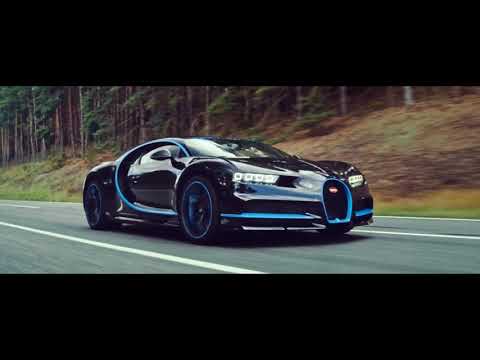
Watch BUGATTI Chiron 0-400-0 km/h in 42 seconds – A WORLD RECORD #IAA2017 on Bugatti.