


Views: 0


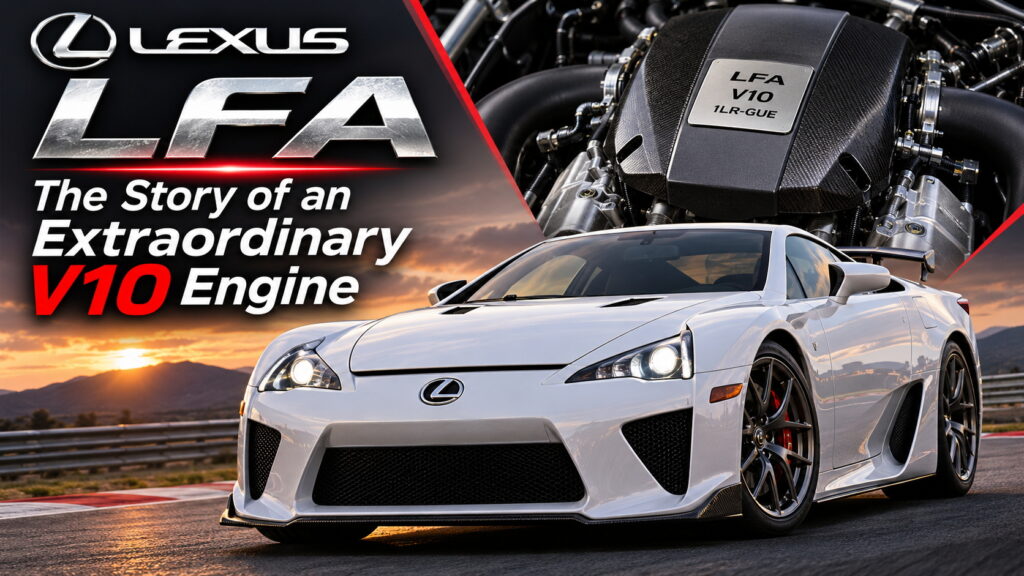
The Lexus LFA is one of the most remarkable supercars ever developed in Japan. Combining sophisticated carbon-fiber construction, precision engineering, and an unforgettable naturally aspirated V10 engine, the LFA became a defining achievement in Lexus performance history.
Officially unveiled in October 2009, the Lexus LFA entered production in December 2010. Just 500 examples were built before production ended in December 2012.
At the center of this extraordinary machine was the 4.8-liter 1LR-GUE V10, developed in collaboration with Yamaha. It delivered exceptional throttle response, a 9,000-rpm redline, and one of the most distinctive exhaust soundtracks of its era.
1. The Birth of a Japanese Supercar Legend
The LFA began as an ambitious engineering project in the early 2000s. Lexus wanted to build more than a fast luxury vehicle: it wanted to demonstrate the technical capabilities of its engineers and create a truly engaging driving experience.
During development, the team moved toward extensive use of carbon-fiber-reinforced polymer, allowing the finished car to combine a rigid, lightweight body structure with exceptional attention to detail.
The resulting LFA was a front-mid-engine, rear-wheel-drive supercar with a rear-mounted six-speed automated sequential transmission.
2. The Extraordinary 1LR-GUE V10 Engine


The engine was the defining feature of the LFA. Lexus and Yamaha developed a compact, lightweight V10 designed to operate at extraordinarily high engine speeds while retaining durability and refinement.
Displacing 4,805 cc, the naturally aspirated engine produced approximately 552 horsepower at 8,700 rpm in US specifications, with a maximum torque output of approximately 480 Nm.
Key Engine Technologies
- 72-degree V10 configuration: designed to balance packaging, performance, and high-rpm operation.
- Titanium connecting rods: reduced reciprocating mass for exceptional engine response.
- Dry-sump lubrication: helped maintain oil delivery under demanding cornering forces.
- Dual VVT-i: optimized valve timing across the rev range.
- Individual electronically controlled throttle bodies: contributed to precise, immediate throttle response.
- Advanced materials: aluminum, magnesium, and titanium alloys helped reduce weight.
3. Lexus LFA Technical Specifications
| Manufacturer | Lexus |
| Model | LFA |
| Production | 2010–2012 |
| Total Production | 500 vehicles |
| Engine Code | 1LR-GUE |
| Engine Configuration | 72° V10 |
| Displacement | 4,805 cc |
| Aspiration | Naturally aspirated |
| Maximum Power | 552 hp / 412 kW |
| Peak Torque | 480 Nm |
| Maximum Engine Speed | 9,000 rpm |
| Transmission | 6-speed automated sequential |
| Drivetrain | Rear-wheel drive |
| 0–100 km/h | Approximately 3.7 seconds |
| Top Speed | 325 km/h |
| Chassis Structure | Carbon-fiber reinforced polymer |
Performance figures refer to the standard LFA and may vary by market or testing method.
4. The Sound That Made the LFA Famous


One of the LFA’s most celebrated achievements is its remarkable engine sound. The acoustic character was deliberately engineered, rather than left as a byproduct of performance.
Lexus collaborated with Yamaha’s specialists to refine the intake and exhaust acoustics. The engineering team carefully tuned the sound entering the passenger compartment, creating a dramatic rising note as the engine approached its redline.
The result was a clear, high-pitched V10 sound that became an essential part of the LFA’s identity.
5. Handcrafted Engineering and Precision


The LFA’s powertrain was assembled with exceptional attention to precision. Highly skilled technicians worked on the V10 engines using specialized manufacturing and quality-control procedures.
Every component was engineered to support the engine’s unusually high operating speed. The result was a powerplant that combined remarkable mechanical precision with everyday usability.
This painstaking approach to manufacturing helped distinguish the LFA from conventional mass-production performance cars.
6. The Carbon-Fiber Chassis


Beyond its V10 engine, the Lexus LFA was a showcase for advanced structural engineering. The car used carbon-fiber-reinforced polymer extensively in its passenger-cell construction.
Compared with a conventional metal structure, the composite design helped engineers achieve an excellent combination of rigidity and weight efficiency.
The transmission was positioned toward the rear of the car, while the engine was mounted behind the front axle. This configuration supported the LFA’s carefully engineered weight distribution and handling balance.
7. A Driver-Focused Interior


Inside the LFA, luxury and driver engagement were carefully combined. The cockpit featured premium materials, supportive seats, and controls positioned to keep the driver’s attention on the road.
One of its most distinctive innovations was the electronic instrument display. A conventional mechanical tachometer could not respond quickly enough to accurately follow the V10’s rapidly changing engine speed, so Lexus developed a digital tachometer.
The display became one of the LFA’s most recognizable interior features.
8. The LFA Nürburgring Package
Among the 500 cars produced, 50 were specified with the special Nürburgring Package.
This performance-focused version included revised aerodynamic components, suspension modifications, and lightweight wheels. Its V10 also received a modest increase in maximum output to approximately 562 horsepower in US specification.
The package reinforced the LFA’s connection to demanding circuit development and high-performance driving.
9. Lexus LFA Photo Gallery
10. Why the Lexus LFA Remains Special
More than a decade after production ended, the LFA continues to command admiration among automotive enthusiasts.
Its appeal is not defined solely by horsepower figures or top speed. The LFA represents a combination of mechanical engineering, handcrafted precision, lightweight construction, and emotional driver engagement.
The naturally aspirated V10, in particular, helped establish the car’s lasting reputation. In an automotive industry increasingly focused on turbocharging and electrification, the LFA remains a remarkable example of high-revving engine design.
Official Sources and Further Reading
- Toyota Motor Corporation – Lexus LFA Introduction
- Toyota – LFA Vehicle History and Specifications
- Yamaha Motor – Lexus LFA 1LR-GUE Engine
- Wikimedia Commons – Lexus LFA Image Collection
Published by Bin3aiah Cars | Automotive History, Engineering and Performance. Images are credited to their respective creators; individual licensing terms are available through the linked Wikimedia Commons file pages.