


Views: 0
McLaren P1: The Technology Behind a Hybrid Hypercar


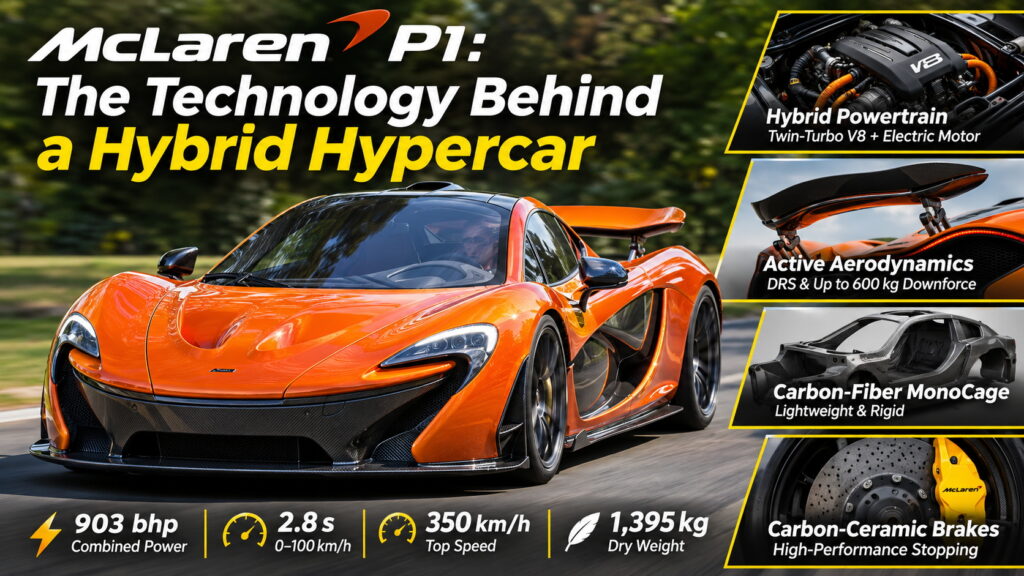
The McLaren P1 is one of the most technologically ambitious hypercars of the 21st century. Unveiled in production form in 2013, it combined a twin-turbocharged V8 engine with an electric motor, active aerodynamics, a carbon-fiber chassis and sophisticated suspension technology.
Rather than treating electrification primarily as a way to reduce fuel consumption, McLaren engineered the P1’s hybrid system to enhance acceleration, power delivery and driving response. The result was a rear-wheel-drive hypercar producing 916 PS (903 bhp) and 900 Nm of torque.
Limited to just 375 road-going examples, the P1 became one of the defining members of the hybrid hypercar generation, alongside the Ferrari LaFerrari and Porsche 918 Spyder.
McLaren P1 Technical Specifications
| Specification | McLaren P1 |
|---|---|
| Introduction | 2013 |
| Engine | 3.8-liter twin-turbocharged V8 |
| Hybrid system | Single electric motor |
| Combined power | 916 PS / 903 bhp |
| Maximum torque | 900 Nm |
| Transmission | 7-speed dual-clutch |
| Drivetrain | Rear-wheel drive |
| 0–100 km/h | 2.8 seconds |
| 0–200 km/h | 6.8 seconds |
| Top speed | 350 km/h, electronically limited |
| Lightest dry weight | 1,395 kg |
| Road-car production | 375 examples |
1. Hybrid Powertrain: A Twin-Turbo V8 and Electric Motor
At the heart of the P1 is a 3.8-liter twin-turbocharged V8 paired with a powerful electric motor. The combustion engine develops approximately 727 bhp, while the electric motor adds up to 176 bhp.
Working together, these systems generate a combined 903 bhp. All power is transmitted to the rear wheels through a seven-speed dual-clutch gearbox.
The electric motor plays a critical role in improving throttle response. A turbocharged engine needs sufficient exhaust gas flow to build boost pressure, and the electric motor can provide immediate torque while the turbochargers respond.
This combination gives the P1 the acceleration of an exceptionally powerful combustion-engine hypercar with the additional responsiveness made possible by electrification.
2. IPAS: Instant Power Assist System
The P1’s Instant Power Assist System, known as IPAS, allows the driver to request additional electric power using a steering-wheel control.
Its operating philosophy draws inspiration from Formula 1 energy-assisted performance systems. Instead of using the electric motor only for efficiency, the P1 employs it as a direct performance tool.
IPAS improves acceleration response and gives the driver access to the hybrid system’s performance potential when battery energy and operating conditions permit.
3. Active Aerodynamics and DRS


Aerodynamic engineering is central to the McLaren P1’s performance. Its tightly sculpted bodywork directs airflow around the vehicle while supporting cooling and stability.
The P1 uses active aerodynamic components, including its adjustable rear wing and front aerodynamic devices. McLaren states that the car can generate up to approximately 600 kg of aerodynamic downforce.
Downforce increases tire loading at speed, helping the vehicle maintain grip during high-speed cornering.
The Drag Reduction System, or DRS, reduces rear-wing drag when activated. This allows the car to balance two competing aerodynamic objectives: minimizing resistance on straights and maximizing grip when cornering.
4. RaceActive Chassis Control


McLaren equipped the P1 with RaceActive Chassis Control, a sophisticated suspension system designed to manage ride height, body movement and vehicle stability.
In Race mode, the P1 adopts a substantially lower ride height and a more aggressive aerodynamic configuration. This improves the effectiveness of its underbody airflow and helps the car remain stable during demanding circuit driving.
The suspension system controls body roll and pitch, allowing the vehicle to maintain its aerodynamic platform more consistently under acceleration, cornering and braking.
5. Carbon-Fiber MonoCage Construction
The P1 uses a carbon-fiber MonoCage structure that incorporates the passenger safety cell and roof structure.
Carbon fiber provides high rigidity relative to its mass, making it particularly valuable in performance vehicles where precise suspension behavior and low weight are essential.
The lightweight construction helps compensate for the additional mass of the hybrid battery and associated electronics. McLaren quotes a lightest dry weight of 1,395 kg for the P1.
The resulting structure contributes to chassis stiffness, vehicle response and occupant protection.
6. Battery Technology and Electric Driving
The McLaren P1 is a plug-in hybrid capable of limited electric-only driving. Its battery supports electric propulsion as well as the substantial power demands of the IPAS system.
Under the original NEDC testing procedure, its electric-only range was approximately 11 kilometers.
Although modest compared with modern plug-in hybrids, this range reflects the P1’s priorities. Its electrical system was designed primarily to deliver high-performance assistance and operate under demanding driving conditions.
7. High-Performance Carbon-Ceramic Brakes


Managing the P1’s extraordinary acceleration requires equally advanced braking technology.
McLaren worked with Akebono on a high-performance braking system featuring specially developed carbon-ceramic discs.
Carbon-ceramic technology offers strong heat resistance and helps maintain braking effectiveness during repeated high-speed stops.
According to McLaren’s published performance figures, the P1 can brake from 100 km/h to a complete stop in approximately 30 meters, under its specified test conditions.
8. How the McLaren P1 Changed Hypercar Engineering
The P1 arrived during a technological turning point for performance cars. Alongside the Ferrari LaFerrari and Porsche 918 Spyder, it demonstrated that hybrid systems could become integral to the fastest road-going vehicles.
What distinguishes the P1 is the integration of its technologies. The electric motor complements the twin-turbocharged engine, while the active aerodynamics and suspension work together to improve stability and grip.
Each major system contributes to the same engineering objective: allowing the driver to exploit exceptional performance with precision and confidence.
McLaren P1 and the Future of Hybrid Hypercars
The P1’s engineering philosophy influenced the direction of subsequent high-performance hybrid development.
Its successor in McLaren’s flagship lineage, the McLaren W1, continues the idea that electrification can contribute directly to acceleration, responsiveness and extreme performance.
The P1 therefore represents more than a technological experiment. It helped prove the long-term potential of combining electric propulsion with advanced combustion-engine engineering.
Conclusion
The McLaren P1 remains an important milestone in automotive history. Its 903 bhp hybrid powertrain, IPAS electric assistance, active aerodynamics, carbon-fiber structure and sophisticated suspension demonstrated how multiple engineering disciplines could be integrated into one exceptional machine.
Its greatest achievement was not simply producing extraordinary acceleration. It showed that hybrid technology could strengthen the connection between driver and vehicle, establishing a new direction for the modern hypercar.
Technical Sources
- McLaren Automotive — P1 Official Specifications
- McLaren Automotive — The Evolution of the P1 Legacy
- McLaren Automotive — McLaren W1
Photography Credits and Licenses
- Front three-quarter photograph: Mr.choppers — CC BY-SA 3.0.
- Rear spoiler photograph: Clément Bucco-Lechat — CC BY-SA 3.0.
- Race mode photograph: Axion23 — CC BY 2.0.
- Tokyo Motor Show photograph: PekePON — CC BY-SA 4.0.


Photography reproduced under the indicated Creative Commons licenses. No image alterations are intended. If photographs are modified, applicable attribution and ShareAlike obligations must be respected.