


Views: 0
The History of Pagani’s Carbon-Fibre Engineering
How Horacio Pagani transformed aerospace-inspired materials into some of the world’s most extraordinary hypercars.


10
Few automotive manufacturers have built their identity around a single material as completely as Pagani Automobili. From the first Zonda to the Huayra and Utopia, carbon fibre has been fundamental to the company’s engineering, performance, safety, and visual character.
For founder Horacio Pagani, carbon fibre was never simply a way to reduce weight. It offered a new way of designing cars, combining structural efficiency with sculptural freedom and meticulous craftsmanship.
The story begins not with the first Pagani supercar in 1999, but in the experimental workshops of Lamborghini during the 1980s.
1. The Lamborghini Years: 1983–1991
Early composite experimentation
The Countach Evoluzione
An experimental program that helped establish the engineering knowledge Pagani would later bring to his own company.
Horacio Pagani joined Lamborghini in the early 1980s, when advanced composites were still unusual in road-car manufacturing. Formula One and aerospace engineering had already demonstrated their potential, but producing durable, precisely manufactured carbon-fibre structures remained expensive and technically challenging.
One important project was the Lamborghini Countach Evoluzione, an experimental lightweight vehicle developed during the decade. Working from early designs overseen by engineer Rosario Vizzini, Pagani led a small team that completed and tested the composite-intensive prototype.
Pagani also invested in his own autoclave when the company was reluctant to purchase one. An autoclave allows composite components to cure under controlled heat and pressure, helping produce consistent, high-quality structures.
That decision was pivotal. It gave Pagani practical manufacturing experience and reinforced his belief that composite engineering could become the foundation of a new generation of performance cars.
Lamborghini.com
+2
2. Modena Design: Building Expertise, 1991–1998
In 1991, Pagani founded Modena Design, a specialist business developing advanced composite technologies.
Rather than immediately concentrating on producing a complete supercar, the company worked on composite components and prototypes for automotive, racing, and aerospace applications.
This work helped develop the capabilities needed to manufacture a complete carbon-fibre car structure: mould design, fibre orientation, laminate construction, curing processes, dimensional accuracy, and surface finishing.
It also helped finance the development of Pagani’s first production car, the Zonda.
Pagani
+1
3. The Pagani Zonda: 1999 and Beyond


10
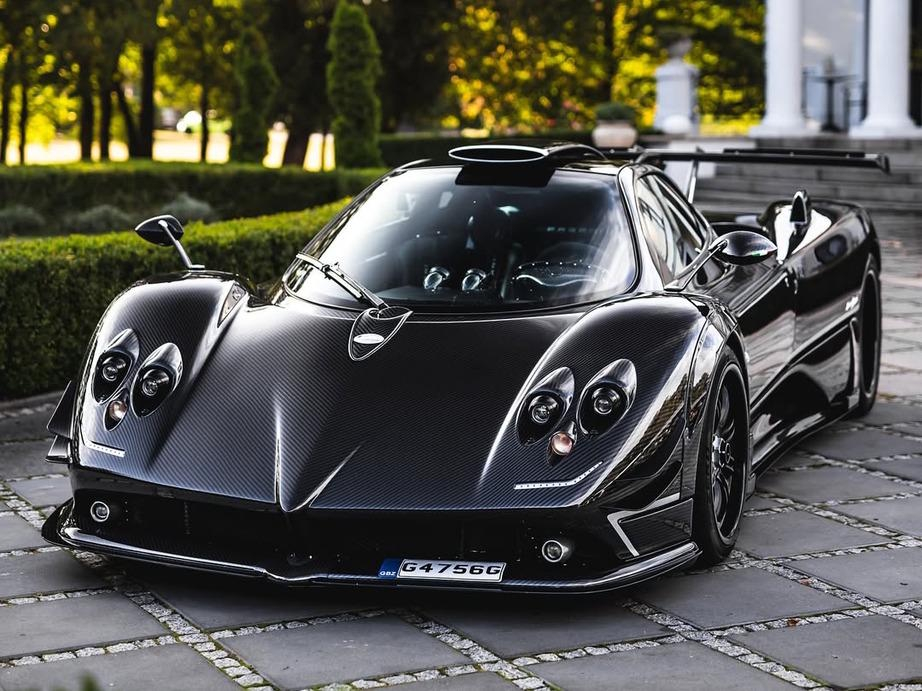
The Pagani Zonda C12 made its public debut at the 1999 Geneva Motor Show. Its dramatic design, Mercedes-Benz V12 engine, and carbon-fibre construction immediately established Pagani as a distinctive new supercar manufacturer.
The Zonda used a carbon-fibre central monocoque, combining structural strength, stiffness, and low mass with an unusually sculptural body.
Unlike traditional steel structures, composite components could be engineered through carefully selected fibre directions and layers. This allowed Pagani to place reinforcement where it was needed rather than relying solely on thicker, heavier material.
The Zonda’s development continued across increasingly sophisticated versions. The Zonda F Roadster, for example, used new triaxial carbon-fibre fabrics to help achieve the same weight as the coupé despite the demands of an open-top structure.
Pagani
+1
4. Carbon-Titanium: A New Generation of Composites

As Pagani’s experience expanded, engineers began exploring more advanced composite materials.
One major innovation was Carbo-Titanium, a family of composites combining carbon fibres with titanium reinforcement within the laminate architecture.
Carbon fibres offer excellent stiffness and strength relative to weight, while titanium reinforcement can help improve particular mechanical properties, including resistance to certain forms of damage, depending on material construction and loading.
The aim was not simply to manufacture an exotic-sounding material. It was to optimize the structural properties of the vehicle while maintaining extremely low weight.
Carbo-Titanium became particularly important in the later Zonda lineage, including the track-focused Zonda R family and its derivatives.
The Zonda Revolucion, unveiled in 2013, featured a carbon-titanium central monocoque and a reported vehicle weight of 1,070 kg.
Pagani
+1
5. The Pagani Huayra: Carbon-Fibre Engineering Evolves


11
Introduced in 2011, the Pagani Huayra represented the next major stage in Pagani’s composite engineering.
Its construction continued the company’s emphasis on lightweight structures, integrating increasingly sophisticated composite materials with advanced aerodynamics and carefully engineered mechanical components.
The Huayra’s development produced several important milestones:
- Huayra Roadster (2017): Revised composite structures contributed to an 80 kg weight reduction compared with the original Huayra coupé, alongside a claimed 52% increase in rigidity.
- Huayra Roadster BC (2019): Introduced advanced Carbo-Titanium HP62 G2 and Carbo-Triax HP62 monocoque material formulas.
- Improved structural engineering: More sophisticated composite layups helped engineers balance stiffness, mass, safety, and the additional structural demands of roofless cars.
The Huayra Roadster BC achieved a manufacturer-reported dry weight of just 1,250 kg, demonstrating how the brand continued refining its materials rather than simply adding power.
Pagani
+1
6. The Utopia: A New Standard in Composite Technology


11
The Pagani Utopia introduced Pagani’s third major model generation in 2022.
By this stage, Pagani had developed a sophisticated portfolio of proprietary materials, including Carbo-Titanium HP62 G2 and Carbo-Triax HP62.
The company also developed a new class of visible carbon fibre for exterior bodywork. According to Pagani, this material offered a 38% improvement in stiffness at the same density, combining engineering advancement with the characteristic visual finish of exposed carbon fibre.
The Utopia Roadster, introduced in 2024, took this approach further, incorporating more than 40 composite-material formulas within the vehicle.
It achieved the same claimed dry weight as the Utopia coupé: 1,280 kg. This is particularly notable because open-top vehicles generally require additional structural reinforcement.
Pagani
+1
Utopia Roadster — engineering highlights
1,280 kg
Manufacturer-reported dry weight
40+
Composite material formulas
864 hp
AMG-developed V12 output
HP62 G2
Carbo-Titanium monocoque material
Specifications: Pagani Utopia Roadster.
Pagani
+1
7. How Pagani Manufactures Carbon-Fibre Components


The manufacturing process is as important as the materials themselves.
A simplified overview of the engineering process shows how lightweight composite components are created.
- Digital engineering and mould design. Engineers establish the shape, loading requirements, and structural function of each component.
- Fibre selection and layup. Layers are arranged in carefully planned orientations to achieve the desired structural characteristics.
- Curing. Compatible composite systems are consolidated and cured under controlled conditions, often using heat and pressure.
- Machining and inspection. Finished parts are trimmed and checked for dimensional accuracy and manufacturing defects.
- Assembly and finishing. Structural components are integrated into the vehicle, while visible carbon surfaces receive the exceptionally precise cosmetic finish associated with Pagani.
Every Pagani is produced on a very limited scale. Rather than prioritizing the volume efficiency of mass production, its manufacturing philosophy places exceptional emphasis on individual craftsmanship, material quality, and customization.
8. Timeline: Four Decades of Carbon-Fibre Innovation
| Year | Engineering milestone |
|---|---|
| 1980s | Horacio Pagani works on composite development at Lamborghini |
| 1991 | Modena Design founded |
| 1999 | Zonda C12 debuts with carbon-fibre monocoque |
| 2000s | Zonda variants advance carbon-fibre construction and introduce carbon-titanium applications |
| 2011 | Huayra generation begins |
| 2017 | Huayra Roadster demonstrates new composite weight and rigidity improvements |
| 2019 | Huayra Roadster BC develops HP62 composite formulas |
| 2022 | Utopia introduces the third model generation |
| 2024 | Utopia Roadster uses more than 40 composite formulas |
9. Why Pagani’s Carbon-Fibre Legacy Matters
Pagani’s contribution to automotive engineering is not that it invented carbon-fibre cars. Formula One teams and other manufacturers had already pioneered important composite structures.
Its distinctive achievement has been the sustained development of advanced composite technology within extremely low-volume, road-legal hypercars.
Across successive generations, Pagani has demonstrated three enduring priorities: reducing mass without abandoning structural performance, experimenting with increasingly sophisticated material systems, and treating engineering surfaces as part of the car’s visual identity.
From Horacio Pagani’s early autoclave experiments to the Utopia Roadster, the company’s history illustrates how decades of material research can define an entire automotive brand.
For Pagani, carbon fibre is more than a lightweight construction material. It is the connection between science, performance, craftsmanship, and design.
Publication package — Bin3aiah Cars
Featured image suggestion
Editorial reference


Recommended subject: Pagani Utopia exposed-carbon bodywork. Use a licensed original image from an approved media source before publication.
| SEO field | Recommended content |
|---|---|
| Title | The History of Pagani’s Carbon-Fibre Engineering |
| Slug | pagani-carbon-fibre-engineering-history |
| Meta description | Discover how Pagani pioneered advanced carbon-fibre hypercar engineering, from Horacio Pagani’s Lamborghini years to the Zonda, Huayra and Utopia. |
| Primary keyword | Pagani carbon fibre engineering |
| Secondary keywords | Horacio Pagani, Carbo-Titanium, Pagani Zonda, Huayra monocoque, Utopia |
| Category | Automotive Technology |
| Tags | Pagani, Carbon Fibre, Hypercars, Engineering, Automotive History |
Research sources
Primary manufacturer sources used to establish the history and technical details:
- Pagani — Official Company History
- Pagani — Modena Design History
- Pagani — Huayra Roadster BC Technical Release
- Pagani — Utopia Official Specifications
- Pagani — Utopia Roadster Engineering
- Lamborghini — Carbon-Fibre Engineering History
Editorial status: Article prepared with researched technical references, image suggestions, and SEO metadata. Images shown are visual references, not verified publication-licensed assets. The article has not been published to cars.bin3aiah.net.