


Views: 0
The Evolution of Porsche’s Flat-Six Engine: From Air-Cooled Legend to Hybrid Powerhouse
BIN3AIAH CARS | ENGINEERING & AUTOMOTIVE HISTORY | OCTOBER 2026


7
For more than six decades, the Porsche flat-six engine has been at the heart of one of the world’s most recognizable sports cars: the Porsche 911.
From the mechanical character of the original air-cooled 911 to today’s sophisticated turbocharged and electrified powertrains, Porsche has continually refined the same fundamental engine configuration.
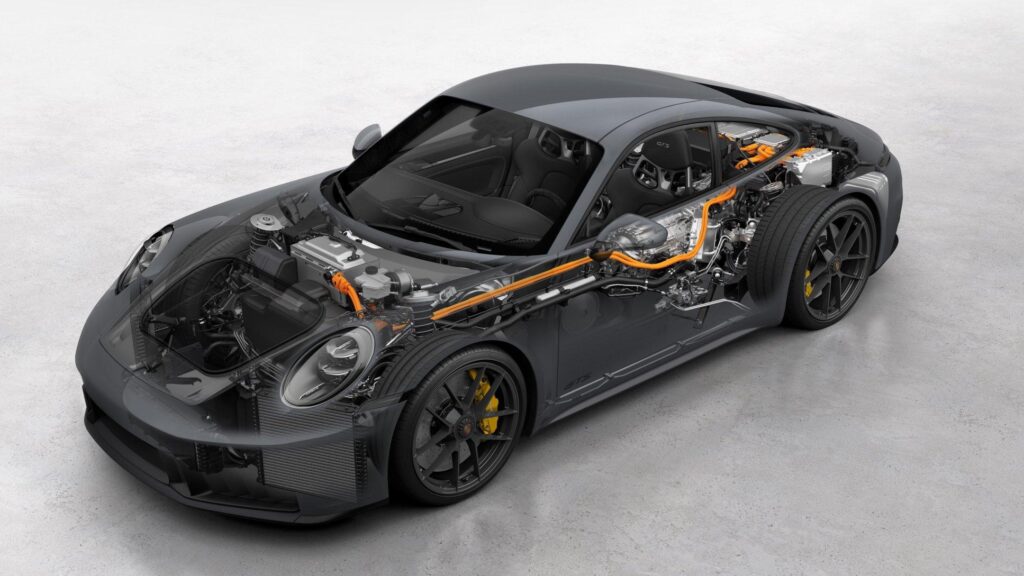
What began in 1963 as a modest 2.0-liter engine producing 130 PS has evolved into an extraordinary family of powerplants, including the 711 PS hybrid system introduced in the 2025 Porsche 911 Turbo S.
Porsche Newsroom
+1
1. What makes Porsche’s flat-six engine special?


A flat-six, also known as a horizontally opposed six-cylinder or boxer engine, places three cylinders on either side of a central crankshaft.
Unlike a traditional inline-six or V6 engine, the pistons move horizontally in opposing directions.
This configuration offers several advantages:
- Low center of gravity: Its relatively flat design helps concentrate engine mass lower in the car.
- Excellent mechanical balance: The arrangement naturally cancels many primary and secondary engine vibrations.
- Compact height: The low profile suits the distinctive rear-engine packaging of the 911.
- Characteristic sound: Intake, exhaust, firing characteristics and mechanical components contribute to the unmistakable Porsche flat-six soundtrack.
Although Porsche has redesigned its flat-six repeatedly, these fundamental principles have endured.
2. 1963–1973: The birth of the flat-six legend


7
The original 911, unveiled at the 1963 Frankfurt Motor Show as the Porsche 901, marked a defining turning point in Porsche’s engineering history.
Its newly developed, air-cooled 1,991 cc six-cylinder boxer engine produced approximately 130 PS.
The engine featured an overhead-camshaft layout, a cooling fan, finned cylinders and an oil-cooling system.
Over the following decade, Porsche increased displacement through successive developments:
- 2.0 liters in the original 911
- 2.2 liters for the 1970 model year
- 2.4 liters for the 1972 model year
- 2.7 liters in the legendary 1973 911 Carrera RS
The Carrera RS 2.7 became one of the most celebrated early versions, producing 210 PS and demonstrating how much performance potential Porsche could extract from a naturally aspirated flat-six.
These developments established the engine as the technical and emotional foundation of the 911.
Porsche Newsroom
+1
3. 1974–1989: Turbocharging changes everything


8
The arrival of the Porsche 911 Turbo (930) represented one of the greatest transformations in the flat-six’s history.
Porsche applied knowledge developed through motorsport to its production sports cars, introducing a turbocharged 3.0-liter engine with 260 PS.
Turbocharging used exhaust gases to drive a turbine, forcing additional air into the engine and allowing more fuel to be burned to produce greater power.
In 1977, Porsche upgraded the Turbo to a 3.3-liter engine with an intercooler and 300 PS.
The result was exceptionally strong acceleration for the period, although early turbocharged cars also became famous for their noticeable turbo lag.
Meanwhile, naturally aspirated versions continued evolving. The 911 SC used a 3.0-liter engine, while the Carrera 3.2 arrived for the 1984 model year with improved electronic engine management.
This era showed that the flat-six could deliver both everyday usability and supercar-level excitement.
Porsche Newsroom
+1
4. 1989–1998: The final evolution of air cooling


Porsche 964
3.6 L · 250 PS Carrera


Porsche 993
3.6 L · 272–285 PS Carrera
The 964 generation introduced a substantially revised 3.6-liter engine with twin-spark ignition and electronic engine management. Its standard Carrera version delivered 250 PS.
The subsequent 993 generation pushed air-cooled engineering even further.
Major developments included improved intake systems, engine management and, in higher-performance models, twin turbochargers.
The 993 Turbo introduced a remarkably capable 3.6-liter twin-turbo flat-six, while selected performance versions produced substantially more power.
The 993 also marked the end of an era.
When production ended in 1998, it became the final air-cooled Porsche 911 generation.
Its distinctive mechanical sound, robust character and analog driving experience helped secure its status among enthusiasts and collectors.
Porsche Newsroom
+1
5. 1997–2005: The water-cooled revolution


5
The introduction of the 996 generation brought the most controversial change in Porsche’s engine history: the transition from air cooling to liquid cooling.
Stricter emissions requirements, rising power expectations and the need for tighter temperature control made this transformation increasingly necessary.
The original 996 Carrera used a 3.4-liter, water-cooled flat-six producing 300 PS.
Liquid cooling enabled greater thermal precision, while four-valve cylinder heads improved breathing and combustion efficiency.
The new design also laid the foundation for further performance improvements in future generations.
Despite initial criticism from traditional enthusiasts, the 996 played an essential role in keeping the 911 competitive in a rapidly changing automotive industry.
Porsche Newsroom
+1
6. 2004–2019: Precision engineering and the rise of modern turbocharging


The 997 and 991 generations brought significant advancements in electronic engine management, fuel injection, friction reduction and variable valve timing.
In the 997 generation, Porsche introduced direct fuel injection to Carrera engines with the 2008 model update, improving combustion control and efficiency.
The early 991 Carrera featured a naturally aspirated 3.4-liter engine developing 350 PS, while the Carrera S used a 3.8-liter flat-six producing 400 PS.
The next major milestone came in 2015, when the updated 991.2 Carrera family adopted turbocharging across its standard Carrera lineup.
The new 3.0-liter twin-turbo engines produced:
- 370 PS in the Carrera
- 420 PS in the Carrera S
- 450 PS in the later Carrera GTS
The shift improved low-speed torque and everyday acceleration while allowing Porsche to use smaller engine displacement without sacrificing performance.
Porsche Newsroom
+1
7. The naturally aspirated masterpiece: Porsche 911 GT3


6
While most mainstream Carrera models embraced turbocharging, Porsche continued developing high-revving naturally aspirated engines for its GT division.
The modern Porsche 911 GT3 demonstrates how advanced a traditional combustion engine can become.
4.0 L
Displacement
510 PS
Output
9,000
RPM limit
Porsche’s latest GT3 engine incorporates individual throttle valves, sophisticated lubrication, motorsport-derived components and precise valvetrain engineering.
It shows that even in the age of electrification, a naturally aspirated flat-six can deliver extraordinary responsiveness and driving involvement.
Porsche Newsroom
+1
8. 2024–2026: Hybrid technology enters the flat-six era


8
The introduction of Porsche’s T-Hybrid system in the updated 992-generation Carrera GTS represented another historic turning point.
Instead of replacing the flat-six, Porsche integrated electrical assistance into its performance architecture.
The Carrera GTS debuted a new 3.6-liter flat-six with an electrically assisted turbocharger, a compact high-voltage battery and an electric motor integrated into its transmission.
The technology reduces response delays, recovers energy and contributes additional power when required.
Porsche Newsroom USA
The system advanced further with the 911 Turbo S unveiled in September 2025.
PORSCHE 911 TURBO S · T-HYBRID
711 PS
Combined system output
800 Nm
Maximum torque
2.5 s
0–100 km/h
322 km/h
Top speed
The 2025-unveiled Turbo S combines its 3.6-liter boxer engine with two electric turbochargers and a performance-oriented hybrid drivetrain.
Rather than abandoning the 911’s mechanical identity, Porsche has adapted the flat-six for a new technological era.
Porsche Newsroom
9. Porsche flat-six evolution: Timeline and specifications
Power through the generations
Representative models · PS

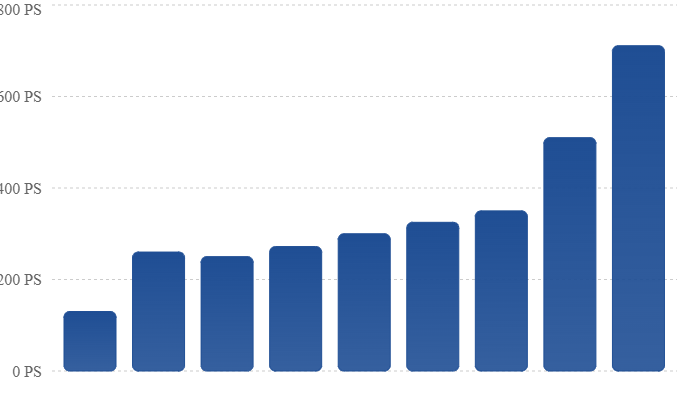
Values are for selected models, not the maximum output of every generation.
| Era | Representative engine | Major milestone |
|---|---|---|
| 1963 | 2.0 L naturally aspirated | Original flat-six |
| 1974 | 3.0 L turbo | Production turbocharging |
| 1989 | 3.6 L air-cooled | Twin-spark ignition |
| 1993 | 3.6 L air-cooled | Final air-cooled generation |
| 1997 | 3.4 L water-cooled | Liquid cooling |
| 2008 | 3.6/3.8 L | Carrera direct injection |
| 2015 | 3.0 L twin-turbo | Turbocharged Carrera lineup |
| 2024 | 4.0 L GT3 | High-revving naturally aspirated design |
| 2024–2025 | 3.6 L T-Hybrid | Electrification and eTurbo technology |
Years refer to milestones or model introductions. PS denotes metric horsepower; specifications vary by model and market.
10. Why the Porsche flat-six remains iconic
The Porsche flat-six is more than an engine configuration. It is a fundamental part of the 911’s identity.
Its evolution demonstrates Porsche’s ability to preserve a recognizable mechanical concept while continually rethinking how that concept works.
Air cooling gave way to liquid cooling. Carburetors evolved into increasingly sophisticated fuel injection. Turbocharging transformed power delivery. Electrification now adds a new dimension to performance.
Yet the six horizontally opposed cylinders remain.
The most remarkable aspect of the Porsche flat-six is not simply how much power it produces today, but how successfully Porsche has adapted its original engineering philosophy across generations of changing technology.
Recommended photo and video gallery
Visual research for the published article. Use Porsche-approved or appropriately licensed originals, with attribution and usage rights checked before uploading.


1. Original Porsche 911


2. Carrera RS 2.7

3. Original 911 Turbo

4. Air-cooled engine


5. Final air-cooled era


6. Water-cooling revolution

7. Modern engine management


8. Twin-turbo Carrera


9. Naturally aspirated GT3


10. Hybrid flat-six future
Three suggested video references:
- Porsche 911 engine history
- GT3 naturally aspirated engine engineering
- Porsche T-Hybrid technology explained
Sources and further reading
The article is based primarily on Porsche’s official historical and engineering documentation:
- Porsche Newsroom — History and Future of the 911
- Porsche — 60 Years of the 911
- Porsche — The Water-Cooled 996
- Porsche — 911 GT3 Engineering
- Porsche — Hybrid 911 Turbo S
SEO package — Bin3aiah Cars
SEO TITLE
Porsche Flat-Six Engine Evolution: 1963 to 2026
URL SLUG
porsche-flat-six-engine-evolution Copy
META DESCRIPTION
Explore the evolution of Porsche’s flat-six engine from the 1963 air-cooled 911 to modern turbocharged, GT3 and T-Hybrid powertrains.
PRIMARY KEYWORD
Porsche flat-six engine evolution
SECONDARY KEYWORDS
Porsche 911 engine history, Porsche boxer engine, air-cooled Porsche 911, water-cooled flat-six, Porsche GT3 engine, Porsche T-Hybrid
SUGGESTED CATEGORIES
Porsche · Automotive History · Engine Technology
Publication status: Article and SEO package prepared for cars.bin3aiah.net. The media selections are references, not yet a rights-cleared uploaded gallery. No WordPress post has been published.