
Views: 0
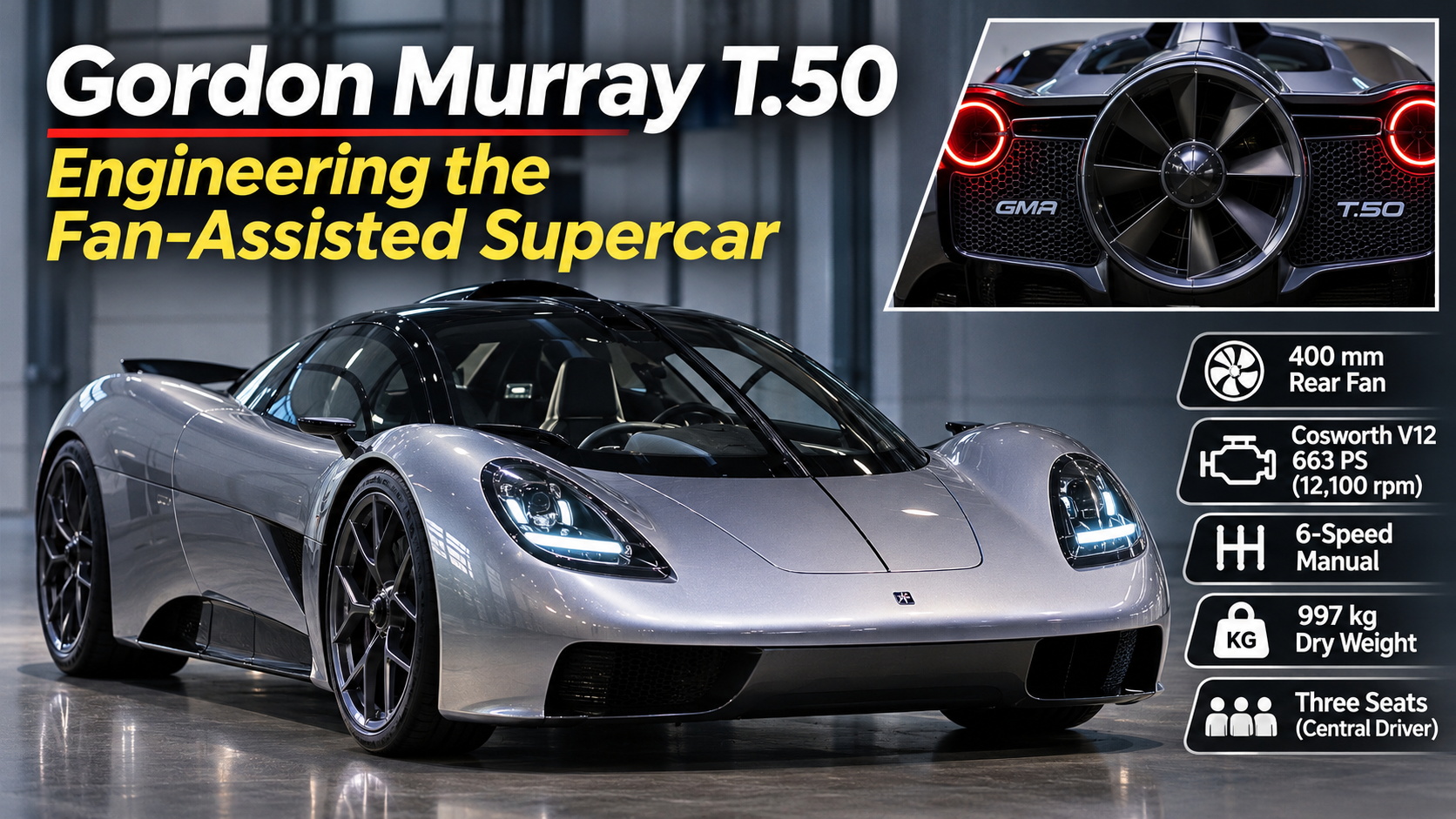
Gordon Murray T.50: Engineering the Fan-Assisted Supercar
The Gordon Murray Automotive T.50 is one of the most remarkable supercars of the modern era. Developed under the direction of legendary automotive designer Gordon Murray, it combines active fan-assisted aerodynamics, an exceptionally high-revving V12 engine, a lightweight carbon-fiber structure, and a three-seat cockpit.
Unveiled in August 2020, the T.50 was designed to emphasize driver engagement and mechanical purity rather than simply pursuing ever-higher horsepower figures. Its central driving position and naturally aspirated engine recall the iconic McLaren F1, but its aerodynamic technology introduces a different level of engineering sophistication.

Gordon Murray T.50 Technical Specifications
| Specification | Details |
|---|---|
| Manufacturer | Gordon Murray Automotive |
| First unveiled | 2020 |
| Engine | 3,994 cc naturally aspirated Cosworth V12 |
| Power | 663 PS (654 bhp), original specification |
| Torque | 467 Nm |
| Maximum engine speed | 12,100 rpm |
| Transmission | Six-speed Xtrac manual |
| Drivetrain | Rear-wheel drive |
| Dry weight | 997 kg |
| Fan diameter | 400 mm |
| Seating | Three seats, central driver |
| Planned road-car production | 100 examples |
How the T.50 Fan-Assisted Aerodynamics Work
The most distinctive innovation of the T.50 is its rear-mounted 400 mm aerodynamic fan. Unlike a conventional radiator cooling fan, this system is primarily designed to manage airflow beneath the vehicle.
The fan works with active diffuser ducts and movable rear spoilers to control airflow around the underbody. By extracting air from the rear diffuser region, it helps manage the boundary layer and improves the effectiveness of the car’s ground-effect aerodynamics.
The system provides different configurations for cornering stability, braking, and high-speed efficiency. According to Gordon Murray Automotive’s original development claims, High Downforce mode can increase downforce by 50%, while Streamline mode can reduce drag by 12.5%.
These figures are manufacturer claims under specified operating conditions, rather than independently verified performance measurements.

The Six Aerodynamic Modes
The T.50 uses six aerodynamic operating modes, combining automatic systems with driver-selectable settings.
- Auto: Provides the default passive aerodynamic configuration.
- Braking: Automatically increases aerodynamic assistance during heavy deceleration.
- High Downforce: Increases downforce to improve traction and cornering stability.
- Streamline: Adjusts airflow to reduce aerodynamic drag.
- Vmax Boost: Optimizes high-speed efficiency while enabling additional temporary power from the integrated starter-generator and ram-air system.
- Test: Allows the fan and active aerodynamic components to be demonstrated while stationary.
The fan is driven by a 48-volt electric motor, with a maximum fan speed of approximately 7,000 rpm.
The Cosworth V12: Built for High-Revving Performance
Powering the T.50 is a bespoke naturally aspirated V12 developed by Cosworth. Its approximately four-liter displacement and 12,100 rpm redline distinguish it from the turbocharged and hybrid powertrains found in many contemporary high-performance cars.
The engine prioritizes rapid throttle response, low rotating mass, and a distinctive high-frequency mechanical soundtrack.
Unlike turbocharged engines that depend on forced induction to generate substantial torque, the T.50’s V12 is designed to deliver a particularly immediate and linear relationship between accelerator input and engine response.
Its six-speed Xtrac manual gearbox complements this character, allowing drivers to control gear changes directly and preserving the mechanical interaction Murray considered essential to a rewarding driving experience.

Why Lightweight Construction Matters
With a stated dry weight of just 997 kg, the T.50 demonstrates how reducing mass can transform vehicle performance.
Its bonded carbon-fiber monocoque, composite bodywork, and extensively optimized components help minimize weight while maintaining structural rigidity.
Reduced mass benefits several important aspects of vehicle dynamics:
- Quicker acceleration for a given engine output.
- Reduced energy required during braking.
- More responsive steering and direction changes.
- Lower mechanical demands on tires and suspension.
- Greater agility without relying entirely on electronic intervention.
This philosophy contrasts with supercars that compensate for additional mass primarily through greater engine power.
The Central Driving Position
One of the clearest connections between the T.50 and the McLaren F1 is the three-seat cockpit.
The driver sits centrally, with two passengers positioned slightly farther back on either side. This arrangement provides a symmetrical forward perspective and places the driver at the center of the vehicle.
The cockpit includes physical switches, dedicated instrumentation, and an exposed manual gear selector. Rather than relying heavily on large touchscreen interfaces, the layout emphasizes tactile controls and immediate access to essential driving functions.

From the Brabham BT46B to the T.50
Fan-assisted aerodynamics are closely connected with Gordon Murray’s Formula 1 engineering career.
In 1978, Murray designed the Brabham BT46B, a Formula 1 car featuring a large rear fan. The design became famous after its single Grand Prix appearance at the Swedish Grand Prix, where Niki Lauda secured victory.
The McLaren F1 later incorporated smaller fans to support aerodynamic airflow management.
The T.50 advances these ideas by integrating a sophisticated electric fan, active diffuser valves, and movable spoilers into a road-legal performance car.
Although the underlying aerodynamic principles have historical roots, the T.50’s integrated control system represents a modern and unusually comprehensive implementation.
What Makes the Gordon Murray T.50 Special?
The T.50 stands apart because its engineering decisions consistently prioritize the driving experience.
- A rare naturally aspirated, high-revving V12 engine.
- A six-speed manual transmission rather than an automatic gearbox.
- An exceptionally lightweight carbon-fiber platform.
- An advanced fan-assisted aerodynamic system.
- A central driving position inspired by the McLaren F1.
- Limited production and highly specialized craftsmanship.
Instead of concentrating on a single maximum speed or acceleration target, the T.50 combines these technologies to deliver a responsive, communicative, and mechanically engaging character.
Conclusion: A Different Vision of Supercar Engineering
The Gordon Murray T.50 demonstrates that extraordinary automotive performance can be achieved through aerodynamic intelligence, low weight, and careful mechanical engineering rather than sheer horsepower alone.
Its remarkable fan-assisted aerodynamic system, Cosworth V12, manual gearbox, and central driving position make it an important modern expression of driver-focused supercar design.
For automotive enthusiasts, the T.50 is not simply a successor in spirit to the McLaren F1. It is a demonstration of how innovative engineering can preserve the emotional connection between driver and machine.
References and Further Reading
- Gordon Murray Automotive — T.50 Global Reveal
- Gordon Murray Automotive — T.50 Technical Specification (PDF)
- Wikimedia Commons — Gordon Murray Automotive T.50 Photographs
Technical figures reflect published manufacturer specifications. Image credits and licenses are provided beneath each photograph. This article is independent editorial content and is not affiliated with Gordon Murray Automotive.