
Views: 1
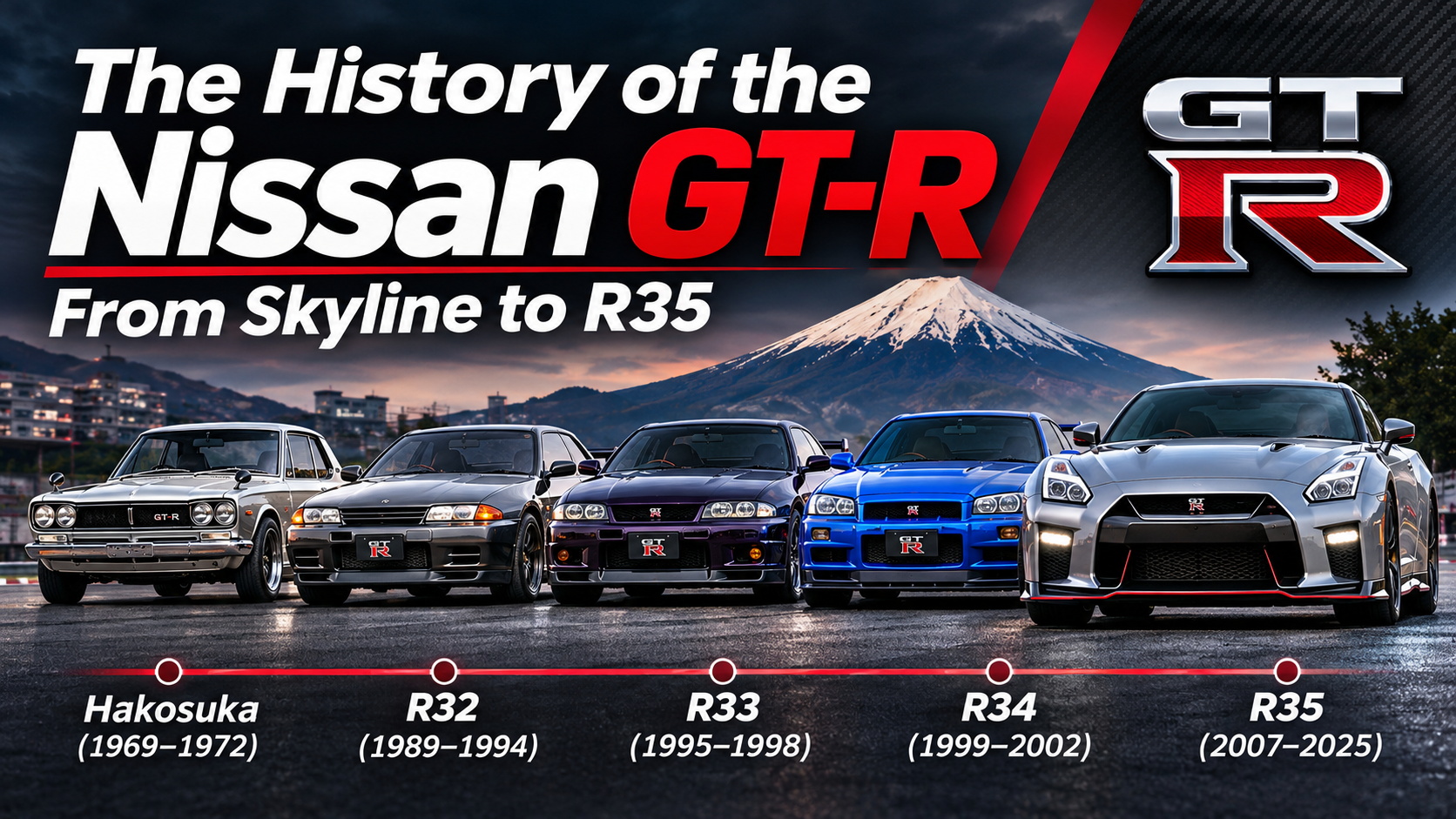
The Nissan GT-R is one of the most celebrated performance cars in Japanese automotive history. From its origins as a racing-inspired Skyline sedan in 1969 to the technologically sophisticated R35, the GT-R has represented Nissan’s pursuit of speed, precision and engineering excellence.
Nicknamed Godzilla, the GT-R earned international recognition through racing victories, powerful turbocharged engines, advanced all-wheel-drive systems and a devoted enthusiast community.
Its history includes six major generations, a long interruption in production and a transformation from a Skyline performance model into a standalone sports car.

Nissan GT-R Generations at a Glance
| Generation | Years | Engine | Key Feature |
|---|---|---|---|
| PGC10 / KPGC10 | 1969–1972 | 2.0L S20 I6 | Original Hakosuka |
| KPGC110 | 1973 | 2.0L S20 I6 | Rare Kenmeri |
| R32 | 1989–1994 | 2.6L twin-turbo I6 | ATTESA E-TS AWD |
| R33 | 1995–1998 | 2.6L twin-turbo I6 | Improved chassis |
| R34 | 1999–2002 | 2.6L twin-turbo I6 | Digital performance display |
| R35 | 2007–2025 | 3.8L twin-turbo V6 | Standalone GT-R |
1. The Original Skyline GT-R (1969–1972)

The GT-R story began in February 1969 when Nissan introduced the Skyline 2000GT-R, chassis code PGC10. Initially available as a four-door sedan, the car combined practical bodywork with engineering developed for high-performance driving.
Its defining feature was the S20 engine, a naturally aspirated 2.0-liter straight-six producing approximately 160 PS. The engine featured dual overhead camshafts and four valves per cylinder, reflecting Nissan’s racing expertise.
A two-door hardtop version, known as the KPGC10, followed in 1970 and became particularly popular among motorsport enthusiasts.
The generation earned the nickname Hakosuka, a combination of Japanese terms associated with the Skyline’s boxy design.
The original GT-R established an impressive competition record, accumulating 52 domestic touring-car race victories. This racing heritage created the foundation for the GT-R nameplate.
2. Kenmeri GT-R (1973): The Rare Generation

In 1973, Nissan introduced the second-generation Skyline GT-R, designated KPGC110. Known as the Kenmeri GT-R, it featured a longer, more contemporary two-door design while retaining the S20 six-cylinder engine.
However, the combination of stricter emissions requirements, changing market conditions and the oil crisis contributed to its very short production life.
Only 197 examples were manufactured, making the Kenmeri one of the rarest production GT-R models.
After its discontinuation, the GT-R badge disappeared from Nissan’s production range for approximately 16 years.
3. R32 Skyline GT-R (1989–1994): The Birth of Godzilla

After a long absence, Nissan revived the GT-R in August 1989 with the Skyline R32, chassis code BNR32. This model completely transformed the GT-R’s technical identity.
The R32 introduced the legendary RB26DETT, a 2.6-liter twin-turbocharged inline-six officially rated at 280 PS.
It also featured the ATTESA E-TS electronically controlled all-wheel-drive system, working alongside advanced chassis technology to distribute power effectively and improve traction.
The R32 achieved remarkable motorsport success, winning all 29 races it entered in the Japanese Touring Car Championship between 1990 and 1993.
Its racing achievements, particularly in Australia, helped establish the famous Godzilla nickname.
4. R33 Skyline GT-R (1995–1998): Chassis Refinement

Introduced in 1995, the Skyline R33 GT-R continued the technological approach established by the R32.
It retained the RB26DETT 2.6-liter twin-turbocharged engine, while Nissan concentrated on improving vehicle balance, body rigidity, suspension performance and high-speed stability.
The R33 was larger and heavier than its predecessor, but its chassis refinements improved control and predictability.
The V-Spec version introduced further enhancements, including ATTESA E-TS Pro, which incorporated more sophisticated differential control.
Although the R33 is sometimes overshadowed by the R32 and R34, it remains a significant chapter in the GT-R story because it demonstrated Nissan’s commitment to improving total vehicle performance rather than merely increasing engine output.
5. R34 Skyline GT-R (1999–2002): The Cultural Icon

The R34 Skyline GT-R arrived in 1999 and became one of the most recognizable Japanese sports cars ever produced.
Its design featured aggressive bodywork, a prominent rear wing, distinctive circular taillights and compact proportions compared with the R33.
Mechanically, the R34 retained the RB26DETT twin-turbocharged inline-six, officially producing 280 PS, along with advanced all-wheel-drive and chassis systems.
One of its most memorable innovations was the multifunction dashboard display, which provided the driver with information such as engine and performance data.
High-performance versions included the V-Spec, V-Spec II and Nür variants, each contributing to the R34’s reputation among enthusiasts and collectors.
Outside motorsport, the R34 became a cultural phenomenon through video games, films and the global Japanese domestic market enthusiast scene.
Production ended in 2002, concluding the Skyline GT-R era.
6. R35 Nissan GT-R (2007–2025): A Modern Performance Icon

Unveiled in 2007, the Nissan GT-R R35 represented the biggest transformation in the model’s history.
For the first time, the GT-R was developed and marketed as a standalone model rather than a high-performance Skyline variant.
The famous RB26 engine was replaced by the VR38DETT, a hand-assembled 3.8-liter twin-turbocharged V6 producing 480 PS at launch.
The R35 introduced a six-speed dual-clutch transmission with a rear transaxle layout, combining rapid gear changes with advanced ATTESA E-TS all-wheel drive.
Its engineering included sophisticated electronic controls, aerodynamic development, high-performance braking systems and continuously improved suspension technology.
Throughout its long production life, Nissan refined the R35 with increased engine output, improved aerodynamics, enhanced materials and updated driving technology.
The result was a high-performance sports car capable of challenging substantially more expensive European competitors while maintaining the GT-R’s distinctive engineering identity.
7. Nissan GT-R NISMO: Motorsport-Inspired Performance

NISMO, Nissan’s motorsport and performance division, developed the most track-focused factory versions of the R35 GT-R.
These models featured upgraded turbochargers, improved suspension tuning, aerodynamic enhancements and extensive use of carbon-fiber components.
In U.S. specifications, the 2024 GT-R NISMO produced 600 horsepower, compared with 565 horsepower for the standard GT-R Premium.
Carbon-ceramic brakes and specially developed aerodynamic components further improved the car’s high-performance capabilities.
The NISMO editions demonstrated how far Nissan could develop the R35 platform through motorsport-inspired engineering.
8. The End of R35 Production in 2025
On August 26, 2025, Nissan officially announced that the final R35 GT-R had rolled off the production line at its Tochigi plant in Japan.
Approximately 48,000 R35 GT-R vehicles were produced during the model’s 18-year lifespan.
The final vehicle was a Premium Edition T-Spec finished in Midnight Purple and destined for a customer in Japan.
The announcement marked the end of one of Nissan’s longest-running performance-car generations.
Although the R35 entered automotive history, Nissan stated its intention to bring the GT-R nameplate back in a future generation. No replacement specifications or launch date were confirmed in that announcement.
What Made the Nissan GT-R Legendary?
- Motorsport heritage: Decades of competition success established the GT-R as a serious performance machine.
- Advanced engineering: Turbocharged engines, all-wheel drive and sophisticated chassis technology became defining characteristics.
- Tuning potential: The RB26DETT and VR38DETT became important engines within international performance-car communities.
- Global influence: Movies, video games and motorsport introduced the GT-R to millions of enthusiasts.
- Distinctive identity: Every generation preserved the GT-R philosophy while adapting to new technology.
Conclusion: The Lasting Legacy of the Nissan GT-R
The Nissan GT-R has evolved from a 1969 racing-inspired sedan into one of the world’s most recognizable high-performance sports cars.
The original Hakosuka established the racing foundation, the R32 delivered revolutionary performance technology, the R33 refined the engineering formula, and the R34 achieved extraordinary cultural recognition.
Finally, the R35 transformed the GT-R into a standalone global performance model that remained competitive through nearly two decades of continuous development.
Although R35 production ended in 2025, the GT-R’s legacy remains deeply connected to automotive innovation, motorsport and Japanese performance-car culture.
Sources and Further Reading
- Nissan Heritage Collection — historical vehicles and technical information.
- Nissan Global Newsroom — official R35 production-ending announcement, August 26, 2025.
- Wikimedia Commons — Nissan Skyline GT-R — photographs and individual image licenses.
Editorial content: Bin3aiah Cars. Photographs are credited individually under their applicable licenses. Nissan and GT-R are trademarks of their respective owner. This article is independent editorial content and is not affiliated with or endorsed by Nissan.