
Views: 0
How Variable Valve Timing Improves Engine Performance
Modern car engines are expected to deliver strong acceleration, smooth everyday performance, good fuel economy, and lower emissions. Achieving all these objectives with a traditional fixed valve-timing system is difficult because an engine’s airflow requirements change with speed and load.
Variable Valve Timing (VVT) helps solve this problem by adjusting when the intake and exhaust valves open and close. This allows the engine to operate more effectively under different driving conditions, from low-speed city traffic to high-RPM acceleration.

What Is Variable Valve Timing?
In a four-stroke engine, intake valves admit air or an air-fuel mixture into the combustion chambers, while exhaust valves release burned gases.
Camshafts traditionally control the opening and closing of these valves according to a fixed mechanical schedule. However, the ideal valve timing at 1,500 RPM is not necessarily the best timing at 6,000 RPM.
Variable Valve Timing allows the engine to adjust its camshaft timing while running. By changing the relationship between camshaft rotation and crankshaft position, VVT can optimize cylinder filling, exhaust-gas flow, combustion stability, and pumping losses.
It is important to distinguish valve timing from valve lift. Timing determines when valves open and close, while lift determines how far they open. Some advanced engines use both variable timing and variable lift systems.
How Does Variable Valve Timing Work?
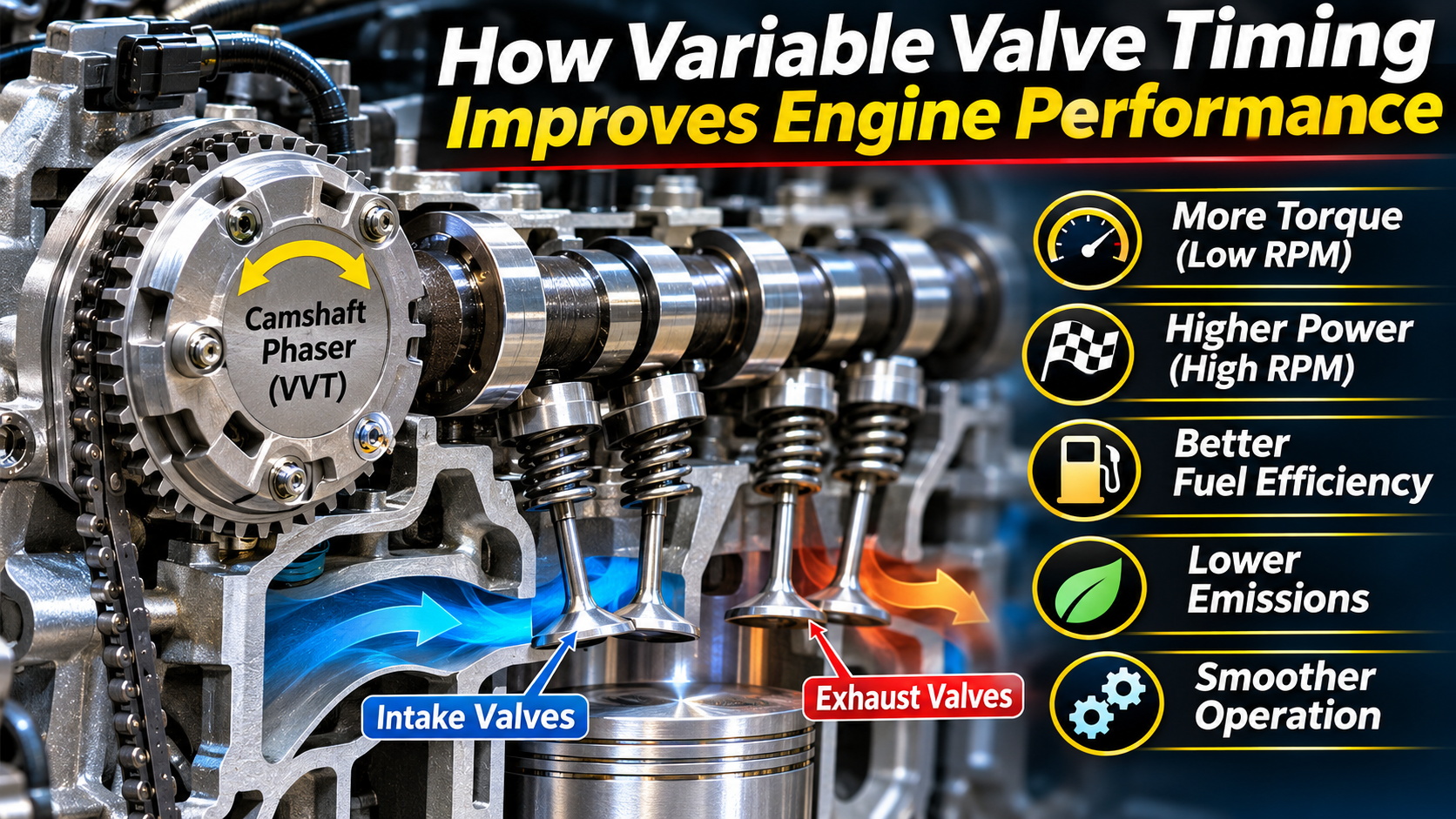
Many modern VVT engines use hydraulic camshaft phasers. These mechanisms can rotate the camshaft slightly relative to its timing sprocket, advancing or retarding valve events without changing the camshaft’s basic lobe shape.
The engine control unit (ECU) calculates the required valve timing using information from sensors monitoring engine speed, load, temperature, and camshaft position.
A typical hydraulic VVT system operates through the following process:
- Engine monitoring: Sensors collect information about current operating conditions.
- ECU calculation: The engine computer determines the desired camshaft timing.
- Oil pressure regulation: An electronically controlled valve directs pressurized engine oil to the camshaft phaser.
- Camshaft adjustment: Hydraulic pressure advances or retards the camshaft relative to the crankshaft.
- Feedback correction: Camshaft position sensors help the ECU confirm that the requested timing has been achieved.

How VVT Improves Engine Performance
1. Stronger Torque at Low Engine Speeds
At lower RPM, the movement of intake air differs significantly from what occurs at high engine speeds. If the intake valves close too late, some of the incoming charge may flow back toward the intake manifold.
By selecting suitable intake-valve timing, an engine can improve charge retention and cylinder filling. This helps generate useful low-speed torque, improving everyday acceleration and drivability.
2. More Power at High RPM
At higher speeds, the engine must move large volumes of air through its cylinders in a very short time.
Optimized intake-valve closing can take advantage of the momentum of the incoming air, improving the amount of charge retained inside each cylinder. Suitable exhaust-valve timing can also improve the removal of combustion gases.
Better gas exchange can increase volumetric efficiency, helping an engine maintain stronger horsepower at higher RPM.
3. Improved Fuel Efficiency
Variable Valve Timing can reduce the energy wasted when an engine draws air through a partially closed throttle.
At certain operating points, valve timing can be adjusted to reduce pumping losses or support more efficient combustion. Some engine designs also use controlled intake-valve closing as part of an Atkinson-cycle or Miller-cycle strategy.
The size of the fuel economy improvement depends on engine architecture, calibration, driving conditions, and the other technologies installed.
4. Lower Exhaust Emissions
VVT can also influence valve overlap, the period when the intake and exhaust valves are open simultaneously.
Carefully controlling overlap can help manage residual exhaust gases within the cylinder. Under suitable conditions, internal exhaust-gas recirculation can reduce combustion temperatures and nitrogen oxide formation.
Optimized valve timing can also support more stable combustion and lower hydrocarbon emissions, although the results depend on operating conditions and engine design.
5. Smoother Idling and Better Throttle Response
Valve timing suitable for maximum power may produce unstable combustion at idle.
Modern VVT systems can select different timing settings during idling, cruising, and acceleration. This flexibility can improve idle stability, responsiveness, and the overall driving experience.
Understanding Valve Timing and Valve Overlap

The timing diagram demonstrates that valve operation does not always correspond exactly with the piston reaching top dead center or bottom dead center.
For example, an intake valve may open before the piston begins its intake stroke and remain open after it reaches bottom dead center. These events are influenced by airflow momentum and pressure differences.
In a fixed-timing engine, the relationship remains the same at every RPM. With camshaft-phasing VVT, the valve events can be shifted to match the engine’s operating requirements.
Major Variable Valve Technologies
Honda VTEC and i-VTEC
Honda’s VTEC system uses different cam profiles to provide different valve lift, duration, and timing characteristics. Traditional high-performance VTEC designs switch between cam profiles suitable for lower and higher engine speeds.
Some i-VTEC implementations combine VTEC with continuously adjustable camshaft phasing, giving the engine greater control over its valve operation.

Toyota VVT-i
Toyota’s Variable Valve Timing with intelligence (VVT-i) system adjusts camshaft timing to improve engine performance and efficiency across different operating conditions.
Depending on the engine, Toyota may use variable timing on the intake camshaft or both intake and exhaust camshafts. More advanced implementations, including VVT-iE, can use electric actuation for selected camshafts.

BMW VANOS and Valvetronic
BMW’s VANOS technology changes camshaft timing, while its Valvetronic system varies intake-valve lift.
On engines equipped with both technologies, this combination allows greater flexibility in controlling airflow, combustion characteristics, and engine responsiveness.
Valvetronic can also reduce reliance on the traditional throttle valve during normal operation, helping reduce pumping losses.
Fixed Valve Timing vs. Variable Valve Timing
| Feature | Fixed Valve Timing | Variable Valve Timing |
|---|---|---|
| Camshaft timing | Fixed | Adjustable |
| Low-speed torque | Compromise calibration | Can be optimized |
| High-speed power | Compromise calibration | Can be optimized |
| Fuel efficiency | Less adaptable | Potentially improved |
| Emissions control | Limited flexibility | Greater flexibility |
| Mechanical complexity | Generally lower | Generally higher |
Can Variable Valve Timing Systems Fail?
Although VVT offers significant engineering advantages, its additional components also require proper maintenance.
Hydraulically controlled camshaft phasers depend on suitable engine oil pressure and oil flow. Low oil pressure, contaminated oil, a faulty oil control valve, or mechanical wear can interfere with their operation.
Possible symptoms of a VVT-related problem include:
- Rough or unstable engine idling.
- Reduced acceleration or engine performance.
- Increased fuel consumption.
- Unusual rattling sounds from the timing system.
- An illuminated check-engine warning light.
These symptoms are not exclusive to VVT faults, so proper diagnostic testing is necessary before replacing components.
The Future of Variable Valve Technology
Engine manufacturers continue to develop more advanced control systems that can adjust valve lift, timing, and duration over wider operating ranges.
Some approaches use electromechanical or electrohydraulic valve actuation rather than relying entirely on conventional camshaft mechanisms.
Such technologies offer opportunities for more precise airflow management, although complexity, manufacturing cost, energy consumption, and long-term reliability remain important considerations.
Variable valve control also remains useful in hybrid vehicles, where combustion engines may operate under carefully selected efficiency-focused conditions.
Conclusion
Variable Valve Timing is an important advancement in internal combustion engine engineering. By allowing valve timing to change with engine operating conditions, VVT can deliver stronger low-speed torque, improved high-RPM performance, better fuel efficiency, and more effective emissions management.
Rather than forcing an engine to operate with one fixed valve-timing compromise, VVT gives manufacturers the flexibility to optimize performance over a much wider range of driving conditions.
For modern gasoline engines, that flexibility is a major contributor to the balance between performance and efficiency.