
Views: 0
Bugatti Bolide: Engineering a Track-Only Hypercar

The Bugatti Bolide represents one of the most ambitious engineering achievements in modern hypercar development. Powered by Bugatti’s legendary 8.0-liter quad-turbocharged W16 engine, it abandons the compromises of everyday road use in favor of extreme circuit performance.
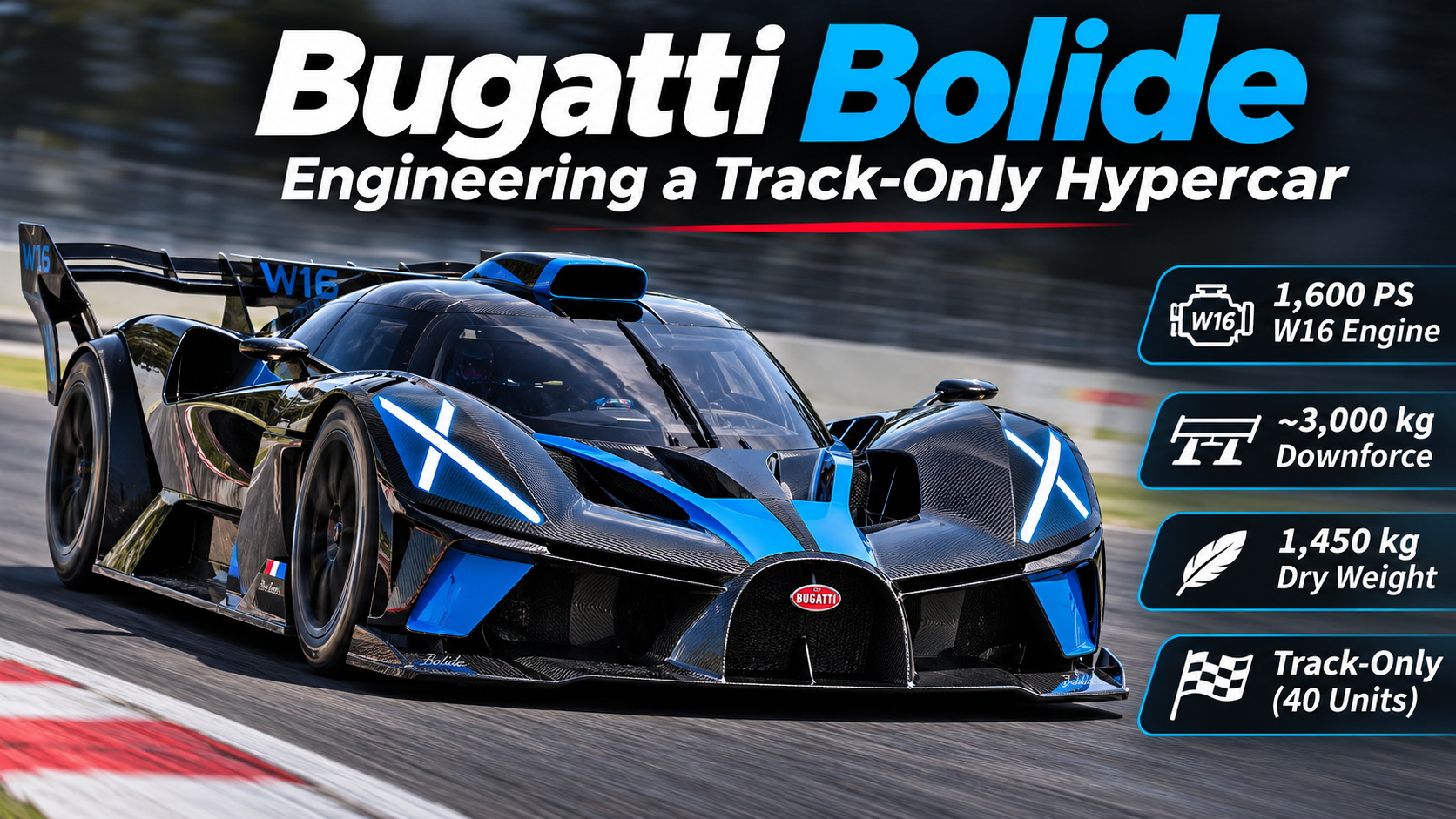
Originally unveiled as an experimental concept in 2020, the Bolide evolved into an exclusive track-only production model. With 1,600 PS, an advanced carbon-fiber structure, extensive aerodynamic engineering and racing-derived braking technology, it demonstrates how far Bugatti could push its celebrated W16 platform.
Bugatti Bolide: Technical Specifications

| Engine | 8.0-liter quad-turbocharged W16 |
|---|---|
| Maximum power | 1,600 PS (1,578 hp) |
| Maximum torque | 1,600 Nm |
| Engine layout | Mid-mounted W16 |
| Drivetrain | All-wheel drive |
| Dry weight | 1,450 kg |
| Chassis | Carbon-fiber monocoque |
| Braking system | Brembo carbon-carbon |
| Tires | Michelin Pilot Sport racing slicks |
| Downforce | Nearly 3,000 kg at maximum speed |
| Production | 40 examples |
| Road legal | No — track-only |
1. The W16 Engine: A Powerhouse Reengineered
At the heart of the Bugatti Bolide is the remarkable 8.0-liter W16 engine, equipped with four turbochargers. In production specification, it develops 1,600 PS at 7,000 rpm and delivers 1,600 Nm of torque.
Unlike a conventional road-going hypercar, the Bolide must operate under sustained racing conditions. Frequent acceleration, repeated heavy braking and prolonged high engine loads demand exceptional reliability and thermal management.
Bugatti therefore optimized the powertrain’s cooling and associated systems for circuit driving. Its engineers prioritized consistent performance across repeated laps rather than concentrating exclusively on maximum straight-line speed.
The original Bolide concept promised up to 1,850 PS using specialized 110-octane fuel. The production model uses a 1,600 PS specification compatible with 98 RON fuel, providing a more practical solution for customers operating the car at racing circuits.
2. Extreme Aerodynamics and Downforce
Aerodynamics are central to the Bolide’s engineering philosophy. The dramatic front splitter, sculpted airflow channels, expansive rear wing and sophisticated diffuser work together to generate substantial aerodynamic loads.
Bugatti reports that the production Bolide can develop almost 3,000 kg of downforce at maximum speed. This aerodynamic force presses the car toward the track, improving tire grip and allowing higher cornering speeds.
However, generating enormous downforce introduces challenges. The aerodynamic balance must remain predictable during acceleration, braking and rapid changes of direction.
To address these demands, Bugatti used extensive computational simulations followed by real-world circuit testing. Engineers refined airflow management and aerodynamic balance to develop a car that can exploit its considerable performance potential while remaining manageable for its driver.
3. Carbon-Fiber Construction and Safety
Low weight is essential for a machine designed to accelerate, brake and corner at extraordinary speeds. The Bolide uses an advanced carbon-fiber monocoque engineered for exceptional structural rigidity.
Bugatti collaborated with motorsport engineering specialist Dallara on the car’s structural development, drawing on principles associated with modern endurance racing.
The chassis was designed to withstand demanding loads, including rollover scenarios. Its configuration incorporates a low seating position and an ergonomically optimized cockpit.
Despite its competition-oriented character, the Bolide includes electronic driver assistance, power steering and climate control. These systems help make the demanding driving experience more accessible without changing the vehicle’s track-only purpose.
4. Carbon-Carbon Racing Brakes
With 1,600 PS available, slowing the Bolide is as important as accelerating it. Bugatti worked with Brembo to develop an extraordinary carbon-carbon braking system derived from high-level motorsport technology.
Carbon-carbon brakes are especially suited to extreme circuit operation because they can withstand very high operating temperatures and repeated energy-intensive braking events.
This technology requires careful integration with brake cooling, aerodynamic design and vehicle dynamics. The system helps the Bolide deliver consistent stopping performance during intensive track sessions.
5. Track-Focused Chassis and Handling

The Bolide’s handling capabilities result from the interaction of its suspension, all-wheel-drive system, electronic differentials, specialized Michelin racing slicks and immense aerodynamic loading.
The vehicle must respond precisely to driver inputs while managing substantial mechanical and aerodynamic forces.
Engineers focused on delivering effective power distribution, predictable cornering responses and stability under high-speed braking. This integrated approach is essential because outright horsepower alone cannot produce competitive circuit performance.
6. From Experimental Concept to Limited Production
When Bugatti presented the original Bolide concept in 2020, it was intended to demonstrate the ultimate potential of the W16 engine in an uncompromising lightweight track machine.
Customer interest encouraged Bugatti to transform the experimental project into a limited-production vehicle. Production was restricted to 40 examples, making the Bolide one of the brand’s most exclusive modern creations.
The production version required extensive redevelopment and validation, including changes to its structure, cooling systems, powertrain calibration, aerodynamics and safety engineering.
By 2025, Bugatti had completed the Bolide production program, marking the conclusion of an extraordinary chapter in the company’s W16 history.
7. Why the Bugatti Bolide Matters
The Bugatti Bolide is more than a demonstration of extraordinary horsepower. It highlights the complexity of engineering a hypercar capable of repeatedly performing at extremely high levels on a racing circuit.
Its achievement comes from integrating advanced aerodynamics, high-performance combustion engineering, lightweight composites, specialized braking systems and carefully developed vehicle dynamics.
Where the Chiron established new benchmarks for road-going speed and luxury, the Bolide explores the performance possibilities of Bugatti engineering when the racetrack becomes the sole priority.
Conclusion
The Bugatti Bolide stands as an extraordinary expression of modern hypercar engineering. Its 1,600 PS W16 engine, lightweight carbon-fiber chassis, substantial downforce and sophisticated motorsport technology create a machine designed specifically for extreme circuit driving.
More importantly, the Bolide celebrates the engineering legacy of Bugatti’s iconic W16 engine, demonstrating how an exceptional powertrain can evolve into the centerpiece of a dedicated racing machine.
Sources and Further Reading
- Bugatti Newsroom — Bolide Model Archive
- Bugatti — Bolide Safety Engineering
- Bugatti — Carbon-Carbon Braking Technology
- Bugatti — Aerodynamic Testing
Image credits: Calreyn88 / Wikimedia Commons. Images distributed under the Creative Commons CC0 1.0 public-domain dedication.