
Views: 5
BIN3AIAH CARS | ITALIAN HYPERCARS
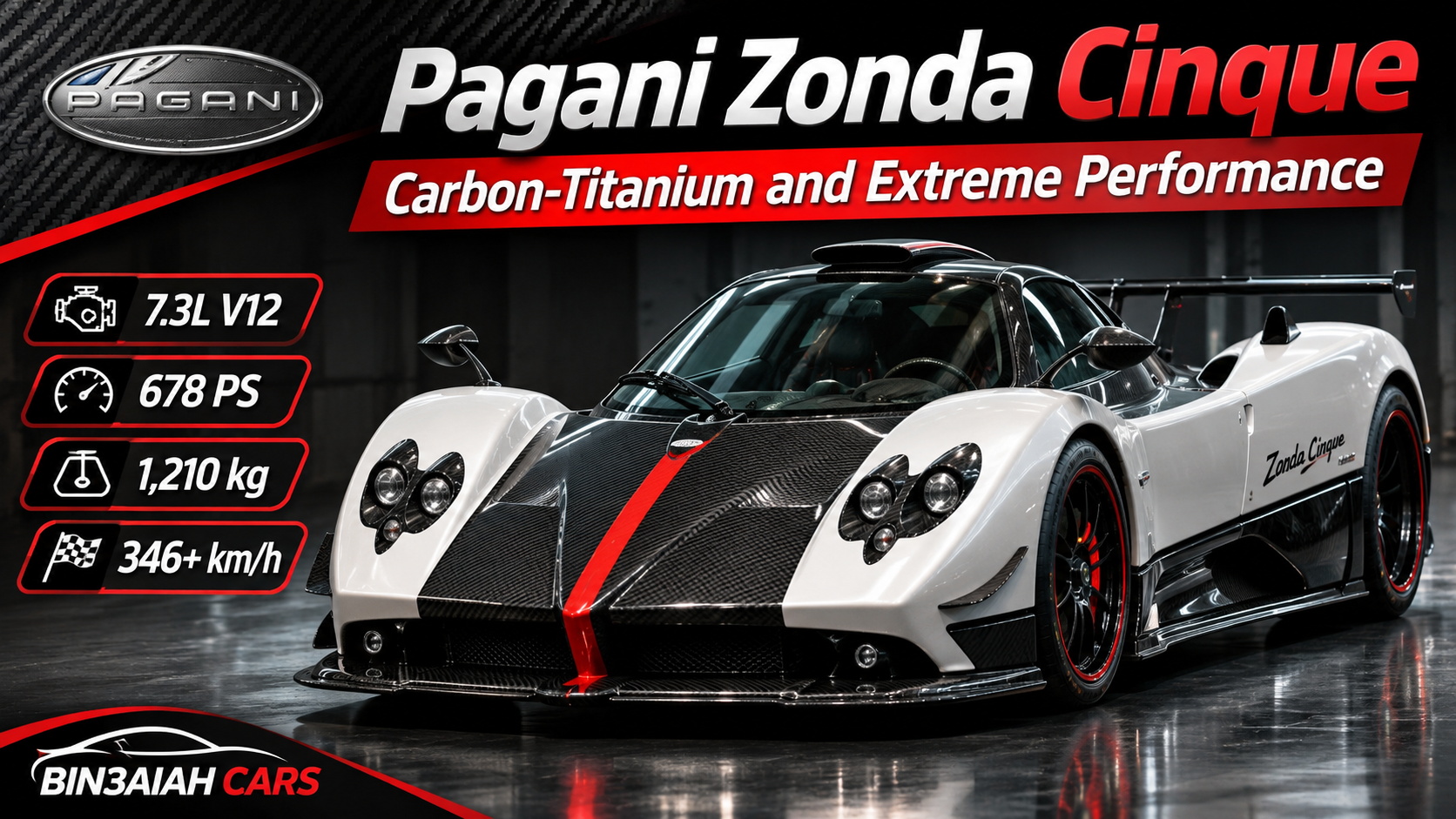
Pagani Zonda Cinque: Carbon-Titanium and Extreme Performance
Five extraordinary coupés. A naturally aspirated AMG V12. An innovative carbon-titanium chassis. One of the most exclusive creations in Pagani history.

The Pagani Zonda Cinque represents an extraordinary chapter in Italian automotive engineering. Combining exotic materials, motorsport-inspired aerodynamics and a powerful naturally aspirated Mercedes-AMG V12, the Cinque brought the character of a racing machine to a road-legal hypercar.
Its name means five in Italian, reflecting the exceptionally limited production of just five coupés. The project demonstrated how advanced engineering and handcrafted luxury could coexist in a single automobile.
Performance at a Glance
1. The Origins of the Pagani Zonda Cinque
The Cinque originated from a special request by Pagani’s Hong Kong dealer for an exceptionally capable road-going Zonda. Presented at the 2009 Geneva Motor Show, it incorporated engineering ideas associated with the track-focused Zonda R.
Rather than simply increasing engine output, Pagani focused on structural materials, weight reduction, aerodynamic efficiency and the overall driving experience.
2. Carbon-Titanium: A Revolution in Materials

The defining innovation of the Cinque was its carbon-titanium monocoque. This composite technology integrates titanium into a carbon-fibre-based material to achieve desirable structural properties without excessive weight.
A lightweight, rigid structure helps engineers maintain precise suspension geometry and improve the responsiveness of a high-performance vehicle.
Advantages of Carbon-Titanium Technology
- Excellent strength-to-weight characteristics.
- Improved structural rigidity.
- Potential for reduced vehicle mass.
- A strong foundation for precise handling.
- Advanced composite manufacturing technology.
3. The Naturally Aspirated Mercedes-AMG V12
Behind the passenger compartment sits a 7.3-litre Mercedes-AMG V12. Without turbochargers or hybrid assistance, this engine delivers 678 metric horsepower, equivalent to approximately 669 mechanical horsepower, and 780 Nm of torque.
Its naturally aspirated configuration is central to the Cinque’s personality. Direct throttle response, mechanical character and an unmistakable exhaust note make the engine an essential part of the driving experience.
Pagani also used an exotic Inconel and titanium exhaust system to combine thermal resistance with reduced weight.
4. Motorsport-Inspired Aerodynamics
Every major aerodynamic surface contributes to the Cinque’s high-speed capabilities. Its aggressive appearance is closely connected to the practical demands of airflow management, cooling and stability.
- Extended front splitter for aerodynamic load.
- Adjustable rear wing for aerodynamic balance.
- Revised underbody and rear diffuser.
- Roof-mounted engine air intake.
- Additional openings for cooling airflow.
Pagani reports approximately 750 kg of aerodynamic load at speeds above 300 km/h. This illustrates the importance of aerodynamics alongside engine performance in extreme hypercars.
5. Transmission, Suspension and Braking
The Cinque introduced a six-speed automated sequential transmission to the Zonda family. Steering-wheel-mounted controls allow the driver to manage gear changes while maintaining focus on the road.
Lightweight suspension components, specialised Pirelli tyres and Brembo carbon-ceramic brakes complement the vehicle’s powerful engine and lightweight construction.
6. Complete Technical Specifications
| Specification | Pagani Zonda Cinque |
|---|---|
| Manufacturer | Pagani Automobili |
| Country | Italy |
| Introduction | 2009 Geneva Motor Show |
| Body Style | Two-door coupé |
| Engine | Mercedes-AMG 7.3L V12 |
| Aspiration | Naturally aspirated |
| Power | 678 PS / 669 hp / 499 kW |
| Torque | 780 Nm |
| Transmission | 6-speed automated sequential |
| Drivetrain | Rear-wheel drive |
| Chassis | Carbon-titanium monocoque |
| Dry Weight | 1,210 kg |
| Power-to-Weight Ratio | Approximately 560 PS/tonne (dry) |
| 0–100 km/h | 3.4 seconds |
| 0–200 km/h | 9.6 seconds |
| Claimed Top Speed | Over 350 km/h |
| Braking System | Brembo carbon-ceramic |
| Brake Disc Diameter | 380 mm front and rear |
| Lateral Acceleration | Up to 1.45 g (manufacturer claim) |
| Front Tyres | 255/35 R19 |
| Rear Tyres | 335/30 R20 |
| Coupé Production | 5 units |
| Production Status | Discontinued |
7. Interior Design and Craftsmanship
Inside, the Zonda Cinque combines the functional atmosphere of a racing cockpit with the individuality of a handcrafted luxury automobile.
Exposed composites, metallic controls, leather upholstery and lightweight sports seats establish a distinctive environment. Four-point harnesses and structural reinforcement further reflect its motorsport-inspired development.
8. Pagani Zonda Cinque Roadster

Pagani subsequently developed the Cinque Roadster, offering an open-air interpretation of the original concept. Its structure was adapted to accommodate a removable roof. The naturally aspirated V12 and principal performance figures remained closely aligned with those of the coupé.
Production of the Roadster was also limited to five examples, bringing the combined production of the two Cinque body styles to only ten cars.
9. Exclusivity and Collectability
The Cinque’s appeal extends beyond its acceleration figures. Its limited production, bespoke construction, naturally aspirated engine and role in the development of advanced automotive composites make it particularly desirable among collectors.
Each example represents a rare opportunity to experience Pagani’s distinctive approach to automotive design during the Zonda era.
10. Pagani Zonda Cinque Photo Gallery


Gallery credits: MrWalkr (CC BY-SA 4.0), Dr.emmettbrown (CC BY-SA 3.0) and Y.Leclercq (CC BY-SA 4.0). Gallery previews are visually cropped. Click each picture to access its original file and licence.
Explore more Pagani Zonda Cinque photographs
11. Frequently Asked Questions
How many Pagani Zonda Cinque cars were made?
Five coupés and five roadsters were produced.
What engine does the Zonda Cinque use?
A naturally aspirated 7.3-litre Mercedes-AMG V12.
Is the Pagani Zonda Cinque road legal?
Yes. It was developed as a road-going hypercar with motorsport-inspired engineering.
What is special about its chassis?
It introduced carbon-titanium monocoque technology to road-going automobiles.
How fast is the Pagani Zonda Cinque?
Its claimed top speed exceeds 350 km/h, while 0–100 km/h takes 3.4 seconds.
Conclusion
The Pagani Zonda Cinque is more than an exceptionally rare Italian hypercar. It is an example of how materials science, aerodynamic development, mechanical performance and artistic craftsmanship can shape an extraordinary automobile.
Its carbon-titanium construction and naturally aspirated AMG V12 ensure that the Cinque occupies a distinctive position in the history of Pagani and the wider hypercar world.