
Views: 4
BIN3AIAH CARS | AUTOMOTIVE LEGENDS
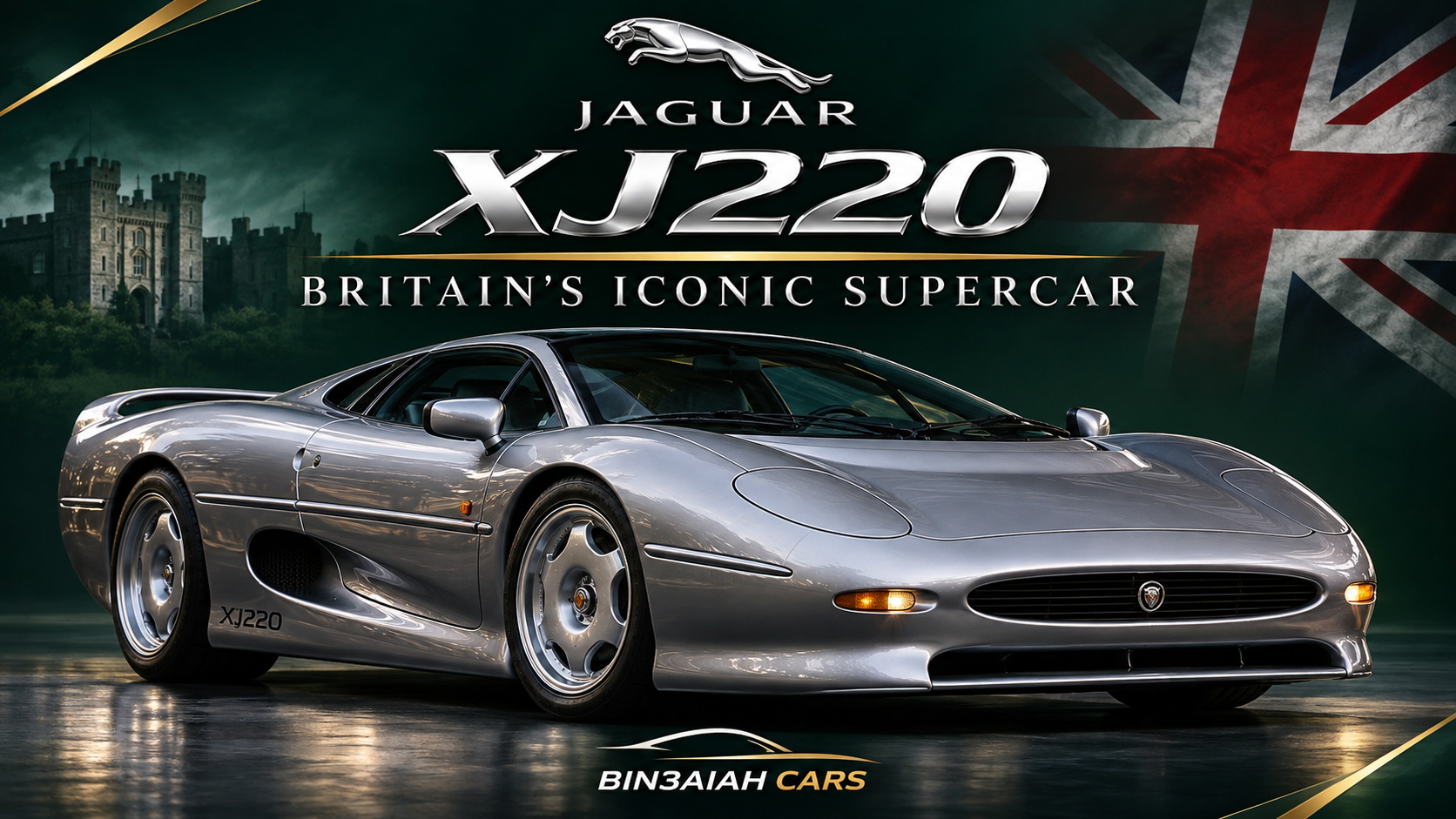
Jaguar XJ220: The History of Britain’s Iconic Supercar
1992–1994 | Twin-Turbo V6 | British Engineering

The Jaguar XJ220 represents one of the most extraordinary chapters in British automotive history. Combining dramatic styling, motorsport-inspired engineering and remarkable straight-line performance, the XJ220 challenged the world’s most exclusive supercars during the early 1990s.
Although its journey from concept to production was controversial, the XJ220 eventually became a celebrated symbol of Jaguar’s engineering ambition and a defining supercar of its generation.
Performance Highlights
Maximum Power
Special Test Speed
0–60 mph
Twin-Turbo V6
1. The Birth of the Jaguar XJ220
The origins of the XJ220 date back to the 1980s, when a small group of Jaguar engineers began working on an ambitious high-performance vehicle outside their normal development duties.
Known as the Saturday Club, the team envisioned a road-going supercar that would demonstrate Jaguar’s technological capabilities and reconnect the company with its racing heritage.
The resulting concept was unveiled at the 1988 British International Motor Show in Birmingham. Its futuristic appearance and ambitious performance targets generated enormous public interest.
The XJ220 designation referred to the project’s original target of approximately 220 miles per hour.
2. From V12 Concept to Twin-Turbo V6
The original concept featured a naturally aspirated V12 engine and an advanced four-wheel-drive system. However, Jaguar substantially revised the engineering package before production.
Working with Tom Walkinshaw Racing, Jaguar adopted a more compact 3.5-litre twin-turbocharged V6 derived from motorsport technology. Power was delivered exclusively to the rear wheels through a five-speed manual transmission.
The revised configuration helped Jaguar manage vehicle weight, packaging and performance requirements, although some prospective customers were disappointed by the departure from the original concept.

3. Technical Specifications
| Specification | Jaguar XJ220 |
|---|---|
| Manufacturer | JaguarSport |
| Country of origin | United Kingdom |
| Production period | 1992–1994 |
| Body style | Two-door supercar coupé |
| Engine | 3.5-litre twin-turbocharged V6 |
| Maximum power | 550 PS (542 bhp / 405 kW) |
| Maximum torque | Approximately 644 Nm |
| Transmission | 5-speed manual |
| Engine layout | Rear mid-engine |
| Drivetrain | Rear-wheel drive |
| 0–60 mph | Approximately 3.6 seconds (claimed) |
| Standard top speed | Approximately 343 km/h (213 mph) |
| Special high-speed test | Approximately 349 km/h (217.1 mph) |
| Construction | Aluminium honeycomb structure and aluminium bodywork |
| Production volume | 275 according to Jaguar; 281 according to Jaguar Daimler Heritage Trust |
| Production status | Discontinued |
4. Extraordinary Performance and Speed Records
During the early 1990s, the Jaguar XJ220 established itself as a leader in the international supercar market. Its turbocharged engine, streamlined bodywork and aerodynamic development enabled exceptional high-speed performance.
In 1992, racing driver Martin Brundle achieved approximately 217.1 mph at the Nardò test facility in Italy using a specially configured XJ220. The catalytic converters had been removed for the run, meaning this result should be distinguished from the standard production specification.
With a standard top speed of approximately 213 mph, the XJ220 earned recognition as the world’s fastest production car of its era before being eclipsed by the McLaren F1.
5. Aerodynamic Design

The XJ220 remains instantly recognizable thanks to its elongated body, low roofline and exceptionally wide stance. Its design emphasized airflow management rather than excessive decorative elements.
- Low and streamlined front bodywork.
- Concealed headlamp design.
- Large side air intakes for engine cooling.
- Carefully developed underbody aerodynamics.
- Long, flowing rear bodywork.
- Lightweight aluminium construction.
These features created an elegant appearance while contributing to the stability required for sustained high-speed driving.
6. Interior and Driving Experience

Unlike contemporary supercars that emphasized minimalist racing interiors, the XJ220 combined high performance with traditional Jaguar luxury.
Its cabin featured leather upholstery, analogue instruments and a conventional manual gear lever. The low seating position and direct mechanical controls contributed to an engaging driving experience.
Without the sophisticated electronic driving systems found in modern supercars, the XJ220 demanded considerable respect from its driver, particularly when the turbochargers delivered their full boost.
7. Production Challenges and Commercial History
Customer cars were manufactured in Bloxham, Oxfordshire, through JaguarSport, the partnership between Jaguar and Tom Walkinshaw Racing.
Unfortunately, the production launch coincided with a downturn in the exotic-car market. Economic uncertainty, changing customer expectations and disappointment over the revised engine configuration contributed to weaker demand.
Production ended in 1994. Jaguar’s official historical announcement records 275 completed vehicles, while the Jaguar Daimler Heritage Trust gives a total of 281.
Regardless of the counting differences between sources, the XJ220 remains a rare and historically significant automobile.
8. Jaguar XJ220-C and Motorsport

Jaguar’s motorsport ambitions led to the development of the XJ220-C competition model. Adapted for racing, it featured extensive modifications to its bodywork, aerodynamics and mechanical components.
The XJ220-C competed at the 1993 24 Hours of Le Mans. One example crossed the finish line first in its GT category but was subsequently disqualified following a technical eligibility dispute.
Despite the controversial result, the programme reinforced the close relationship between the XJ220 and Jaguar’s racing heritage.
9. Jaguar XJ220-S
The XJ220-S was an exceptionally rare road-going derivative developed by TWR with stronger links to the competition programme.
It featured revised aerodynamic components, lightweight bodywork and increased engine output. Its more aggressive character made it a particularly desirable variation of the original XJ220.
10. The Supercar Rivals of the 1990s
The XJ220 emerged during an extraordinary period of automotive development. Its contemporaries included several of the most influential supercars ever produced.
| Supercar | Engine | Power |
|---|---|---|
| Jaguar XJ220 | 3.5L Twin-Turbo V6 | 550 PS |
| Ferrari F40 | 2.9L Twin-Turbo V8 | 478 PS |
| Bugatti EB110 GT | 3.5L Quad-Turbo V12 | 560 PS |
| Porsche 959 | 2.85L Twin-Turbo Flat-6 | 450 PS |
| McLaren F1 | 6.1L Naturally Aspirated V12 | 627 PS |
Figures represent commonly quoted standard model outputs. Special editions may differ.
11. Jaguar XJ220 Photo Gallery


Gallery photographs are sourced from Wikimedia Commons. Each photograph links to its original file page containing the creator and applicable licence. Retain all required attribution when republishing.
12. Watch the Jaguar XJ220 in Action
Explore the XJ220 through automotive documentaries and driving videos:
▶ Jaguar XJ220 — Classics with History
13. The Jaguar XJ220 Legacy
The reputation of the Jaguar XJ220 has evolved considerably since its introduction. What was once considered a commercially troubled project is now recognized as an extraordinary engineering achievement.
Its limited production, timeless styling, analogue driving experience and exceptional performance have secured its position among the most significant supercars of the twentieth century.
More than simply a fast Jaguar, the XJ220 represents a period when manufacturers pursued ambitious mechanical solutions and attempted to redefine the limits of road-car performance.
Frequently Asked Questions
Why is it called the Jaguar XJ220?
The designation reflected its original engineering target of 220 mph.
How fast is the Jaguar XJ220?
Its standard top speed was approximately 213 mph, while a specially configured example achieved 217.1 mph during testing.
Does the Jaguar XJ220 have a V12 engine?
The 1988 concept featured a V12. The production version used a 3.5-litre twin-turbocharged V6.
How many Jaguar XJ220 cars were built?
Jaguar reports 275 units, while the Jaguar Daimler Heritage Trust records 281.
Is the Jaguar XJ220 still manufactured?
No. Production ended in 1994.
Conclusion
The Jaguar XJ220 stands as one of Britain’s most remarkable automotive creations. Its controversial development, remarkable speed and unmistakable design make it an essential part of global supercar history.
It remains a lasting symbol of British engineering ambition.