
Views: 0
The Engineering Behind Modern Hypercar Braking Systems
Automotive Engineering | Hypercar Technology | Performance & Innovation
Modern hypercars are engineered to accelerate from 0 to 100 km/h in just a few seconds and reach speeds exceeding 350 km/h. However, achieving extraordinary speed is only half the engineering challenge. Bringing these machines to a controlled stop requires equally advanced technology.
From carbon-ceramic brake discs to sophisticated electronic control systems and aerodynamic braking, modern hypercars combine mechanical engineering, materials science, and computer-controlled technology to deliver exceptional stopping performance.


8
1. Carbon-Ceramic Brakes: The Foundation of Hypercar Stopping Power
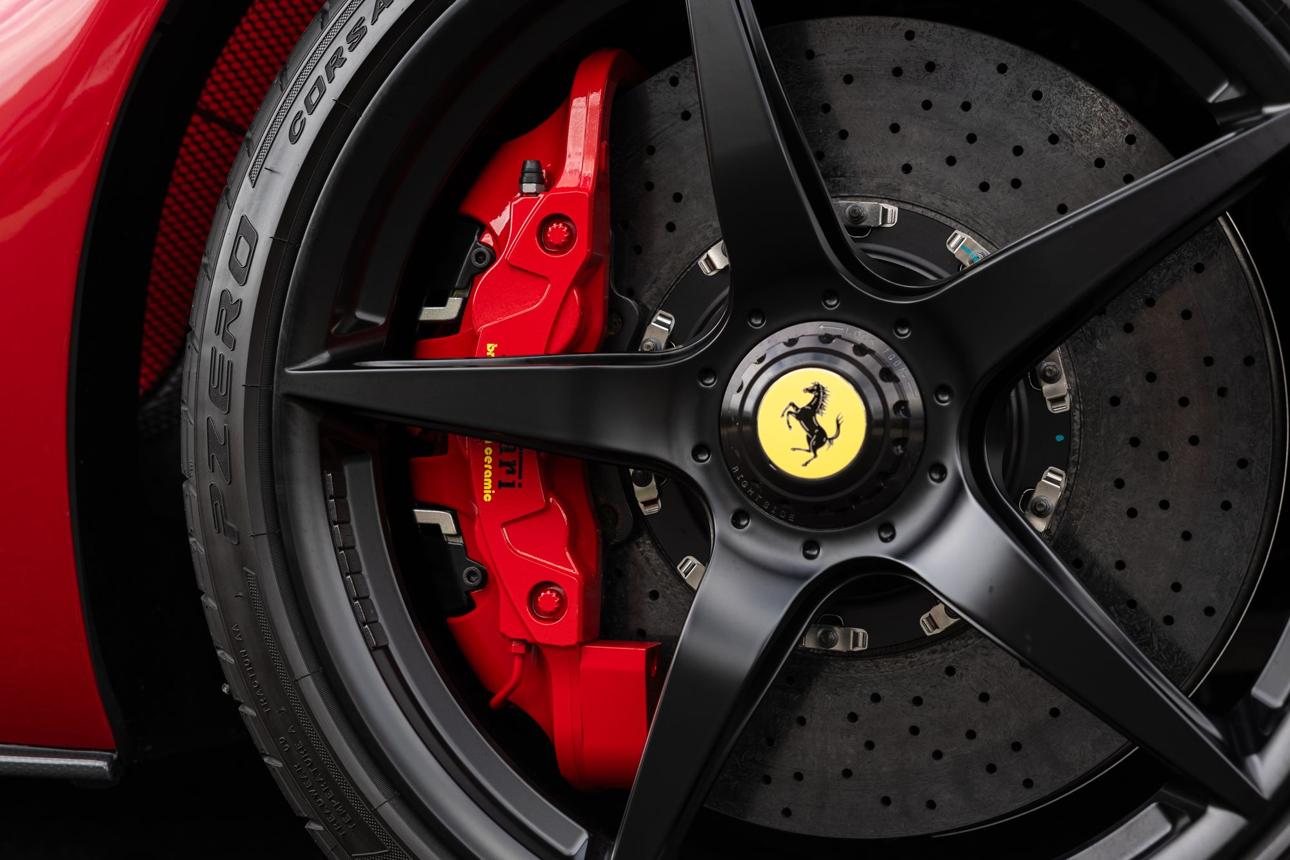
Most modern high-performance hypercars use carbon-ceramic brake discs rather than conventional cast-iron rotors.
These discs typically consist of carbon-fiber-reinforced silicon carbide, combining low weight with exceptional heat resistance.
Key advantages include:
- High resistance to brake fade during repeated heavy braking.
- Lower weight than comparable cast-iron discs, reducing unsprung and rotating mass.
- Excellent durability under suitable operating conditions.
- Strong performance across a wide temperature range when paired with appropriate brake pads.
Carbon-ceramic systems can operate at extremely high temperatures, although their exact limits depend on the material, pad compound, and cooling design.

2. The Physics of Stopping a Hypercar
Braking involves converting a moving vehicle’s kinetic energy into heat and, in hybrid or electric vehicles, potentially recovering part of that energy through regenerative braking.
The kinetic energy equation is:
\[ E_k=\frac{1}{2}mv^2 \]
Because speed is squared, doubling a vehicle’s speed increases its kinetic energy by four times.
Consider a hypothetical 1,800 kg hypercar:
Kinetic energy at different speeds
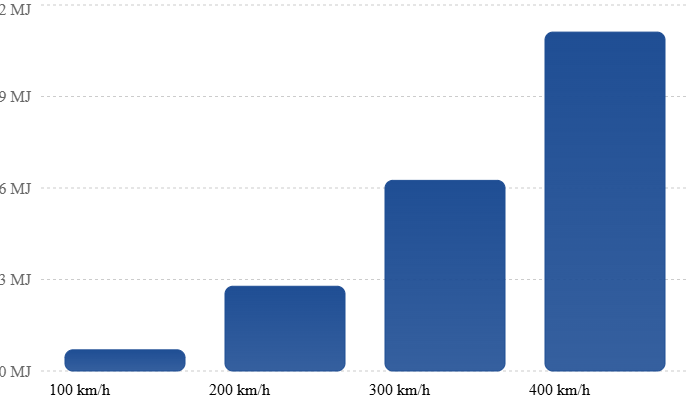
Illustrative calculation for a 1,800 kg vehicle; excludes rotational energy and other effects.
At 400 km/h, the vehicle carries approximately 11.1 megajoules of kinetic energy. A large proportion of this energy must be dissipated by the braking system during a hard stop, with aerodynamic drag and other resistances also contributing.
This explains why heat management is central to hypercar brake engineering.
3. Multi-Piston Brake Calipers

Hypercar brake calipers are commonly manufactured from high-strength aluminum alloys, using rigid monobloc or multi-piece constructions.
Many systems employ six-piston front calipers and four-piston rear calipers, although configurations vary significantly.
Multiple pistons help distribute clamping force across large brake pads, while caliper rigidity improves pedal consistency and pressure control.
Braking performance ultimately depends on the combined behavior of hydraulic pressure, friction materials, effective disc radius, tires, and road conditions—not simply the number of pistons.
4. Aerodynamic Braking: Using Air Resistance
Some hypercars use active aerodynamic components to improve stability and increase drag during braking.

McLaren P1
Its active rear wing can rise into an airbrake position to increase drag and rear downforce.

Bugatti Veyron
Its rear wing changes position under braking, contributing to deceleration and vehicle stability.
Aerodynamic braking becomes especially useful at very high speeds because aerodynamic drag increases approximately with the square of vehicle speed.
The resulting aerodynamic power dissipation increases approximately with the cube of speed, making air resistance particularly influential during high-speed deceleration.
5. Intelligent ABS and Brake-by-Wire Systems
Modern hypercars increasingly rely on sophisticated electronic braking systems.
Advanced anti-lock braking systems (ABS) monitor individual wheel speeds and adjust hydraulic pressure to reduce wheel lockup.
Brake-by-wire technology can interpret the driver’s braking request electronically, coordinating hydraulic braking with regenerative braking and other vehicle systems.
The advantages can include more precise brake-force distribution, consistent pedal response, and improved integration with stability control.
However, ABS cannot overcome the fundamental limits of tire grip.
6. Regenerative Braking in Hybrid and Electric Hypercars

Hybrid and electric hypercars introduce an additional braking capability: using electric motors as generators to recover kinetic energy.
Vehicles such as the Ferrari SF90 Stradale integrate electrified propulsion with advanced braking controls.
During deceleration, electric motors can generate electricity, which is stored in the battery when operating conditions permit.
The system must balance regenerative braking with conventional friction brakes, particularly during emergency stops, when the battery is full, or when available regeneration is limited.
7. Brake Cooling and Thermal Management

A braking system must do more than generate stopping force. It must repeatedly handle immense thermal loads.
Engineers use several approaches:
- Internal ventilation channels to circulate cooling air.
- Carefully designed ducts that direct airflow toward discs and calipers.
- High-temperature brake fluids and seals.
- Disc and pad materials selected for thermal stability.
- Sensors and thermal modeling to evaluate temperatures under demanding driving conditions.
Without sufficient cooling, excessive heat can cause brake fade, accelerated wear, fluid boiling, or component damage.
8. What Actually Determines Stopping Distance?
Even the most advanced braking hardware cannot guarantee a shorter stop if the tires cannot transmit enough force to the road.
For a simplified constant-deceleration model:
\[ d=\frac{v^2}{2a} \]
Here, \(d\) is braking distance, \(v\) is initial speed, and \(a\) is the magnitude of deceleration.
Interactive braking distance calculator
Idealized model
Initial speed
200 km/h
Constant deceleration
1.1 g
Braking distance
143.0 m
Stopping time
5.15 s
Assumes constant deceleration on level ground, excluding driver reaction time, aerodynamic variation, and real-world tire and road limitations. Not a measured result for any particular hypercar.
9. The Future of Hypercar Braking
Future braking technologies are likely to emphasize smarter energy recovery, more advanced electronic control, improved thermal management, and lighter components.
As electric hypercars become more powerful, engineers must manage the interaction between high-performance friction brakes, regenerative braking, tire traction, and battery constraints.
Conclusion
The engineering behind modern hypercar braking systems is a combination of advanced materials, precise mechanical design, aerodynamics, electronics, and thermal management.
Carbon-ceramic discs withstand demanding thermal conditions, multi-piston calipers deliver controlled clamping force, active aerodynamic systems assist high-speed deceleration, and intelligent electronic systems help manage stability and energy recovery.
A truly exceptional hypercar is not simply one that accelerates quickly—it is one that can repeatedly slow down with precision, stability, and control.
Suggested SEO title: Hypercar Braking Systems Explained: Carbon-Ceramic Brakes, ABS & Aerodynamics Meta description: Discover how modern hypercar braking systems work, from carbon-ceramic discs and multi-piston calipers to active aerodynamics and regenerative braking.