
Views: 2
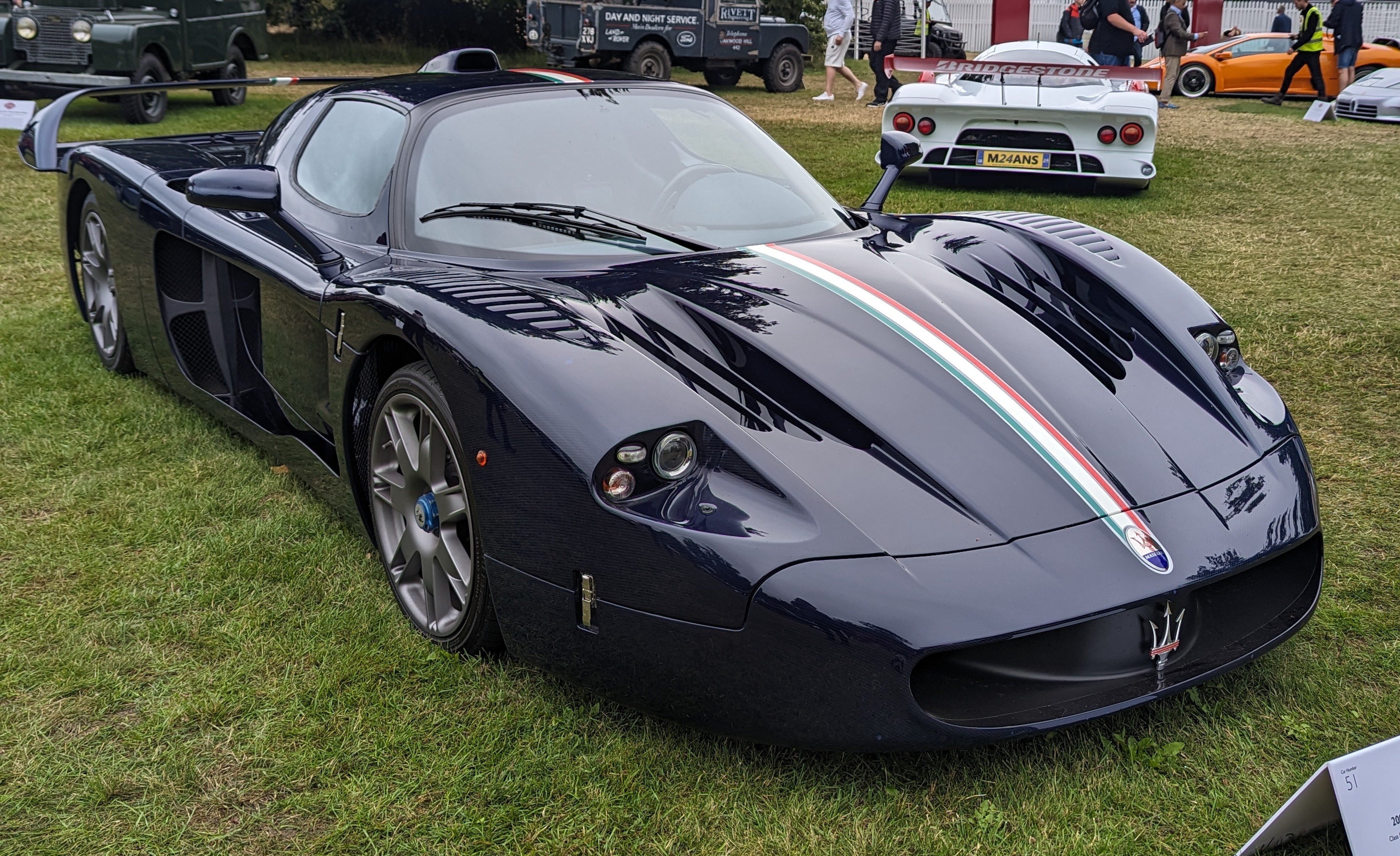
The Maserati MC12 Stradale was introduced in 2004 as the road-going side of a GT homologation programme. Produced in 2004 and 2005, the 50-car Stradale series combined a naturally aspirated V12 with a long-tail body and removable hard top. It should be distinguished from the GT1 racing car and the later Versione Corse track derivative.
Sources: Maserati historical archive.
Specifications
| Specification | Original-model details |
|---|---|
| Introduction | 2004; Geneva motor-show launch material |
| Production/status | 2004–2005; discontinued |
| Body and seating | Two-seat long-tail coupé-spyder; removable hard top |
| Engine | 5,998 cc naturally aspirated 65° V12; 48 valves; dry-sump lubrication |
| Power | 630 CV at 7,500 rpm |
| Torque | 652 Nm at 5,500 rpm |
| Transmission/drivetrain | Six-speed electrohydraulic Cambiocorsa automated manual; paddle shift; rear-wheel drive |
| Acceleration, manufacturer claims | 0–100 km/h: 3.8 s; 0–200 km/h: 9.9 s |
| Top speed, launch claim | Over 330 km/h; historical archive lists 330 km/h |
| Production quantity | 50 Stradale road cars; excludes competition derivatives |
Sources: Maserati — official MC12 historical archive; 2004 Maserati launch brochure — manufacturer document on external host; authenticity not independently authenticated.
Engineering and design
The MC12 drew on Ferrari Enzo technology, but Maserati’s historical archive describes substantial changes to the engine, chassis and aerodynamics. Shared foundations therefore do not make the two cars interchangeable. The MC12’s body and open-roof provision were part of its own road-car configuration, while its development was linked to GT racing requirements.
Sources: Maserati historical archive.
Its monocoque used a carbon-fibre and Nomex sandwich construction, supported by aluminium subframes. In a sandwich structure, outer skins and an internal core work together to provide rigidity. The subframes provide separate supporting structures for attached mechanical components. Together, these components form the car’s lightweight structural foundation.
Sources: Maserati historical archive.
The 5,998 cc V12 had a 65-degree bank angle, 48 valves and dry-sump lubrication. A separate oil reservoir helps support reliable lubrication under demanding loads and gives engineers more freedom over sump depth. The launch brochure rated the engine at 630 CV at 7,500 rpm and 652 Nm at 5,500 rpm. CV is a metric horsepower unit, so the output should not be rewritten as 630 bhp.
Sources: 2004 manufacturer launch brochure.
Power reached the rear wheels through a six-speed Cambiocorsa automated manual with steering-wheel paddles. Electrohydraulic actuation handled the shifting process. This is a different gearbox type from a dual-clutch transmission, even though both can provide paddle-operated changes..
Sources: 2004 manufacturer launch brochure.
Performance in context
Maserati’s launch brochure claimed 0–100 km/h in 3.8 seconds and 0–200 km/h in 9.9 seconds. It described the maximum speed as more than 330 km/h, while the later historical archive gives 330 km/h. Both references point to the Stradale, but the difference in wording is worth preserving rather than turning it into a more precise unsupported figure.
Sources: Launch performance figures; Historical archive.
History, production and variants
The road series was developed for homologation: the production-car connection required by the racing programme. Its 50-car quantity applies to Stradale road cars and should not be expanded by adding competition cars or later track derivatives. The short 2004–2005 production period also belongs specifically to the road model.
Sources: Maserati historical archive.
The GT1 was the competition derivative. The Versione Corse followed in late 2006 as a track-day model, rather than another road Stradale specification. Keeping these identities separate matters both for performance comparisons and for photographs: a racing or track-focused MC12 should be clearly labelled when used to explain the wider programme.
Sources: Maserati historical archive.
Technical relationship
The Ferrari Enzo is relevant as the MC12’s technical basis. That relationship describes engineering ancestry; it does not establish the Enzo as a Maserati model predecessor. The MC12 is best understood here through its own road homologation role and the competition derivatives associated with it.
Sources: Maserati historical archive.
Video
Independent editorial film explicitly featuring the road-going MC12 driven on a circuit, with racing-history context. Title is not a GT1 variant designation. Driving impressions belong to Petrolicious, not Bin3aiah Cars.
Watch 2004 Maserati MC12: The Racing Supercar on Petrolicious.
Sources
- Maserati — official MC12 historical archive
- 2004 Maserati launch brochure — manufacturer document on external host; authenticity not independently authenticated