

Views: 0
BIN3AIAH CARS | HYPERCAR ENGINEERING | TECHNICAL GUIDE
Electric Hypercar Battery Cooling Explained
How advanced liquid cooling, intelligent thermal management, and precision engineering allow electric hypercars to deliver extraordinary acceleration, rapid charging, and sustained performance.


8
Electric hypercars can produce well over 1,000 horsepower almost instantly. But behind that extraordinary performance lies an engineering challenge that is less visible than the electric motors themselves: heat.
During hard acceleration, regenerative braking, high-speed driving, and ultra-fast charging, lithium-ion batteries generate thermal energy. Without effective temperature management, this heat can reduce available power, slow charging, accelerate battery degradation, and compromise safety.
That is why battery cooling systems are among the most important technologies in modern electric hypercars.
1. Why do electric hypercar batteries get hot?
A battery supplies electricity through electrochemical reactions. When high currents flow through its cells, internal resistance produces heat. Other electrochemical processes also contribute to thermal generation.
Three situations are particularly demanding:
- Extreme acceleration: Large electrical currents leave the battery to power high-output motors.
- Repeated track driving: Continuous acceleration and regenerative braking create sustained thermal loads.
- Ultra-fast DC charging: High charging currents generate heat within the battery while energy is replenished.
The challenge is not simply keeping the entire battery cool. Engineers must also minimize temperature differences between individual cells, because uneven temperatures can affect power delivery, aging, and charging limits.
2. How liquid battery cooling works

Most modern high-performance EVs use indirect liquid cooling. Rather than allowing coolant to touch electrically active battery components, engineers circulate fluid through sealed metal channels, plates, or cooling ribbons.
SIMPLIFIED HEAT TRANSFER PATHConceptual diagram, not a specific manufacturer’s battery layout. A production system may include a chiller, radiator, valves, heater, and multiple coolant circuits.
The process follows a continuous cycle:
- Heat moves from battery cells through thermally conductive materials into cooling plates.
- A circulating coolant, often a water-glycol mixture, absorbs the thermal energy.
- An electric pump moves the warmed fluid toward a radiator or refrigerant-based chiller.
- Heat is released to the outside environment through the cooling system.
- Cooler fluid returns to the battery, and the process repeats.
Modern systems also warm batteries in cold conditions, helping them reach appropriate operating temperatures.
Southwest Research Institute
+1
3. The technologies behind battery cooling

Liquid cold plates
Metal plates containing internal coolant channels draw heat away from battery cells or modules. Their geometry is optimized for heat transfer, uniform temperature distribution, pressure drop, and manufacturing efficiency.

Chillers, radiators, and pumps
These components transport and reject heat. A refrigerant chiller can cool the battery loop below ambient air temperature when radiator-only cooling is insufficient.

Battery management systems (BMS)
Sensors and control electronics monitor cell temperatures, voltages, and operating conditions. Thermal controllers regulate pumps, valves, cooling capacity, and battery power limits.

Immersion cooling
An alternative architecture places cells in direct contact with an electrically insulating fluid. It offers different heat-transfer possibilities but presents additional sealing, materials, packaging, and serviceability challenges.
Research continues into hybrid systems that combine liquid cooling with phase-change materials to buffer short-duration temperature spikes.
Springer Nature Link
+1
4. Real-world example: Rimac Nevera


5
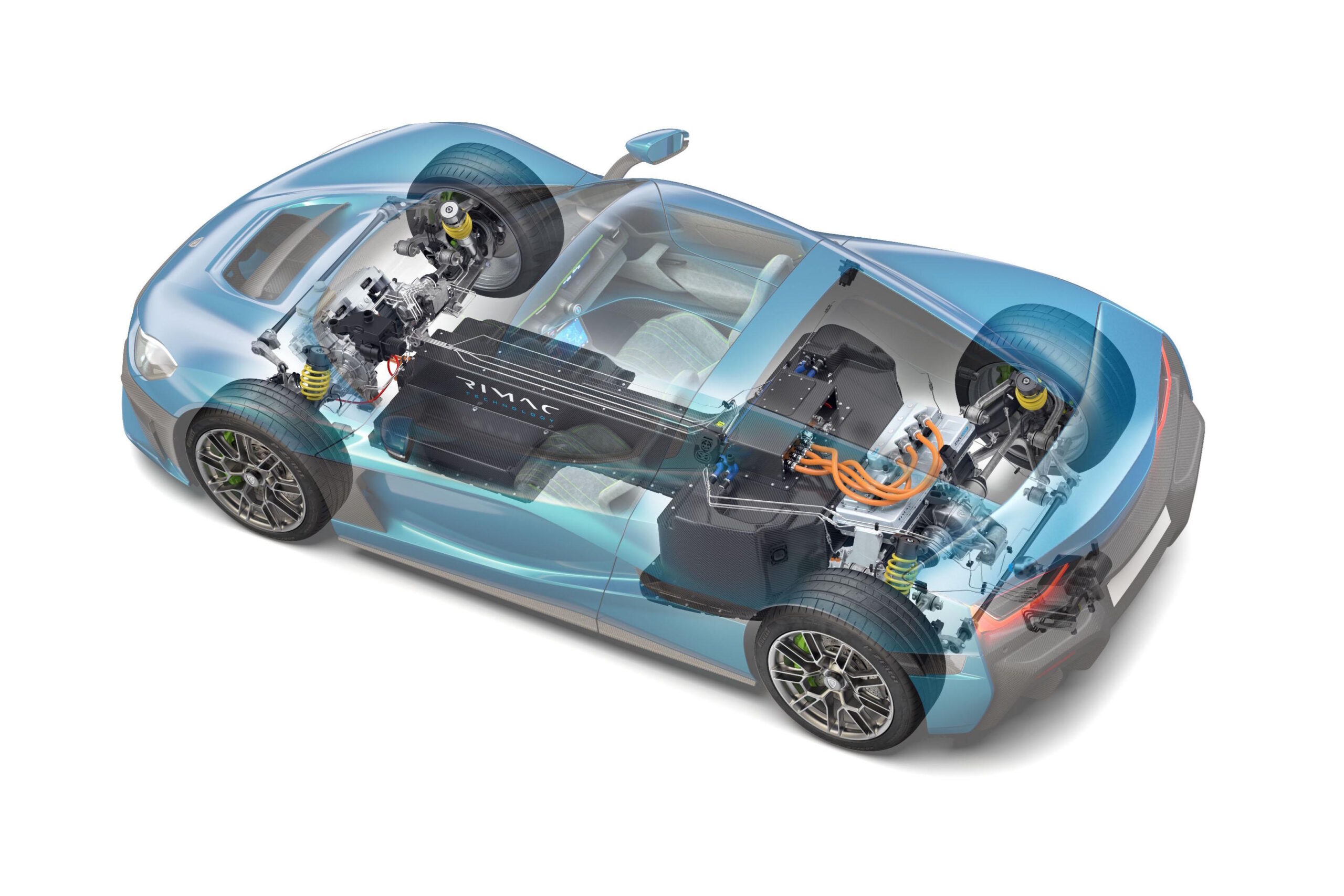
The Rimac Nevera demonstrates how thermal management becomes critical when engineers combine extreme power with rapid charging.
120 kWh
Battery capacity
1,914 hp
Maximum output
6,960
Battery cells
500 kW
Rated peak DC charging
Rimac developed an H-shaped, liquid-cooled battery pack that forms an integral part of the Nevera’s structure.
The manufacturer specifies five cooling systems and two refrigerant circuits across the vehicle. These help manage different thermal requirements, although the precise internal cooling arrangements are not fully disclosed publicly.
The Nevera shows why maximizing battery output requires sophisticated coordination between the battery, motors, power electronics, and cooling hardware.
Rimac Automobili
+1
5. How Porsche manages battery temperatures

The Porsche Taycan provides another useful engineering example.
Its thermal management system can heat or cool the high-voltage battery and coordinate the cooling needs of other electrical components. Porsche adjusts temperature targets according to operating mode, charge level, and anticipated charging requirements.
For example, when a suitable fast charger is programmed into the navigation system, the car can precondition its battery ahead of arrival. That helps the pack reach a temperature suited to accepting high charging power.
Although the Taycan is a high-performance electric sports car rather than a hypercar, its thermal engineering illustrates principles used throughout the performance EV sector.
Porsche Newsroom
+1
6. Comparing battery cooling technologies
| Technology | Main advantage | Main limitation |
|---|---|---|
| Air cooling | Simple and relatively inexpensive | Lower heat-transfer capability |
| Liquid cold plates | Effective, controllable thermal management | Adds pumps, plumbing, and weight |
| Immersion cooling | Direct fluid-to-cell heat transfer | Material compatibility and servicing complexity |
| Phase-change-assisted cooling | Buffers temporary heat peaks | Heat storage capacity is finite |
| Refrigerant-based cooling | Can cool below ambient temperature | Greater system complexity and energy use |
There is no universally superior architecture. The best choice depends on battery chemistry, pack geometry, target power, vehicle mass, cooling capacity, cost, and reliability requirements.
7. Why temperature management affects performance
Illustrative thermal conditions
Not manufacturer operating limits
Cold
Reduced power and charge acceptance
Managed
Desired operating region
Warm
Higher cooling demand
Excessive heat
Protection and power limiting
An effective cooling system supports several crucial performance characteristics.
Consistent acceleration: As the battery temperature rises, a vehicle may reduce output to protect its cells. Removing heat can help preserve power availability during repeated high-load operation.
Faster charging: Battery temperature influences the charging current the pack can safely accept. Preconditioning and effective heat rejection help maximize the practical charging window.
Battery longevity: Managing high temperatures and uneven cell heating can reduce thermal stresses and certain degradation mechanisms.
Safety: Cooling, sensors, electrical protection, and cell-level safety design contribute to overall battery protection. Cooling alone cannot guarantee prevention of thermal runaway.
8. What’s next for hypercar battery cooling?
Engineers are investigating more compact cold plates, advanced coolant-flow designs, direct refrigerant systems, dielectric immersion cooling, phase-change materials, and predictive software.
A major goal is improved thermal uniformity: keeping every cell within a controlled temperature range while minimizing the energy and mass required by the cooling system.
The future is not simply about making batteries colder. It is about maintaining the right temperature, in the right place, at the right time, with as little additional energy as possible.
Video gallery

Nevera Revealed – Official Rimac Video
Production car engineering and vehicle systems, with an under-the-skin segment beginning at 02:56.
Rimac Automobili · YouTube

Mate Rimac: Inside the Nevera Story
Documentary on the car’s development and engineering philosophy.
Rimac Automobili · March 2026

Porsche Engineering – Algorithm With Foresight
Technical explanation of model-based thermal prediction and optimization.
Porsche Engineering · Technical article
Conclusion
Electric hypercars are more than batteries and powerful motors. They are highly integrated thermal, mechanical, electrical, and software systems.
Effective battery cooling enables exceptional acceleration, supports fast charging, protects battery health, and helps sustain performance beyond a single acceleration run.
As power and charging demands continue to increase, thermal management will remain a defining element of electric hypercar engineering.
Website publishing package
SEO metadata
Draft prepared
SEO title
Electric Hypercar Battery Cooling Explained | Technology Guide
Slug
electric-hypercar-battery-cooling-explained
Meta description
Discover how electric hypercars cool their batteries using liquid cooling, cold plates, chillers, and intelligent thermal management systems.
Category
Hypercar Engineering
Tags
Electric Hypercars, Battery Cooling, EV Technology, Rimac Nevera, Porsche Taycan, Thermal Management
Primary references: Rimac Engineering, Porsche Newsroom, SAE battery thermal management research.
Media note: Illustrative image results and official engineering photographs require source, licensing, and attribution verification before reuse on the website. The image suggestions above are not yet an approved ten-image publication gallery.
Publication status: Article and SEO package prepared for cars.bin3aiah.net. No WordPress changes or publication have been made.