
Views: 1
The 2011 Pagani Huayra opened a new chapter for the Italian marque after the Zonda. Its twin-turbo V12 and active aerodynamics gave Pagani a different technical direction, while its sculpted body retained the brand’s emphasis on craftsmanship. This guide covers the original Huayra coupé, rather than the later BC or Roadster versions.
Pagani Huayra specifications
| Specification | Original Huayra coupé |
|---|---|
| Introduction | 2011 |
| Engine | Mercedes-AMG M158 twin-turbo V12 |
| Displacement | 5,980 cc |
| Power | 544 kW (730 hp) at 5,800 rpm, as listed by Pagani |
| Torque | 1,000 Nm at 2,600–4,200 rpm |
| Transmission | Seven-speed transverse sequential automated manual |
| Dry weight | 1,350 kg; varies by specification |
| Length / body width / height | 4,605 / 2,036 / 1,169 mm |
| Weight distribution | 44% front / 56% rear |
Figures follow Pagani’s published Huayra specification. Dry weight is not the same as a ready-to-drive kerb weight. These figures should not be applied to later variants.
Engine and active aerodynamics
Pagani paired the AMG engine with four movable aerodynamic flaps and an adjustable front suspension. Together, these systems manage the balance between drag and downforce. The engineering aim was also to deliver the turbocharged engine’s power progressively, reducing the abrupt response that can make a powerful car harder to control.
Design shaped by the wind
Work on the C9 project began in 2003. Horacio Pagani wanted a clear change from the Zonda, with different proportions and more cabin space. Wind informed the design theme, from the flowing body to the aerodynamic surfaces.
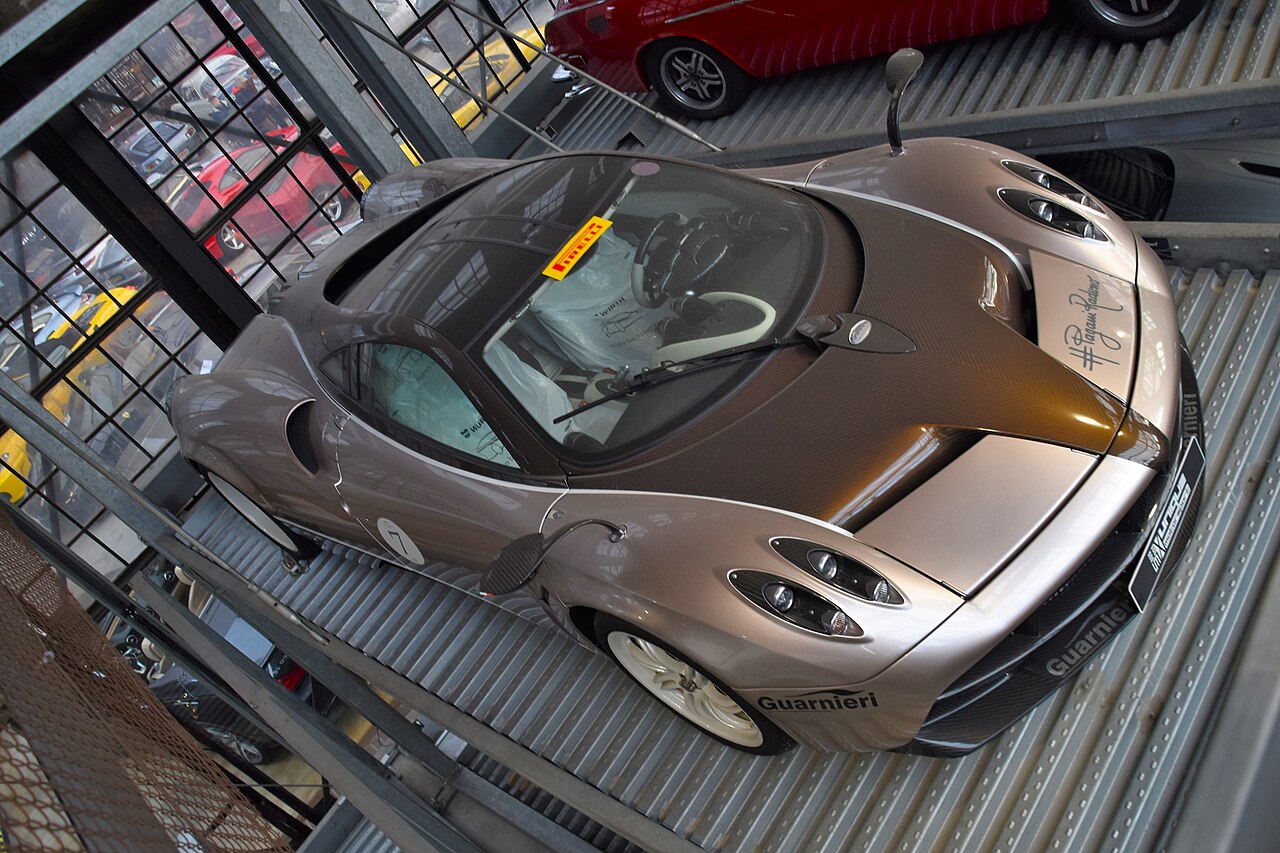
In the accompanying photograph, the coupé’s low nose, curved windscreen and slender mirror supports give it an immediately recognisable profile. The image shows a 2014 example of the model introduced in 2011; it is not a photograph of the original launch car.
History and later variants
Pagani’s official history identifies 2011 as the Huayra’s introduction year. The family later expanded with the Huayra BC in 2016, named in tribute to customer Benny Caiola, and the Huayra Roadster in 2017. The Roadster BC followed in 2019. Each has its own engineering specification, so their output and weight figures belong in separate comparisons.
The Utopia made its official debut in Milan in September 2022 as Pagani’s third major model chapter, following the Zonda and Huayra. This places the original Huayra between two distinct generations of the brand’s road cars.
Bin3aiah Cars perspective
The Huayra is especially interesting as a study in how styling and engineering can work together. Its moving aerodynamic surfaces are central to that story. For another approach to Italian supercar design, explore our 2002 Ferrari Enzo guide.
Official sources and media
- Pagani Huayra: official specifications, gallery and video section
- Pagani: The Story of a Dream — model history
- Pagani Utopia: official 2022 debut
Featured photograph: Charles (usf1fan2), Pagani Huayra Coupé (2014), via Wikimedia Commons, licensed under CC BY 2.0. Resized for web use; site thumbnails may be cropped.
_(52561505159).jpg)