
Views: 0
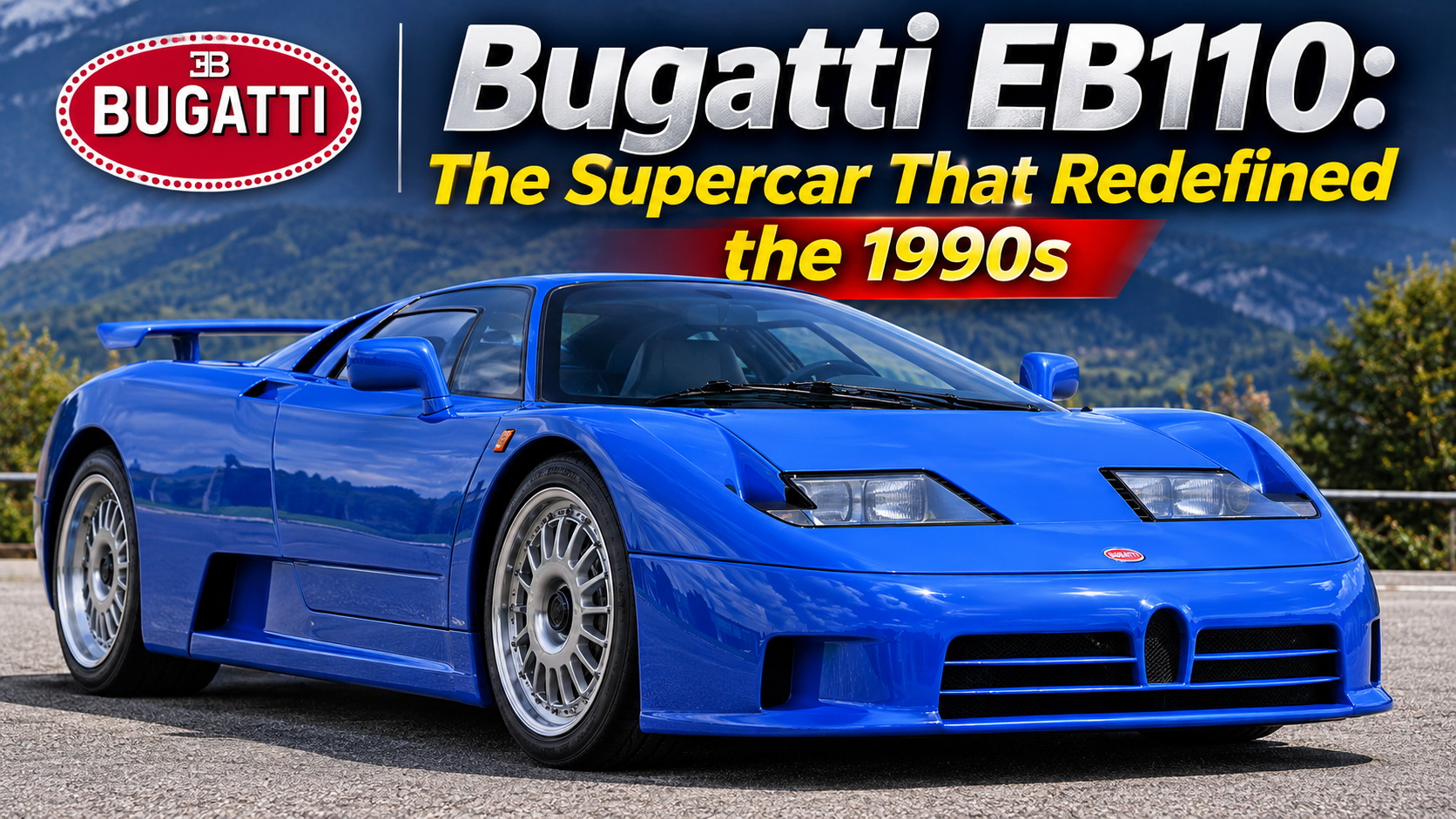
Bugatti EB110: The Supercar That Redefined the 1990s
Quad-turbocharged V12 power, carbon-fiber engineering, all-wheel drive, and breathtaking performance. The Bugatti EB110 was one of the most technologically advanced supercars of its generation.

The Bugatti EB110 is one of the most remarkable supercars ever produced. Introduced in 1991, it combined extraordinary engineering with advanced technologies that would later become central to modern hypercars.
Its 3.5-liter quad-turbocharged V12 engine, carbon-fiber monocoque chassis, permanent all-wheel drive, and six-speed manual transmission made it a formidable rival to the Ferrari F40, Lamborghini Diablo, and other performance icons.
Although its production life was short, the EB110 left an engineering legacy that extended into the Bugatti Veyron, Chiron, and beyond.
1. The Rebirth of Bugatti
In the late 1980s, Italian entrepreneur Romano Artioli set out to revive the legendary Bugatti marque. A modern manufacturing facility was established in Campogalliano, Italy, with the ambition of producing an exceptionally advanced supercar.
On September 15, 1991, the new model was officially unveiled in Paris on the 110th anniversary of Ettore Bugatti’s birth. The name EB110 paid tribute to the company’s founder.
Designed through an ambitious international engineering effort, the car combined Italian design and manufacturing with advanced aerospace-inspired materials.

2. The Extraordinary Quad-Turbo V12
At the heart of the EB110 was a 3,498 cc V12 engine featuring five valves per cylinder and four turbochargers.
This sophisticated powertrain was built to deliver immense performance from a relatively compact engine displacement. Its four turbochargers worked with intercooling to generate the power required for extreme acceleration and high-speed driving.

The standard EB110 GT produced approximately 560 metric horsepower (PS), while the later Super Sport increased output to approximately 612 PS.
Power was distributed to all four wheels, providing exceptional traction and helping the car accelerate effectively despite its immense engine output.
3. Revolutionary Carbon-Fiber Construction
One of the EB110’s greatest achievements was its lightweight carbon-fiber monocoque, manufactured by French aerospace specialist Aérospatiale.
Weighing approximately 125 kilograms, the monocoque provided a strong and rigid structural foundation. It helped Bugatti combine demanding performance targets with sophisticated suspension engineering.
Independent suspension and advanced aerodynamics further supported the car’s road-holding and stability. Together, these technologies made the EB110 an unusually ambitious engineering project for its era.
4. EB110 GT vs EB110 Super Sport
Bugatti produced two principal road-going versions of the EB110: the original GT and the more extreme Super Sport.


Bugatti EB110 GT
The GT was designed to combine supercar performance with a degree of grand-touring comfort. Its V12 produced approximately 560 PS, enabling acceleration from 0 to 100 km/h in approximately 3.5 seconds.
Bugatti EB110 Super Sport
Introduced in 1992, the Super Sport was lighter and more powerful than the GT. It received engine enhancements, weight-saving measures, and more aggressive aerodynamic details.
Its approximately 612 PS output enabled extraordinary acceleration and a claimed maximum speed of roughly 351 km/h, with some reported figures reaching approximately 355 km/h.
| Specification | EB110 GT | EB110 SS |
|---|---|---|
| Engine | 3.5L V12 | 3.5L V12 |
| Turbochargers | 4 | 4 |
| Power | 560 PS | Approx. 612 PS |
| 0–100 km/h | Approx. 3.5 s | Approx. 3.3 s |
| Top Speed | Approx. 342 km/h | Approx. 351 km/h |
| Transmission | 6-Speed Manual | 6-Speed Manual |
| Drivetrain | AWD | AWD |
Performance figures are approximate period specifications and may vary by source and testing method.
5. Distinctive 1990s Supercar Design
The EB110 featured unmistakable 1990s styling, with a low wedge-shaped silhouette, compact horseshoe grille, prominent cooling intakes, and upward-opening scissor doors.
Its aerodynamic body was engineered to support cooling, reduce drag, and maintain stability at extremely high speeds.

The Super Sport adopted a more aggressive visual character, including a prominent rear wing and additional performance-oriented styling features.

6. A Pure Driver-Focused Interior
Unlike today’s digitally dominated hypercars, the EB110 offered a relatively traditional cockpit.
Analog instruments, leather upholstery, a manual gear selector, and straightforward controls created a driving environment focused on mechanical engagement.

The experience was centered on the V12 engine, manual gearbox, steering feedback, and the remarkable performance available from the drivetrain.
7. The EB110 in Motorsport
Although primarily developed as a high-performance road car, the EB110 also appeared in international motorsport.
A racing version participated in the 1994 24 Hours of Le Mans, demonstrating Bugatti’s determination to connect the revived marque with its historic racing heritage.
Additional racing development continued through the EB110 Sport Competizione project, further demonstrating the technical potential of the platform.
8. Why Bugatti EB110 Production Ended
Despite its groundbreaking engineering, the EB110 faced serious commercial challenges.
High development expenses, difficult market conditions, and financial pressure on Bugatti Automobili ultimately contributed to the company’s collapse in 1995.
Only a small number of EB110 vehicles were produced. Bugatti has reported 96 GT examples and fewer than 40 Super Sport examples, alongside special racing vehicles.
The exact production total varies depending on which prototypes, unfinished chassis, and competition cars are counted.
9. The Legacy of the Bugatti EB110
The EB110 established several technical characteristics that later became synonymous with the modern Bugatti brand.
- Carbon-fiber structural engineering
- Four turbochargers
- Permanent all-wheel drive
- Extraordinary maximum speed
- Advanced aerodynamics
- Exclusive limited production
When the Bugatti Veyron arrived in 2005, it adopted an evolved interpretation of this approach, featuring all-wheel drive, four turbochargers, and a carbon-fiber structure.
The Chiron continued this tradition, while the limited-edition Bugatti Centodieci directly celebrated the EB110’s design and heritage.
10. Strengths and Limitations
| Strengths | Limitations |
|---|---|
| Revolutionary V12 engineering | Complex maintenance |
| Advanced carbon-fiber chassis | Specialized parts availability |
| Exceptional acceleration | Turbo lag compared with modern cars |
| Permanent AWD traction | High ownership costs |
| Historical significance | Very limited production |
Conclusion: A Supercar Ahead of Its Time
The Bugatti EB110 was far more than a fast and exclusive machine. It was an engineering statement that demonstrated the possibilities of advanced materials, turbocharged performance, and sophisticated drivetrain technology.
Its production life may have been brief, but its influence reached far beyond the 1990s.
References and Further Reading
- Bugatti Newsroom — 30 Years of the EB110
- Bugatti Newsroom — EB110, Veyron and Chiron
- Wikimedia Commons — Bugatti EB110 Images
Image credits: Photographs are sourced from Wikimedia Commons. See each linked file page for creator attribution, licensing requirements, and any modifications. Creative Commons images may require attribution and share-alike compliance; the image source links alone may not satisfy all requirements.