
Views: 0
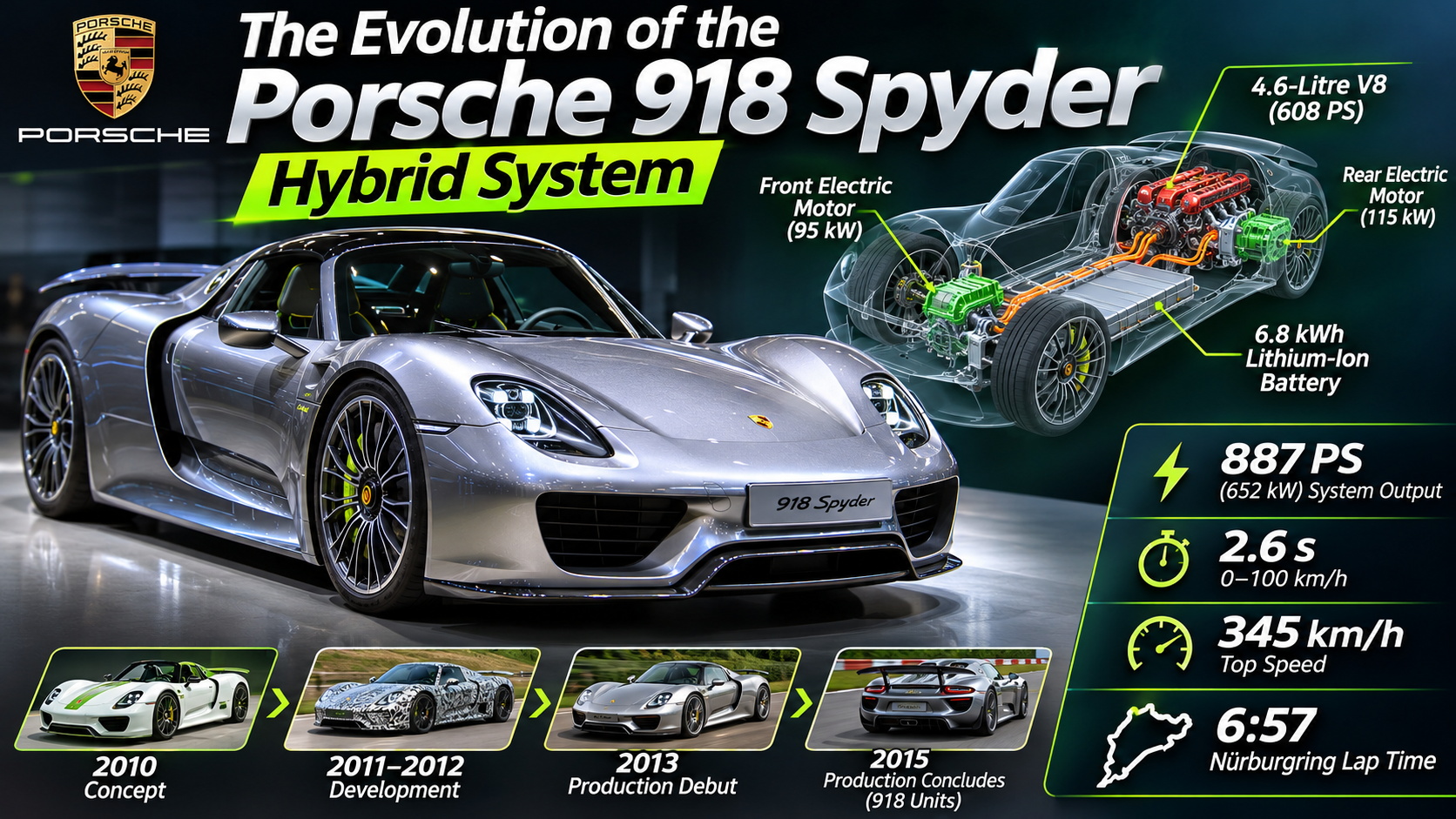
The Evolution of the Porsche 918 Spyder Hybrid System

The Porsche 918 Spyder stands among the most important hybrid supercars ever produced. When Porsche introduced the model, hybrid technology was widely associated with fuel efficiency rather than extreme performance. The 918 Spyder helped change that perception.
Combining a high-revving 4.6-litre V8 with two electric motors, the 918 Spyder delivered a combined output of 887 PS (652 kW). Its sophisticated plug-in hybrid system brought electric propulsion, regenerative braking and electrically controlled all-wheel drive into one extraordinary vehicle.
From its original concept in 2010 to its production debut in 2013, the Porsche 918 Spyder became an engineering milestone that demonstrated how electrification could enhance performance.
1. The Beginning: Porsche 918 Spyder Concept in 2010
Porsche unveiled the 918 Spyder concept at the 2010 Geneva Motor Show. It presented a bold vision: a supercar capable of delivering exceptional performance while also offering electric-only driving.
The concept combined motorsport-inspired engineering with a plug-in hybrid architecture. Public reaction was strongly positive, and Porsche approved series development later that year.
Over the following three years, Porsche engineers refined the integration of the combustion engine, electric motors, battery, cooling systems and power-management electronics.
2. Production Evolution: 2013–2015
The production Porsche 918 Spyder made its international debut at the 2013 Frankfurt Motor Show. The finished car retained the concept’s central idea while introducing the engineering required for road use and repeatable high-performance driving.
Production was limited to 918 examples. The final car was completed in June 2015, making the 918 Spyder one of Porsche’s most exclusive modern supercars.
3. The Three-Part Hybrid Powertrain
The 918 Spyder’s defining technical feature was its three-part propulsion system: a naturally aspirated V8 engine and two independently controlled electric motors.
The 4.6-Litre V8 Engine
At the heart of the 918 Spyder was a 4.6-litre naturally aspirated V8 producing 608 PS (447 kW).
The engine drove the rear wheels through a seven-speed Porsche Doppelkupplung (PDK) dual-clutch transmission. Its high-revving character delivered the response and sound expected of a traditional Porsche supercar.
The Rear Electric Motor
A rear electric motor, rated at approximately 115 kW (156 PS), worked alongside the V8. It supplied immediate electric torque during acceleration and could also propel the rear wheels without combustion-engine assistance.
The Front Electric Motor
A separate front electric motor delivered approximately 95 kW (129 PS). Unlike conventional mechanical all-wheel-drive systems, the front wheels could be driven electrically without a mechanical driveshaft connecting the front and rear axles.
This enabled Porsche to control torque distribution more precisely and improve traction during acceleration and cornering.

4. Porsche 918 Spyder Technical Specifications
| Specification | Porsche 918 Spyder |
|---|---|
| Production years | 2013–2015 |
| Engine | 4.6-litre naturally aspirated V8 |
| V8 power | 608 PS (447 kW) |
| Rear electric motor | 115 kW |
| Front electric motor | 95 kW |
| Combined power | 887 PS (652 kW) |
| Battery | 6.8 kWh lithium-ion |
| Transmission | 7-speed PDK |
| Drive system | Hybrid all-wheel drive |
| 0–100 km/h | 2.6 seconds |
| Top speed | 345 km/h |
| Electric range | Approximately 30 km or more |
| Total production | 918 vehicles |
5. Five Driving Modes: A Different Character for Every Situation
The 918 Spyder offered five driving modes, allowing the vehicle to prioritize electric mobility, everyday efficiency or maximum performance.
E-Power
E-Power prioritized electric-only operation for quiet, locally emission-free driving when battery charge and operating conditions permitted.
Hybrid
Hybrid mode balanced the combustion engine and electric propulsion to improve efficiency during normal driving.
Sport Hybrid
Sport Hybrid emphasized performance by using the V8 more actively while the electric motors provided additional acceleration.
Race Hybrid
Race Hybrid prioritized maximum driving performance, coordinating the power sources for demanding conditions.
Hot Lap
Hot Lap delivered the most aggressive electric boost strategy, using available battery energy to maximize short-term circuit performance.
6. Battery Technology and Regenerative Braking
The Porsche 918 Spyder used a 6.8 kWh lithium-ion battery. Unlike the large battery packs found in modern fully electric vehicles, its battery was designed primarily for high power delivery and recovery.
The system could store electricity from external charging and recover energy during deceleration. When regenerative braking was active, electric motors acted as generators, converting some of the car’s kinetic energy into electricity.
The recovered energy could later be used for acceleration, electric driving and torque assistance. Conventional friction braking remained available when additional stopping force was required.
This combination demonstrated how a performance hybrid could reuse energy while still providing the acceleration expected from a hypercar.
7. Electrically Controlled All-Wheel Drive
The 918 Spyder’s electric front axle was one of its most innovative features.
Because the front and rear propulsion systems could be controlled independently, Porsche could adjust their contribution according to driver demands and available traction.
This architecture improved launch performance and supported precise handling in corners. At very high speeds, the front electric drive could be disconnected, leaving the rear powertrain to continue driving the vehicle.
8. Nürburgring: Proof of Hybrid Performance
In September 2013, the 918 Spyder recorded a remarkable 6-minute, 57-second lap of the Nürburgring Nordschleife.
The result used the 20.6-kilometre timing configuration employed at that time and made the 918 Spyder the first internationally road-legal production-based vehicle to break the seven-minute barrier under that benchmark.
The achievement demonstrated that hybrid technology could support lap-time performance, not simply reduce fuel consumption. Electric torque, energy management and all-wheel-drive traction worked together to produce exceptional acceleration and cornering capability.

9. The Weissach Package
Porsche also offered a Weissach Package for customers seeking further performance optimization.
The package reduced weight through measures including lightweight components, magnesium wheels and additional carbon-fibre elements. These changes improved the car’s performance potential, particularly in circuit driving.
The Weissach Package showed that Porsche continued developing traditional lightweight engineering alongside the car’s advanced hybrid drivetrain.
10. The Lasting Influence of the Porsche 918 Spyder
The 918 Spyder became an important reference point for Porsche’s broader performance electrification strategy.
The Porsche 919 Hybrid racing programme demonstrated the competitive potential of advanced hybrid energy management in endurance motorsport, although it used a different powertrain architecture.
Porsche’s later electrified performance models, including the Panamera Turbo S E-Hybrid and the 911 Carrera GTS T-Hybrid, continued exploring how electric assistance could complement combustion-engine performance.
These vehicles did not directly reproduce the 918 Spyder’s three-part system. However, they reflected the continuing importance of integrating electrical power into high-performance engineering.
Conclusion
The Porsche 918 Spyder was more than a limited-production supercar. It was a technological milestone that helped redefine the role of hybrid propulsion in performance vehicles.
By combining a powerful naturally aspirated V8, two independent electric motors, regenerative braking and advanced energy management, Porsche demonstrated that electrification could improve acceleration, traction, efficiency and driving dynamics.
Its development from the 2010 concept to the production model remains a defining chapter in Porsche engineering history and the evolution of the hybrid hypercar.
Sources and Further Reading
- Porsche Newsroom — The Super Sportscar
- Porsche Newsroom — 10 Years of the 918 Spyder
- Porsche — Powered by Two Hearts
- Porsche — 918 Spyder Model History
Image credits and applicable Creative Commons licences are provided directly beneath each photograph. This article is an independent editorial feature and is not affiliated with or endorsed by Porsche.