
Views: 0
Aston Martin Valkyrie: Formula 1-Inspired Engineering

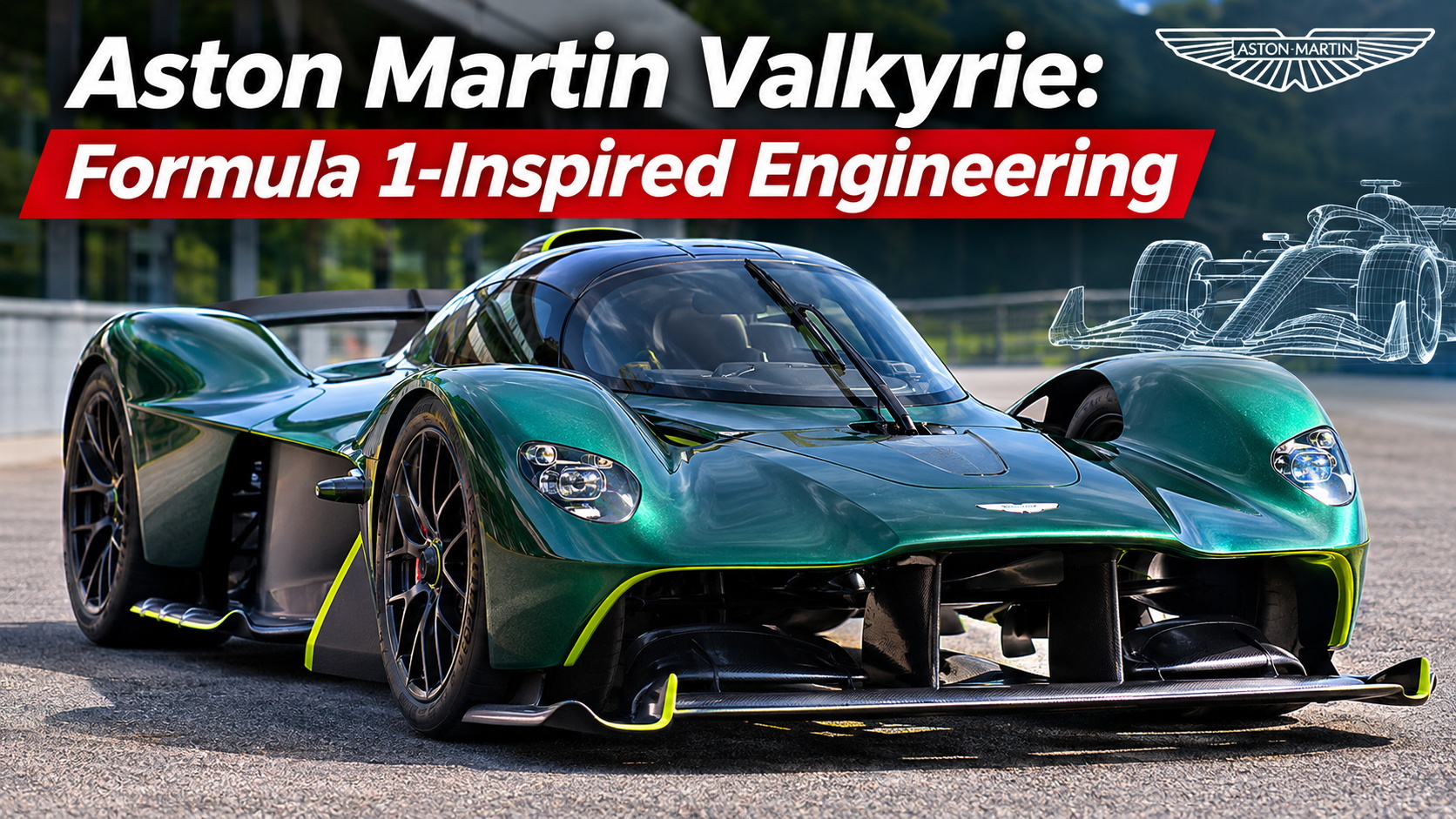
The Aston Martin Valkyrie represents an extraordinary achievement in automotive engineering. Developed by Aston Martin in collaboration with Red Bull Advanced Technologies, this revolutionary hypercar brings Formula 1-inspired technology to public roads.
With an advanced aerodynamic body, an exceptionally powerful naturally aspirated V12 engine, hybrid assistance and lightweight carbon-fibre construction, the Valkyrie was engineered to deliver an experience closer to a racing prototype than a conventional road-going supercar.
Aston Martin Valkyrie: Technical Specifications
| Specification | Details |
|---|---|
| Manufacturer | Aston Martin |
| Development partner | Red Bull Advanced Technologies |
| Engine | 6.5-litre naturally aspirated V12 |
| Engine developer | Cosworth |
| Hybrid system | Electric motor assistance |
| Combined power | 1,140 PS (approximately 1,124 bhp) |
| V12 output | 1,000 bhp |
| Engine maximum speed | 11,100 rpm |
| Chassis | Carbon-fibre monocoque |
| Drivetrain | Rear-wheel drive |
| Transmission | 7-speed automated sequential |
| Road Coupé production plan | 150 vehicles |
Formula 1-Inspired Aerodynamic Engineering
One of the Valkyrie’s defining features is its radical approach to aerodynamics. The car was designed with significant input from legendary Formula 1 engineer Adrian Newey, whose expertise helped shape its distinctive appearance.
Rather than relying primarily on large external wings, the Valkyrie uses enormous Venturi tunnels beneath its body. These tunnels accelerate airflow underneath the vehicle, creating low-pressure regions that generate substantial downforce.

The extensive underfloor tunnels and rear diffuser help increase aerodynamic grip while allowing engineers to manage airflow efficiently.
The result is a vehicle designed to generate extraordinary cornering performance, with downforce playing a major role in keeping the car stable at high speeds.
The Cosworth 6.5-Litre Naturally Aspirated V12
At the heart of the Aston Martin Valkyrie is one of the most remarkable engines ever developed for a road-going automobile.
Its 6.5-litre naturally aspirated V12, developed by Cosworth, produces approximately 1,000 bhp at 10,500 rpm and reaches an exceptional maximum engine speed of 11,100 rpm.
Unlike turbocharged hypercars, the Valkyrie’s naturally aspirated engine delivers immediate throttle response and an intense high-frequency exhaust sound reminiscent of racing machinery.
The engine weighs approximately 206 kilograms and forms an important structural element of the vehicle.
An electric motor contributes additional power and torque assistance, bringing the combined output to approximately 1,140 metric horsepower (PS).
Lightweight Carbon-Fibre Construction
Reducing weight was one of the most important priorities during the Valkyrie’s development.
The hypercar features an advanced carbon-fibre monocoque and lightweight bodywork. Carbon fibre provides high structural rigidity without the mass associated with many conventional construction materials.

The lightweight philosophy extends throughout the vehicle, including its suspension components, seating arrangement and cockpit architecture.
Engineers also designed the packaging around aerodynamic requirements, allowing the enormous underbody tunnels to occupy areas normally reserved for conventional vehicle structures.
Formula 1-Style Cockpit and Driving Position
The Valkyrie’s cockpit is radically different from that of a traditional luxury sports car.
Occupants sit in a reclined, feet-up position similar to that used in single-seat racing cars. This arrangement helps create a low seating position while accommodating the aerodynamic tunnels beneath the cockpit.
The steering wheel incorporates essential driving controls and instrumentation, while the surrounding cabin prioritises function, weight reduction and driver engagement.

Aston Martin Valkyrie AMR Pro
The engineering programme also led to the Aston Martin Valkyrie AMR Pro, a track-only evolution designed to explore the potential of the platform without normal road-car requirements.
The AMR Pro incorporates extensive aerodynamic modifications, a revised chassis configuration and a more circuit-focused design.

Unlike the road-going Valkyrie, the AMR Pro was developed exclusively for circuit use, demonstrating how the underlying engineering could be adapted for more extreme track performance.
From Road Hypercar to Endurance Racing
The Valkyrie’s engineering concept eventually became the foundation for an international endurance racing programme.
In 2025, Aston Martin introduced a competition version designed for the FIA World Endurance Championship and IMSA WeatherTech SportsCar Championship.
The racing Valkyrie uses a modified V12 engine and a purpose-developed competition configuration. Its performance is governed by endurance racing regulations, making it technically distinct from both the road car and the track-only AMR Pro.
Why the Aston Martin Valkyrie Is Special
The Aston Martin Valkyrie represents a rare approach to automotive development: instead of adapting an existing sports car into a faster machine, its engineers designed the entire vehicle around aerodynamic performance, lightweight construction and racing-inspired mechanical systems.
Its innovative underfloor aerodynamics, extraordinary Cosworth V12 and compact carbon-fibre architecture demonstrate the possibilities of combining advanced motorsport engineering with a road-legal hypercar.
For automotive enthusiasts, the Valkyrie is not simply another high-performance supercar. It is an example of how far modern automotive engineering can go when traditional design conventions are challenged.
Conclusion
The Aston Martin Valkyrie stands among the most ambitious automotive engineering projects of its generation. From its enormous Venturi tunnels to its high-revving V12 powertrain, virtually every major component reflects a pursuit of maximum performance.
By combining Formula 1-inspired thinking with Aston Martin’s distinctive design identity, the Valkyrie has secured a remarkable place in the history of modern hypercars.
References and Further Reading
- Aston Martin — Official Model Information
- Aston Martin Works — Valkyrie Overview
- Aston Martin Media — Valkyrie Technical News
Image Licensing
Photographs are credited individually above. CC BY-SA 4.0 images require attribution, a link to the license, and an indication of modifications. Adapted images must comply with the license’s ShareAlike requirements. The CC0 photograph is dedicated to the public domain.