
Views: 2

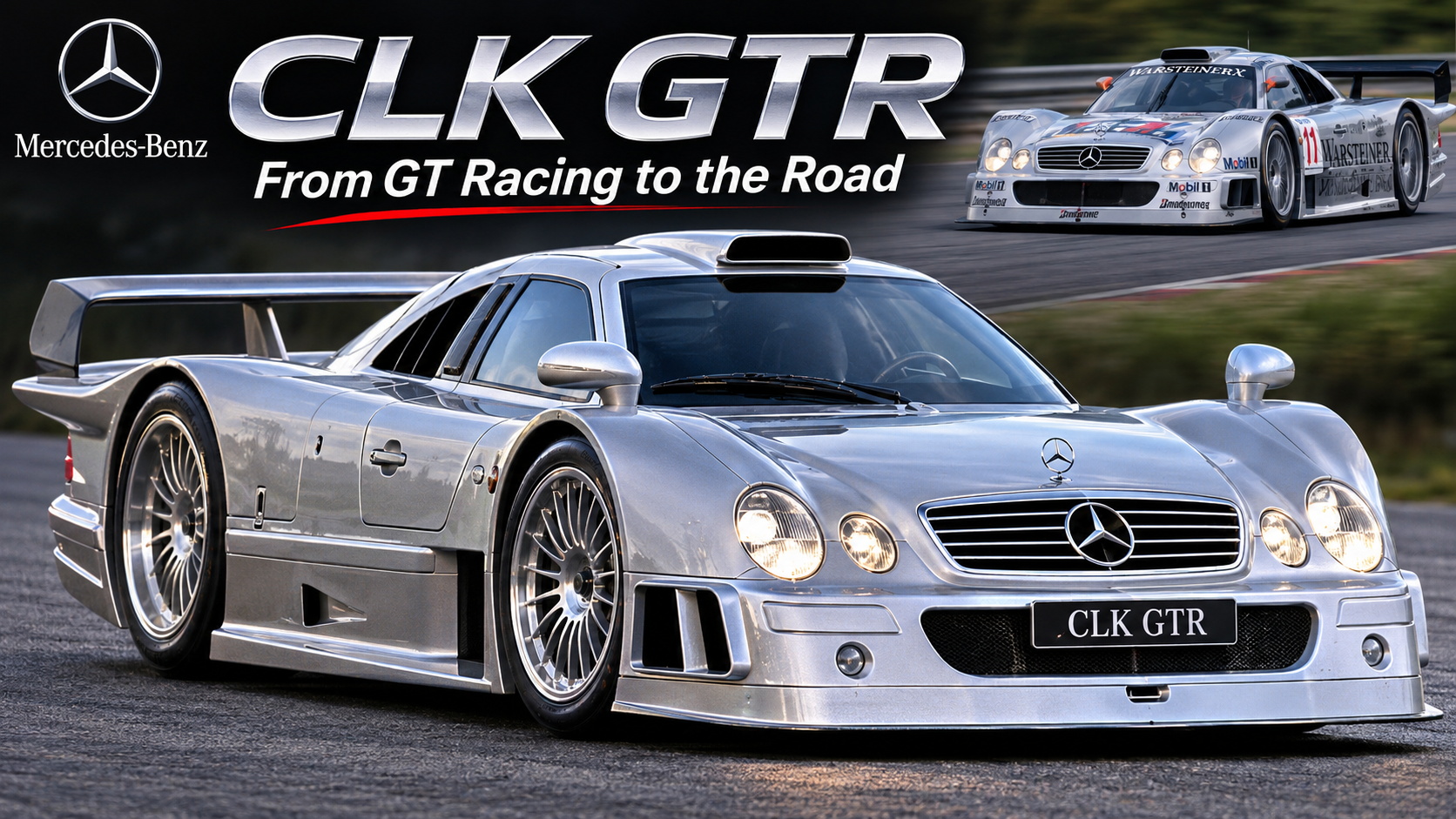
The Mercedes-Benz CLK GTR is one of the most extraordinary supercars ever created. Developed by Mercedes-Benz and AMG to compete in the FIA GT Championship, it combined racing technology, a naturally aspirated V12 engine, carbon-fibre construction, and an unmistakable aerodynamic design.
Unlike most performance cars, which begin as road vehicles before being adapted for racing, the CLK GTR followed the opposite philosophy: the racing car came first, followed by an exceptionally exclusive road-legal version.
1. The Birth of a GT1 Racing Legend
During the late 1990s, international GT racing was one of the most competitive environments in motorsport. Manufacturers such as Porsche and McLaren were developing high-performance machines for the FIA GT1 class.
Mercedes-Benz and AMG responded in 1997 with the CLK GTR, a purpose-built racing car developed in only 128 days.

Although the car carried styling elements resembling the Mercedes-Benz CLK coupe, it shared little with the conventional production model.
The CLK GTR featured a purpose-built carbon-fibre monocoque, an engine positioned behind the occupants, competition suspension, and aerodynamic bodywork developed specifically for racing.
Its development proved successful. Mercedes-AMG captured the 1997 FIA GT drivers’ and manufacturers’ championships, with Bernd Schneider securing the drivers’ title.
2. Mercedes-Benz CLK GTR Specifications
The road-going CLK GTR retained the fundamental architecture of the racing car while introducing equipment and adjustments necessary for public-road use.
| Manufacturer | Mercedes-Benz / AMG |
| Introduced | 1997 (racing car) |
| Road Version | CLK GTR Straßenversion |
| Engine | 6.9-litre naturally aspirated V12 |
| Power | 612 PS (450 kW) |
| Torque | Approximately 775 Nm |
| Transmission | 6-speed sequential |
| Drivetrain | Rear-wheel drive |
| Engine Position | Mid-mounted |
| Chassis | Carbon-fibre monocoque |
| 0–100 km/h | Approximately 3.7–3.8 seconds |
| Top Speed | Over 320 km/h |
| Production | 25 road homologation cars, plus prototypes |
These specifications refer primarily to the standard road-going version. The competition cars and special variants used different engine configurations and performance settings.
3. The Naturally Aspirated V12 Engine
One of the CLK GTR’s defining features was its powerful twelve-cylinder engine.
The competition version used a 6.0-litre V12 derived from Mercedes-Benz road-car engine architecture. The street version received an enlarged 6.9-litre configuration producing approximately 612 metric horsepower.
Unlike modern turbocharged supercars, the CLK GTR delivered its performance through natural aspiration, offering immediate throttle response, progressive power delivery, and an unmistakable V12 soundtrack.

4. Carbon-Fibre Engineering and Aerodynamics
The CLK GTR was designed around a lightweight carbon-fibre monocoque chassis, an engineering solution normally associated with top-level racing cars.
This construction provided exceptional structural rigidity and helped the vehicle manage the forces generated during high-speed competition.
Its aerodynamic design included a low front splitter, wide bodywork, carefully managed underbody airflow, and a prominent rear wing. These elements helped increase stability and aerodynamic grip.


5. From Racing Machine to Road-Legal Supercar
To meet GT1 homologation requirements, Mercedes-Benz developed an extremely limited street-legal version known as the CLK GTR Straßenversion.
Although the road car included equipment needed for registration and everyday road use, it remained closely related to the original racing machine.
The vehicle retained its low seating position, dramatic doors, mid-mounted V12 engine, wide body, and distinctive aerodynamic profile.

A Racing-Inspired Interior
Inside, the CLK GTR offered a cockpit focused more on driving than luxury. The interior combined compact instrumentation, supportive seating, and race-inspired controls.
Compared with conventional Mercedes-Benz grand tourers, the CLK GTR was louder, more specialized, and less forgiving. That uncompromising nature was central to its appeal.

6. Racing Success: 1997–1998
The CLK GTR enjoyed a remarkably successful career in the FIA GT Championship. Its achievements helped demonstrate Mercedes-AMG’s engineering capability at the highest level of GT competition.
Mercedes-AMG won both the FIA GT drivers’ and manufacturers’ championships. Bernd Schneider secured the drivers’ title in the CLK GTR.
The CLK GTR competed early in the season before the new CLK LM took over. Mercedes-AMG won every FIA GT championship round that year.
With the original FIA GT1 category discontinued, Mercedes-Benz moved toward prototype racing with the CLR.
The CLK LM also competed at the 1998 24 Hours of Le Mans, but neither factory entry finished the race. Its outstanding FIA GT results should not be confused with a Le Mans victory.
7. CLK GTR Coupe, Roadster and Super Sport
CLK GTR Coupe
The coupe is the best-known road-going CLK GTR. Its closed roof, distinctive doors, enormous rear wing, and V12 engine made it one of the most recognizable homologation supercars ever produced.
CLK GTR Roadster
The Roadster represented an even rarer open-top interpretation of the CLK GTR. Its revised upper bodywork created an entirely different visual character while retaining the car’s competition-inspired engineering.

CLK GTR Super Sport
Special high-performance CLK GTR configurations have also been associated with an enlarged 7.3-litre V12 engine. These cars are especially desirable because of their rarity and performance.
Production counts can differ depending on whether individual special conversions, development prototypes, and later Roadster conversions are included.
8. Why the CLK GTR Is So Valuable
The CLK GTR occupies a special place among collectible supercars because of its combination of extreme rarity, racing success, engineering originality, and historical significance.
Its connection to the FIA GT Championship makes it more than an exotic road car. It is a direct reminder of an era when manufacturers developed near-prototype racing machines to compete in GT championships.
Its distinctive design, naturally aspirated V12, and limited production have helped establish it as one of the most prestigious Mercedes-Benz collector cars.
9. The CLK GTR’s Lasting Legacy
The Mercedes-Benz CLK GTR represents a remarkable chapter in the history of Mercedes-AMG.
The project combined rapid development, advanced materials, powerful engine technology, and exceptional racing results. It also demonstrated how competition engineering could influence some of the world’s most exclusive road-going supercars.
For automotive enthusiasts, the CLK GTR stands alongside the Porsche 911 GT1 and McLaren F1 GTR as one of the defining machines of the 1990s GT1 era.
Conclusion
The Mercedes-Benz CLK GTR was created with one primary mission: to dominate GT racing.
Its transformation into a road-legal supercar produced one of the most remarkable automobiles of the 1990s. With a naturally aspirated V12, carbon-fibre architecture, dramatic aerodynamics, and authentic racing heritage, the CLK GTR remains a true automotive icon.
RM Sotheby’s — CLK GTR History
DK Engineering — CLK GTR Vehicle Archive
Image sources and licensing:Photographs are linked from Wikimedia Commons. Individual authors, licence terms and required attribution can be found on the corresponding original file description pages.
CLK GTR Street-Version Photo Collection